Trump says to negotiate with Iran, but Tehran talks about fake news

Trump announces negotiations with Iran, but Tehran denies it. The tension keeps crude oil prices high and mobilizes regional mediators.

An announcement that shook the markets

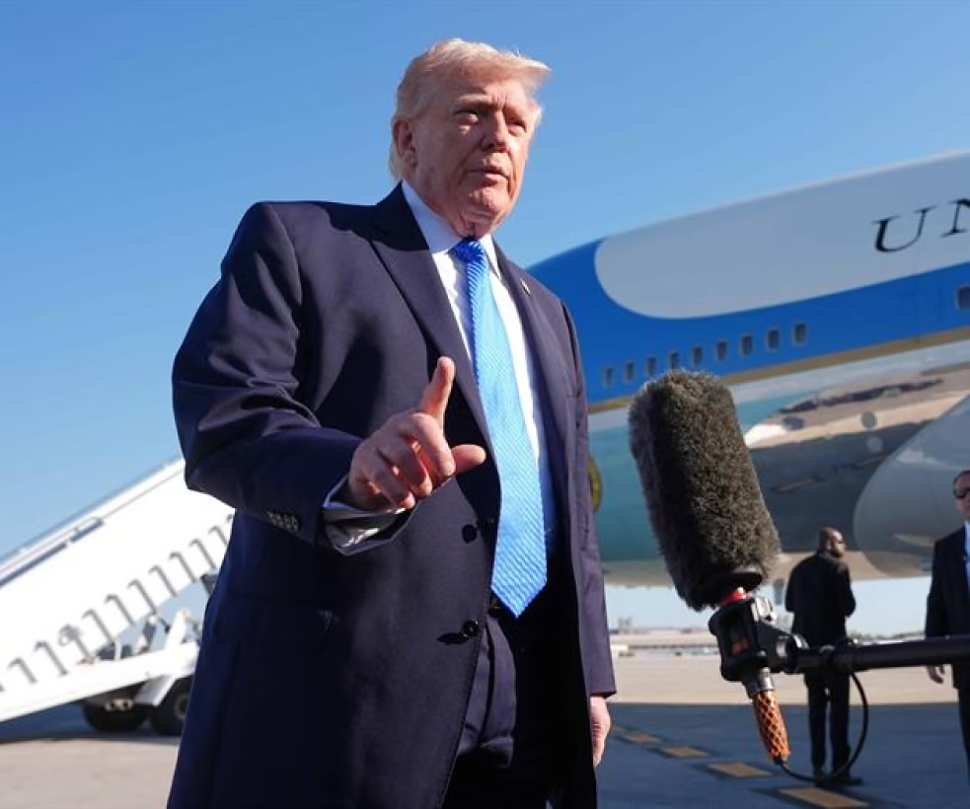
Donald Trump dropped a bombshell this Monday. He said his government is talking to a “respected” Iranian leader and that Iran wants to end the war. He even extended the deadline to reopen the Strait of Hormuz… but with a warning: attacks on power plants if they don’t comply.

The problem is that Tehran denies everything. In fact, they called the US statements “fake news” to manipulate the markets. You know how it is: one side says white, the other black.

RelatedTrump says he talks to Iran; Tehran denies it and tension persists

Oil and mediations

The mere mention of negotiations sent crude oil prices tumbling. That is proof of the real impact of these words. Meanwhile, the war continues on the ground.

Türkiye and Egypt entered the scene as possible mediators. It is the first serious sign of regional diplomacy trying to put out the fire. Not a minor fact.

“The war has caused exponential increases in the prices of oil, fuel and gas,” said Jorge Moreira da Silva, a senior United Nations official.

More than 2,500 dead between Iran and Lebanon, dozens of Israeli and American casualties… The numbers speak for themselves. Israel continues its attacks against targets linked to Iran, including Hezbollah.

And here’s the key point: Trump says he doesn’t plan to send ground forces, but he’s keeping additional ships and marines in the area. It doesn’t rule out anything.

Analysts agree: despite the apparent diplomatic turn, everything remains just as volatile. The Iranian Revolutionary Guard promises retaliation and Hormuz – through which a fifth of the world’s oil passes – remains a tinderbox.

In short: a lot of noise, contradictory announcements, and a tension that continues to cost lives and skyrocket energy prices globally.

Mayo Zambada receives life sentence in the US

Court in Brooklyn confirms life imprisonment for the historic leader of the Sinaloa Cartel.

Life sentence for El Mayo Zambada

A federal court in Brooklyn has handed down the final sentence for Ismael El Mayo Zambada, 76 years old. Judge Brian Cogan confirmed this Monday the life imprisonment for the historic leader of the Sinaloa Cartel.

Zambada pleaded guilty last year to drug trafficking conspiracy and directing a criminal organization. Prosecutors estimate that for decades he moved hundreds of tons of cocaine, heroin and fentanyl.

In addition to the sentence, the US government is demanding a fine of $15 billion as compensation for the damage caused. The figure reflects the scale of their illicit operations.

Zambada’s situation is now identical to that of his former partner, Joaquín El Chapo Guzmán, who has been serving a life sentence since 2019. Both led the most powerful criminal organization in Mexico for years.

The plea deal reached by Zambada included a key guarantee: the US Department of Justice agreed not to seek the death penalty. In exchange, the boss accepted the charges that carry mandatory life imprisonment.

The conviction closes a chapter in the fight against organized crime, but leaves open questions about the future of the Sinaloa Cartel and its trafficking routes to the United States.

Continue reading

US attacks on Iran raise tension in the Middle East

Bombings against the Iranian Revolutionary Guard escalate regional conflict.

On Sunday, the United States launched airstrikes against targets of Iran’s Revolutionary Guard. The action responds to the death of American soldiers in Jordan.

According to US Central Command, the attacks damaged coastal surveillance, air defense facilities and missile depots. The objective: to weaken Iranian control over the Strait of Hormuz, a key route for oil trade.

The offensive totals eight days. Washington has attacked Iranian strategic infrastructure. Tehran responded with bombings against facilities in Kuwait, in addition to threatening other US allies in the region.

US officials said the bombing was retaliation for an Iranian attack on a military base in Jordan. Two American soldiers died there, one is missing and four were wounded. Since the beginning of the conflict, the US reports 16 military deaths and more than 430 injuries.

Iran said the bombings left at least 50 people dead and more than 500 injured. Iran’s atomic energy agency confirmed that an attack hit the construction site of the Darkhovin nuclear power plant in the southwest of the country.

Impact on the Persian Gulf

Kuwait and Bahrain activated anti-aircraft defenses against Iranian drones and missiles. Kuwaiti authorities reported new attacks against a power and desalination plant, vital infrastructure for drinking water.

The United Arab Emirates called for restraint from all parties, after Iranian media broadcast threats against Emirati airports and ports. Tension remains high, with control of the Strait of Hormuz as a central factor.

Continue reading

Earthquake in Peru: five dead and 300 affected in Junín

A 5.5 earthquake in Junín leaves five dead and more than 20 injured. Adobe homes collapsed.

Earthquake in the Peruvian Andes

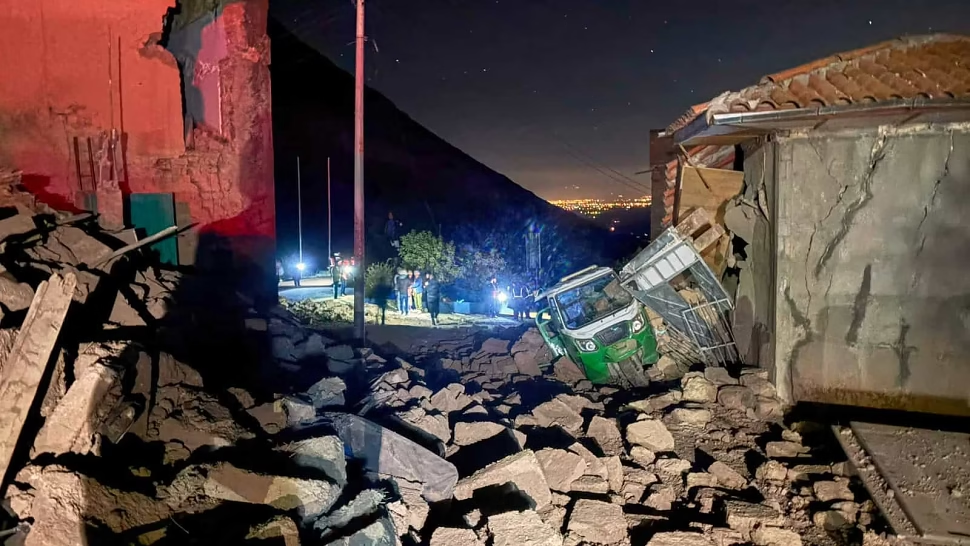
A 5.5 magnitude earthquake shook the Andean region of Junín on Saturday night. Authorities reported at least five people dead, more than 20 injured and around 300 victims.

According to the United States Geological Survey (USGS), the earthquake occurred at 9:24 p.m. The epicenter was located two kilometers west-southwest of Sicaya, province of Huancayo, with a depth of 10 kilometers.

“The predominant adobe constructions in the area contributed to the damage being greater,” explained the head of Civil Defense, Luis Vásquez, who confirmed the deaths.

The National Institute of Civil Defense (INDECI) reported that rescue brigades and health personnel maintain search and medical care tasks. The number of missing people has not yet been determined.

Homes collapsed in several communities. The town’s church and convent, considered historical heritage, suffered damages. Severe damage and losses of farm animals were also reported in Chongos Bajo and Huayucachi.

The interim president of Peru, José María Balcázar, assured that the government deployed emergency aid. He announced a visit to the area, where ministers and regional authorities already work.

Peru is located on the Pacific Ring of Fire, one of the regions with the highest seismic activity in the world. In 2007, an earthquake in Pisco left nearly 600 people dead.

Continue reading