War with Iran keeps Wall Street in suspense

Wall Street awaits a signal about the end of the conflict as crude oil prices plummet after Trump's statements.

The stock market waits, oil dances

The US market remained almost flat this Tuesday. A tense calm. Everyone on Wall Street is watching for one thing: the next signal about when the war with Iran might end.

The S&P 500 fell 0.2%. The Dow Jones lost 34 points. The Nasdaq barely rose. These are minimal movements after the tremendous swing that shook the stock markets on Monday, dragged down by the collapse of crude oil.

RelatedWall Street breathes, but tension with Iran remains latent

The key is in the strait

And why this chaos? Everything revolves around oil and a key geographical point: the Strait of Hormuz. A fifth of the world’s crude oil passes through there every day. The war has largely blocked it, and that has caused prices to skyrocket… and then crash.

A barrel of Brent closed at $87.80. That is 11.3% less than the previous day. Most of that drop occurred on Monday afternoon, after Donald Trump gave an interview to CBS News.

“I think the war is very complete, practically,” Trump said.

Those words made the markets jump with joy. Hope for a quick end to the conflict would mean that oil would once again flow freely from the Middle East. Prices plummeted from almost $120.

But then, things got complicated. Trump later posted on his social network:

“If Iran does anything that stops the flow of oil within the Strait of Hormuz, they will be hit by the United States of America TWENTY TIMES HARDER.”

And to top it all off, an Iranian spokesman made it clear who’s in charge: “Iran will determine when the war ends.” On Tuesday, Tehran launched new attacks against Israel and Gulf countries.

Uncertainty is total. And in financial markets, uncertainty is the worst thing that can happen.

Neuberger Berman’s Hakan Kaya sums it up perfectly:

“The outlook for oil right now is as binary as it gets. Either the Strait of Hormuz reopens… or it remains closed and we are looking at the biggest supply disruption in modern history.”

What really matters: your pocket

Here we leave geopolitics and move on to the real economy. If oil prices remain high for too long, the consequences are serious.

Family budgets, already choked by inflation, could be broken. Companies would see their fuel and logistics costs skyrocket. It is the perfect recipe for the worst possible scenario: stagflation. Stagnant economic growth and high inflation at the same time.

History says that the US stock market recovers quickly from conflicts… as long as crude oil doesn’t stay expensive for too long. The question is whether this time it will be the same.

Meanwhile, other parts of the world reacted with more euphoria to Trump’s opening words. Asian and European stock markets rose strongly at their first opportunity: +5.3% in South Korea, +2.2% in Hong Kong.

On Wall Street there were particular movements: Vertex Pharmaceuticals soared 8.3% after good news about a kidney treatment. West Pharmaceutical Services fell 5.7% after announcing the departure of its CEO.

At the end of the day, everything is still hanging by a thread… or rather, a narrow thread.

Sheinbaum receives Felipe VI at the National Palace on June 25

Sheinbaum will meet with King Felipe VI amid previous diplomatic tensions.

Bilateral meeting at the National Palace

President Claudia Sheinbaum confirmed that next Thursday, June 25, she will meet with King Felipe VI of Spain. The event is scheduled for 4:00 p.m. at the National Palace, taking advantage of the monarch’s visit to Mexico for the 2026 World Cup. The following Friday, the king will attend the Spain-Uruguay match in Guadalajara.

The meeting occurs after years of diplomatic tensions. During the six-year term of Andrés Manuel López Obrador, the relationship cooled due to the demand for a public apology for the grievances of the Conquest. This generated distance with the Royal House and the Spanish government.

Approach signs

With the new government, efforts have been made to maintain institutional dialogue. Sheinbaum had already taken steps in that direction: at the end of April he carried out official activities in Barcelona and expressed his willingness to build a relationship based on mutual respect.

The meeting with Felipe VI reinforces that line. Both leaders will address issues of common interest, without a specific agenda having been leaked. The meeting is seen as a gesture of diplomatic normalization between both nations.

Continue reading

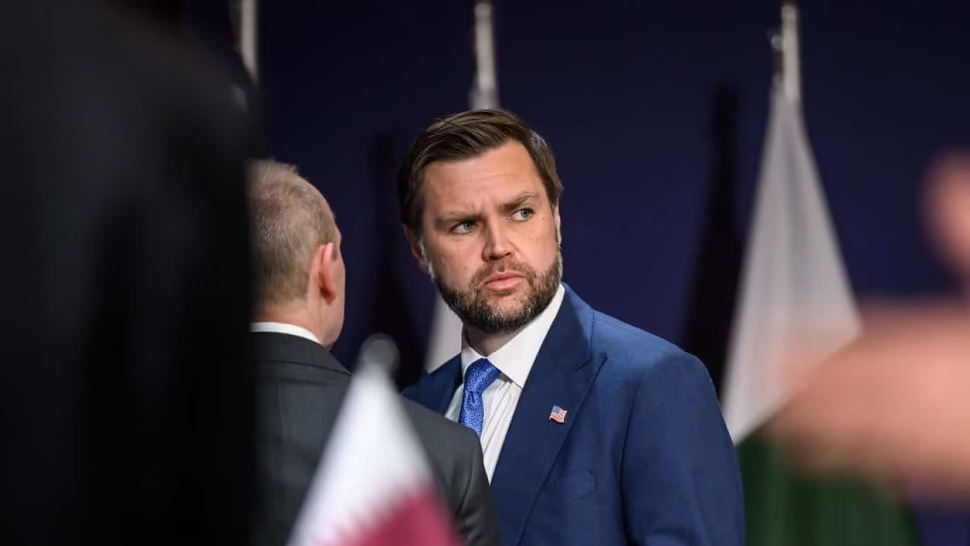
Vance reports progress in negotiations with Iran in Switzerland

Progress in dialogue between Washington and Tehran due to crisis in the Middle East.

Diplomatic advances in Switzerland

The Vice President of the United States, JD Vance, affirmed that the talks with Iranian representatives in the Bürgenstock complex, Switzerland, achieved relevant progress. According to Vance, the foundations were laid for an agreement that would reduce tensions in the Middle East.

During the meeting – which also included mediators from Pakistan and Qatar – two key issues were addressed: the reopening of the Strait of Hormuz and the conflict between Israel and Hezbollah in southern Lebanon.

The Strait of Hormuz, a strategic route for global oil transportation, had been closed by Iran after attacks by the United States and Israel. This skyrocketed international fuel prices. Although some ships have resumed transit, the main route still faces safety risks.

As part of the process, the US Treasury Department issued a temporary license allowing exceptions to sanctions related to Iranian oil. Technical talks will continue over the next 60 days.

The mediators indicated that there was progress in maintaining a ceasefire in Lebanon, but differences persist over the Iranian nuclear program and other key points of the agreement that Washington and Tehran seek to finalize.

Continue reading

Leo XIV criticizes the ease of financing wars and not hunger

The pontiff warned about the drop in financing for food assistance from 2022.

Call from the pontiff in the face of the food crisis

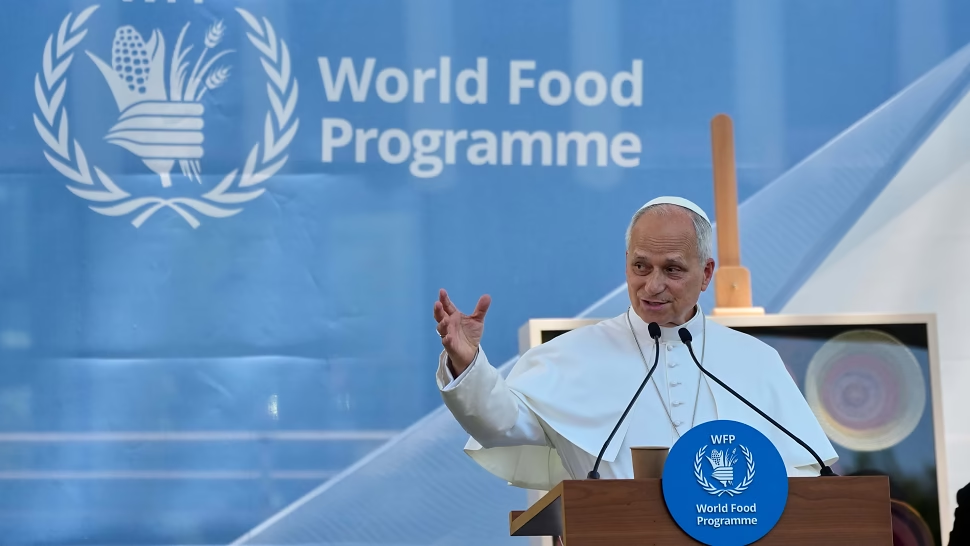
Pope Leo XIV urged governments to allocate more resources to combat hunger. During a meeting in Rome with the UN World Food Program (WFP), he pointed out that it is easier to finance armed conflicts than to guarantee food for millions of people in vulnerable situations.

The pontiff warned that political and administrative obstacles delay humanitarian aid. In contrast, military spending is advancing with fewer obstacles. This paradox reflects a serious inequality in global priorities.

Leo XIV indicated that funding for food assistance has decreased considerably since 2022. Although needs increased due to conflicts, climate crises and economic problems, funds did not grow at the same pace.

He highlighted that recent international contributions, such as the one announced by the United States for the WFP, will benefit millions of people. However, he stressed that there is still a significant gap to cover the necessary resources.

Before the UN body, the pope called on world leaders to place human dignity at the center of their decisions. Strengthening international cooperation is key to confronting hunger and inequality.

Continue reading