A day of contradictions and roller coaster markets
Donald Trump said Monday that war against Iran could be “a short-term excursion.” But minutes later, at the same press conference, he hinted that the worst could be yet to come. And he threatened to intensify the offensive if Tehran tries to “stop the world’s oil supply.”
The US president’s statements generated brutal swings in crude oil prices and stock markets. A roller coaster of uncertainty.
“We are ending this entire threat once and for all, and the result will be lower oil prices for American families,” Trump said.
But the reality on the ground paints a different picture. The war has already blocked crucial flows of crude oil, sending fuel prices soaring in the U.S. The fighting has forced foreigners to flee and displaced millions.
The Khamenei factor: a new leader, a new calculation
The selection of Ayatollah Mojtaba Khamenei, 56, as the new Supreme Leader after the death of his father, was the trigger for the initial panic in the markets. Investors saw it as a clear signal: Iran is preparing for a prolonged defense.
He is only the third Supreme Leader in the history of the Islamic Republic. It has close ties to the Revolutionary Guard, the force that has been launching missiles against Israel and Arab states.
Trump said he was “disappointed” with his election. But what really worries analysts is his profile: he is considered less willing to negotiate than his late father. And he has the final say on the nuclear program.
Kamal Jarazi, an adviser to the Supreme Leader’s office, told CNN that Iran is prepared for a long war and that it “no longer sees room for diplomacy.”
Meanwhile, the attacks intensify. Israel announced a “broad wave” against Isfahan and Tehran. More than 20 explosions rocked the Iranian capital in what appears to be the most intense attack since it all began.
Oil: the nerve of the crisis
This is where it hurts. Iranian attacks on the Strait of Hormuz have virtually closed this key route, through which a fifth of the world’s oil passes. Drones and missiles have also hit energy infrastructure in Saudi Arabia, the United Arab Emirates, Kuwait and Bahrain.
In Bahrain, an attack injured 32 people, including children. In Abu Dhabi, shrapnel from intercepted missiles left two injured. Regional indignation grows.
The result: a barrel of crude oil touched almost $120, its highest level since 2022, before falling towards 90 after Trump’s words about a short war. A volatility that reflects total confusion.
Diplomacy among ruins (and some surreal winks)
Trump also spoke with Vladimir Putin. Russian adviser Yuri Ushakov said Putin “expressed some ideas regarding a quick political and diplomatic settlement.” A desire in the face of an increasingly militarized reality.
In a revealing (and somewhat surreal) comment, Trump compared the Iranian succession process to… Venezuela. He said he liked “the idea” of an internally emerged leader, “how it works” with Delcy Rodríguez.
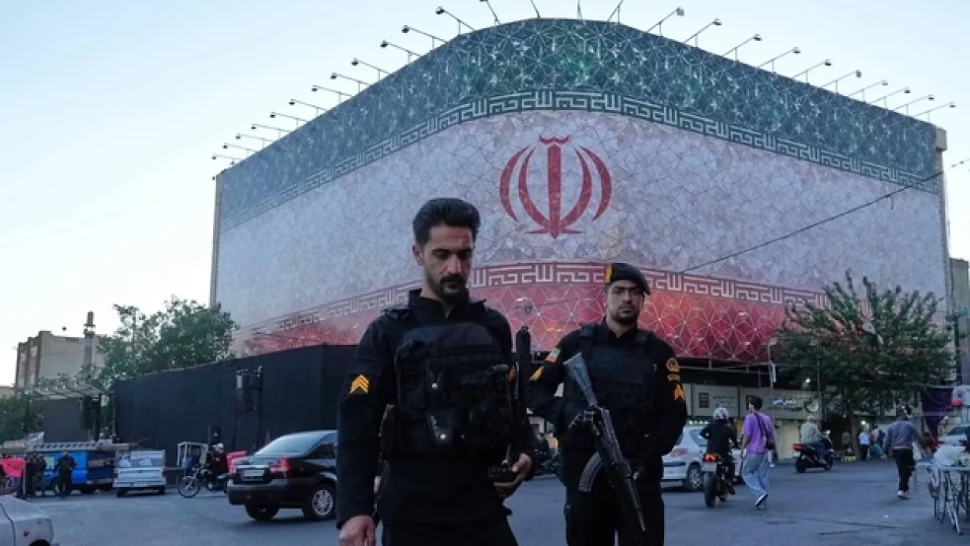
Thousands gathered in Tehran cheering the new leader with chants of “Death to America!” Meanwhile, the US ordered the evacuation of non-essential personnel from Saudi Arabia.
The human toll is grim: at least 1,230 dead in Iran, 397 in Lebanon and 11 in Israel. Seven US service members have died.
Relatives of those soldiers told Trump during the transfer of their remains: “Make sure you win, sir.”
A war that Trump promises will be short but that, with a new tough leader in Tehran and attacks expanding throughout the Gulf, seems to be heading towards something very different.