Earthquake in Peru: five dead and 300 affected in Junín

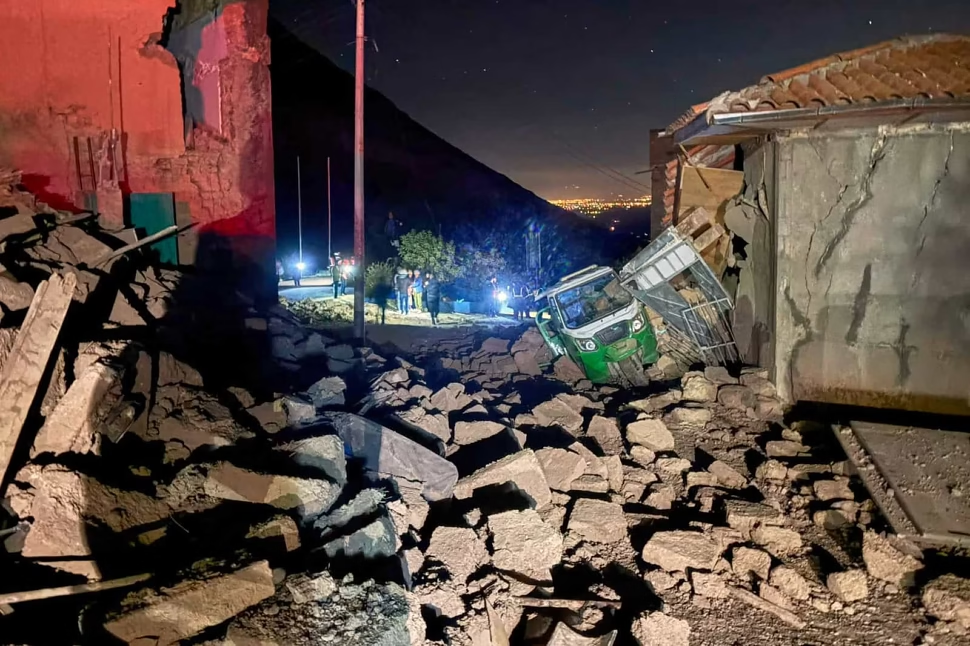
A 5.5 earthquake in Junín leaves five dead and more than 20 injured. Adobe homes collapsed.

Earthquake in the Peruvian Andes

A 5.5 magnitude earthquake shook the Andean region of Junín on Saturday night. Authorities reported at least five people dead, more than 20 injured and around 300 victims.

According to the United States Geological Survey (USGS), the earthquake occurred at 9:24 p.m. The epicenter was located two kilometers west-southwest of Sicaya, province of Huancayo, with a depth of 10 kilometers.

“The predominant adobe constructions in the area contributed to the damage being greater,” explained the head of Civil Defense, Luis Vásquez, who confirmed the deaths.

The National Institute of Civil Defense (INDECI) reported that rescue brigades and health personnel maintain search and medical care tasks. The number of missing people has not yet been determined.

Related5.5 earthquake in Peru leaves six dead and more than 30 injured

Homes collapsed in several communities. The town’s church and convent, considered historical heritage, suffered damages. Severe damage and losses of farm animals were also reported in Chongos Bajo and Huayucachi.

The interim president of Peru, José María Balcázar, assured that the government deployed emergency aid. He announced a visit to the area, where ministers and regional authorities already work.

Peru is located on the Pacific Ring of Fire, one of the regions with the highest seismic activity in the world. In 2007, an earthquake in Pisco left nearly 600 people dead.
Putin receives North Korean foreign minister and praises support in conflict

Putin thanks Pyongyang for its support in the conflict with Ukraine; possible new summit with Kim Jong Un.

Putin and Choe Son Hui: high-level diplomacy

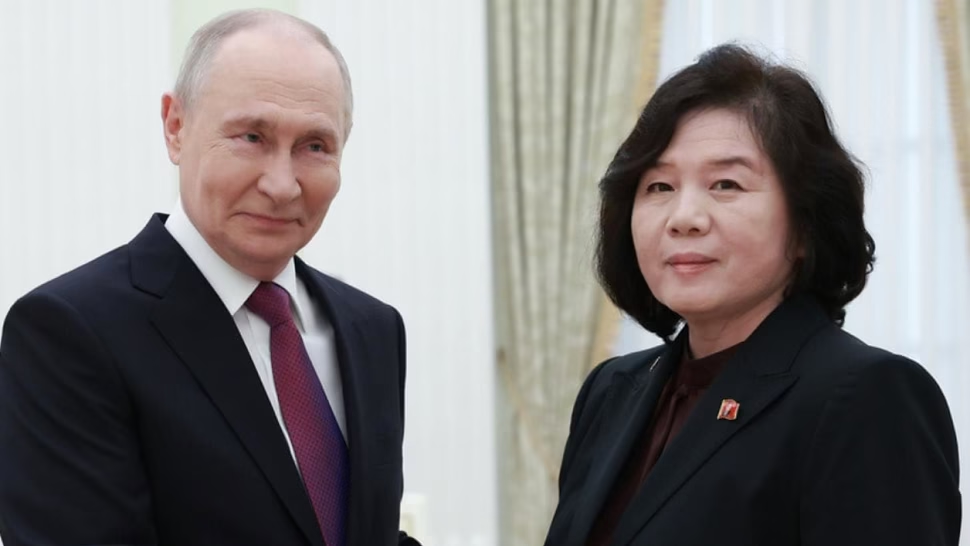
Russian President Vladimir Putin received North Korean Foreign Minister Choe Son Hui this Sunday in the Kremlin. During the meeting, Putin thanked Pyongyang for its support in military operations against Ukraine, according to the state agency Tass.

Choe’s visit occurs for no obvious reason, such as a multilateral summit or an anniversary. This has sparked speculation about a possible new meeting between Putin and North Korean leader Kim Jong Un. North Korean media confirmed that Choe traveled to Russia at the invitation of his counterpart Sergei Lavrov, but did not mention an eventual meeting between the two leaders.

Bilateral talks and mutual support

On Monday, Choe and Lavrov held separate talks. Russia expressed full support for North Korea’s efforts to protect its sovereignty, while Pyongyang reaffirmed its support for Russia in the Ukrainian conflict, the Korean Central News Agency reported.

Putin praised bilateral relations and reiterated his gratitude to the North Korean leadership for supporting his military operations. Choe conveyed that Kim Jong Un remains committed to comprehensively developing ties with Russia.

Cooperation background

Kim visited the Russian Far East for summits with Putin in 2019 and 2023. Last June, during the summit in Pyongyang, the two signed a strategic partnership agreement that promises mutual aid in the face of external aggression.

In recent years, North Korea has prioritized Russia in its foreign policy, sending thousands of soldiers and large supplies of military hardware to support Moscow in Ukraine. In exchange, Pyongyang receives economic assistance and technological transfers that, according to analysts, strengthen its military capabilities.

Kim has also sought to reach out to China, with recent high-level meetings, while promoting the idea of ​​a new Cold War as a united front against the United States.

Impact on the region

Choe’s visit follows diplomatic exchanges between North Korea and China, including meetings between North Korean Premier Pak Thae Song and President Xi Jinping, and senior Chinese official Wang Huning with Kim in Pyongyang.

Kim has suspended all meaningful dialogue with Washington and Seoul since 2019. He is taking advantage of the distraction of the conflict in Ukraine to accelerate his nuclear and missile program, while demanding that the US abandon disarmament demands as a precondition for resuming negotiations.

Continue reading

Petro calls his successor ‘servant’ of the United States

Petro describes his successor as an ally of Washington and warns of mobilizations.

Petro’s last speech: accusations and warnings

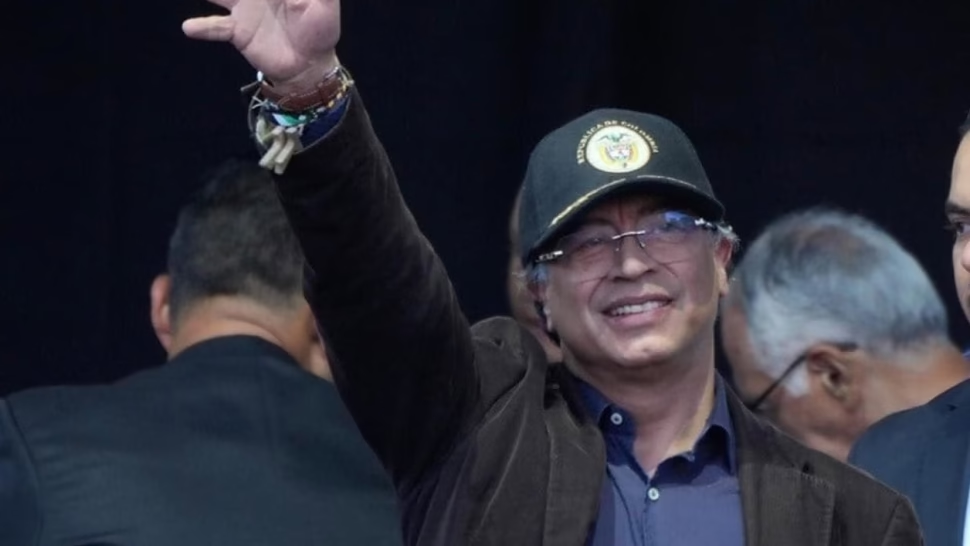
Gustavo Petro delivered his last message as president of Colombia before thousands of followers in the south of Bogotá, during the commemoration of Independence Day. There he described his successor, Abelardo de la Espriella, as a “servant” of the United States.

“The next president of Colombia will be a servant of the rulers of the United States who helped him, in quotes, to elect; then we went from the status of Republic to the status of viceroyalty again,” he stated.

Petro assured that there was “fraud” in the second round of elections and that he will present evidence. He argued that Donald Trump ordered his Secretary of State, Marco Rubio, to take charge of Colombia, and that Rubio acted as a personal friend of De la Espriella.

The response of the president-elect

Hours before, De la Espriella led the patriotic events in Medellín. There he paid tribute to soldiers and police, and stated that the people of Antioquia “decided to defeat tyranny to defend democracy.”

Petro compared the current moment with the independence of Spain in 1810. He said that it was time to give “the second cry for independence” and called for breaking a vase, alluding to the historical episode that triggered the separation of Spanish rule.

The outgoing president warned that if the next government tries to eliminate social reforms from its mandate, it will call for a national strike and protests. He also threatened to break political alliances: no party that votes for De la Espriella’s candidate to preside over the Senate will have support in the 2027 regional elections.

“No ally who votes for fascism in the Senate will have support from the popular force,” said Petro, who will take over as head of the opposition.

Continue reading

The United States and Iran intensify attacks; oil rises

New attacks between Washington and Tehran raise tension and affect energy markets.

Escalation between the United States and Iran

The United States launched a new round of airstrikes against Iran at the beginning of the week, hours after confirming the death of another American soldier. Iran responded with offensives against Kuwait, Jordan and Bahrain, where the US Navy’s Fifth Fleet is located.

The provisional ceasefire agreement signed last month has fallen apart. Maritime traffic in the Strait of Hormuz, a vital route for global energy, is practically paralyzed. Both sides have attacked civilian infrastructure on which millions of people depend.

Impact on energy markets

The violence sent oil prices soaring. Brent crude oil surpassed $88 per barrel, and regular gasoline in the US rose to $1.05 per liter, putting pressure on consumers ahead of the November legislative elections.

The US Central Command said its ninth consecutive night of strikes targeted Iranian command centers, anti-aircraft batteries and surveillance facilities. The IRNA agency reported at least one death near Tabriz. Other locations were also reached.

The British Maritime Trade Operations Center reported a second ship attacked in the Strait of Hormuz, which was left adrift and on fire. The Iranian Revolutionary Guard claimed responsibility for attacks on oil tankers in the area.

Tehran also attacked countries allied with the US. Kuwait said its anti-aircraft defenses fired against an incoming barrage. Jordan reported that it shot down three Iranian missiles without damage. Bahrain condemned Iranian drones against its air traffic system.

Yemen’s Houthis, backed by Iran, announced a maritime embargo against Saudi Arabia in the Red Sea, an alternative route for crude oil exports.

Diplomatic efforts

Pakistan intensified efforts to revive the truce. Iran’s Interior Minister Eskandar Momeni arrived in Islamabad for talks with Prime Minister Shehbaz Sharif. His Pakistani counterpart, Mohsin Naqvi, expressed optimism: “God willing, we will have good news.”

Secretary of State Marco Rubio said the US remains open to negotiating with Iran, but “it has to be real.” He noted that the door to diplomacy would be if those who want something productive for Iran take control.

Iranian authorities reported at least 50 deaths and 517 injuries in recent rounds of US attacks. Since the conflict began on February 28, 17 US service members have died.

Continue reading