Japan assesses damage after powerful earthquake and tsunami warning

The authorities remain on alert after the strong earthquake, while they evaluate damage to infrastructure and confirm dozens of injuries.

Analysis of the seismic event and immediate response

Japanese authorities are carrying out a thorough assessment of the damage this Tuesday, while issuing warnings to the population about the likelihood of significant aftershocks. This state of alert is derived from a powerful earthquake of magnitude 7.5, recorded on the Richter scale, which shook the region late on Monday. The natural phenomenon caused a series of immediate consequences: dozens of injuries, material damage of varying degrees and the generation of a localized tsunami that impacted coastal communities on the Pacific.

According to the official report of the Fire and Disaster Management Agency, the preliminary balance shows a total of 34 injured people, one of them in serious condition. The public broadcaster NHK detailed that most of these injuries were caused by the detachment and fall of objects inside homes and buildings, a common pattern in this type of events. Prime Minister Sanae Takaichi announced the immediate formation of an emergency task force to coordinate the government response. “Our absolute priority is people’s lives and we are deploying all available resources,” said the president, emphasizing the urgency of the work.

RelatedSHOA rules out tsunami threat for Chile after earthquake in Japan

Geophysical characteristics and initial impacts

The epicenter of the earthquake was located in the Pacific Ocean, approximately 80 kilometers off the coast of Aomori prefecture, located at the northern end of the main island of Honshu. The event occurred at an estimated depth of 44 kilometers, according to data from the United States Geological Survey (USGS), which calculated the magnitude at 7.6. The energy released by the fracture of the Earth’s crust generated a warning tidal wave. The Japan Meteorological Agency (JMA) recorded a rise in sea level of up to 70 centimeters in the port of Kuji (Iwate Prefecture), with lower wave heights affecting other coastal locations. These increases caused reported damage to aquaculture facilities, specifically in pans intended for the cultivation of oysters. The agency formally lifted all tsunami warnings at 6:30 a.m. on Tuesday.

The consequences on infrastructure were quickly evident. Chief Cabinet Secretary Minoru Kihara reported power outages affecting around 800 homes, as well as the preventive suspension of Shinkansen bullet train services and local railway lines. Although the company Tohoku Electric Power Co. Power was restored to most of the area during the morning, and high-speed trains resumed operations, other transportation nodes were affected. Approximately 200 passengers were stranded at New Chitose Airport in Hokkaido, after cracks and falls were reported in part of the roof of the domestic terminal.

Logistics mobilization and continuous risk assessment

The operational response included the mobilization of defense resources. Defense Minister Shinjiro Koizumi said about 480 residents were evacuated and housed at Hachinohe Air Base, while 18 helicopters were deployed to conduct an aerial damage assessment. In the area of ​​sensitive energy facilities, the Nuclear Regulatory Authority (NRA) reported a minor incident at the Rokkasho fuel reprocessing plant in Aomori, where about 450 liters of water spilled from a cooling area. The authority clarified that the levels remained within normal parameters and no anomalies were detected in other nuclear power plants or spent fuel storage facilities in the region.

The JMA’s prospective analysis introduces an element of concern in the medium term. The agency warned of a slight increase in the probability of an earthquake of magnitude 8 or greater, with its corresponding potential to generate a significant tsunami, along the northeast coast of Japan, from Chiba to Hokkaido. This forecast, based on seismic activity models, led authorities to urge residents of 182 municipalities to review and update their emergency preparations over the next week. JMA official Satoshi Harada was categorical: “The population must prepare, assuming that a large-scale disaster could repeat itself.” This warning takes on a particular historical dimension, given that Monday’s earthquake occurred just north of the area devastated by the magnitude 9.0 earthquake and subsequent tsunami in 2011, which caused nearly 20,000 fatalities and the accident at the Fukushima Daiichi nuclear plant. Remnant seismic activity continued to manifest on Tuesday, with aftershocks recorded at magnitude 6.6 and 5.1 by the USGS.

Did you find this detailed analysis of natural disaster management useful?Share this report on your social networks to keep your community informed and explore more specialized content on geophysics and emergency response on our site.
SRE rules out Mexicans affected after earthquakes in Venezuela

SRE reports that there are no Mexicans affected by earthquakes in Venezuela.

The Ministry of Foreign Affairs (SRE) reported that, as of this Wednesday afternoon, there were no reports of Mexican people affected by the earthquakes registered in Venezuela.

No effects reported

Through a statement, the Foreign Ministry expressed its solidarity with the Venezuelan people and regretted the damage that had occurred.

“The Ministry of Foreign Affairs expresses all its solidarity with the Venezuelan people and deeply regrets the damage and harm caused,” said the agency headed by Roberto Velasco.

The Mexican embassy in Venezuela remains attentive to the development of the situation. So far, there are no compatriots who have required assistance.

Support channels

For those who need consular protection, the Mexican representation has enabled the emergency number: +58 412 2524675. The authorities recommend staying calm and following local instructions.

The international organization continues to monitor possible aftershocks. For now, no changes are expected in travel recommendations for Mexicans in the region.

Continue reading

Colombia and the Amazon: a turn towards extractive development

De la Espriella's triumph in Colombia raises questions about the future of the Amazon rainforest in the region.

Abelardo de la Espriella’s victory in Colombia’s presidential elections marks a possible change in environmental policy in the region. The businessman, backed by Donald Trump, defeated Iván Cepeda by just 251,000 votes, according to official results.

What will happen to the Amazon?

The Amazon rainforest, which absorbs carbon dioxide and slows climate change, faces a new scenario. Around 40% of Colombian territory is in the Amazon basin. During the government of Gustavo Petro, the country positioned itself as a defender of the jungle. De la Espriella promises to reactivate the oil sector, support fracking and further exploit natural resources.

Elizabeth Dickinson of the International Crisis Group noted that many governments now believe that economic development and conservation can move forward together. However, environmentalists warn that expanding fossil fuel production could increase pressure on sensitive ecosystems.

Peru and Brazil also join this trend. Keiko Fujimori, close to winning in Peru, supports mining. In Brazil, the election between Flávio Bolsonaro and Lula will define the direction of deforestation. Cristiane Mazzetti of Greenpeace Brazil said: “The elected administration sets budget priorities and regulates exploitation. The result is measurable, as shown by the rate of deforestation.”

Illegal gold mining is one of the biggest drivers of destruction in the Amazon. Dickinson added: “It’s very hard to disagree with going after illegal mining, one of the most damaging industries.” But he warned that governments often focus on seizing equipment, without dismantling criminal networks.

Julio Cusurichi, indigenous leader in Peru, stated: “Biodiversity and our territories can help climate change. In our territories we do governance for the planet.” Indigenous organizations denounce that governments do not adequately consult them before approving extractive projects.

Analysts such as Sergio Guzmán indicate that environmental concerns will compete with economic ones. “Many emissions concerns will take a backseat to energy self-sufficiency,” he said. He also mentioned that aerial fumigation of coca crops could resume, affecting Amazonian communities.

In Leticia, the Ticuna indigenous Arnaldo Rufino expressed his fear: “That means cutting down the trees that allow humanity to breathe.” The future of the Amazon will depend on the decisions made by the new governments in the region.

Continue reading

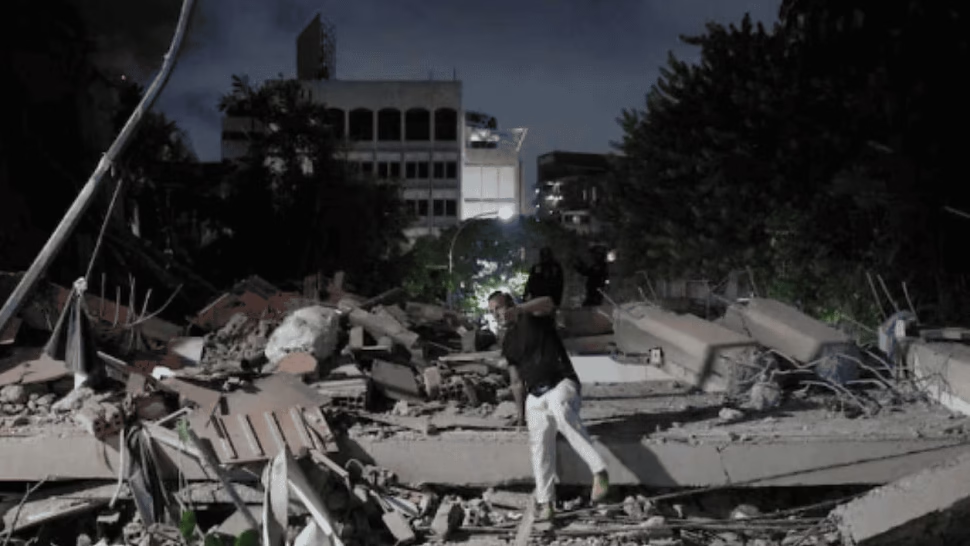
7.1 magnitude earthquake shakes Venezuela and raises alerts

7.1 tremor shakes Venezuela; tsunami warning in Puerto Rico.

7.1 tremor in Venezuela activates tsunami alert

A 7.1 magnitude earthquake was recorded this Wednesday in Venezuela, according to the United States National Oceanic and Atmospheric Administration (NOAA). The earthquake occurred at 22:04 GMT with the epicenter located 21 kilometers east of Morón, in the state of Carabobo.

The depth of the earthquake was 9.6 kilometers, which increased its perception on the surface. NOAA issued a tsunami warning for Puerto Rico and the Virgin Islands, although so far no major damage has been reported in those areas.

Aftershocks and affected areas

The tremor unleashed scenes of alarm in Caracas, where residents took to the streets after feeling the movement. It was also noticed in several cities in Colombia, such as Bogotá, Barranquilla and Bucaramanga, although without serious consequences.

Local authorities evaluate possible effects. Venezuela is located in an area of ​​moderate seismic activity, and events of this magnitude are rare. No casualties or significant structural damage have been reported as of press time.

Continue reading