Analysis of the devastating earthquake in Afghanistan and its consequences
A 6.0 magnitude earthquake shook eastern Afghanistan overnight on Sunday, triggering one of the deadliest natural disasters in the region in recent years. According to official figures provided on Tuesday by the Taliban government spokesman, Zabihullah Mujahid, the provisional toll exceeds 1,400 deaths and more than 3,000 wounded, initially concentrated in the province of Kunar. However, the United Nations has issued a crucial warning: these numbers are experiencing an exponential increase as rescue teams gain access to remote areas that have remained cut off.
The violence of the earthquake devastated entire towns, whose homes, built predominantly with mud bricks and wood, could not withstand the impact. The structural collapse of these buildings has been identified as the primary cause of fatalities and injuries. Indrika Ratwatte, UN resident coordinator for Afghanistan, precisely explained the mechanics of the tragedy: “When the walls of wooden and mud houses collapse, the roof falls on the occupants.” This phenomenon was aggravated by the fact that the earthquake occurred during the early morning hours, when most residents were inside their homes and at rest.
Logistics challenges and the international response
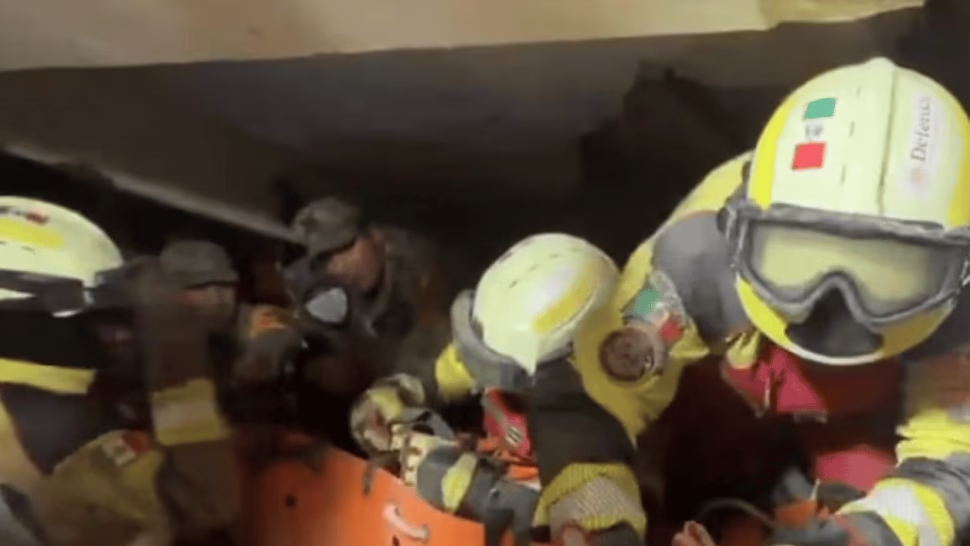
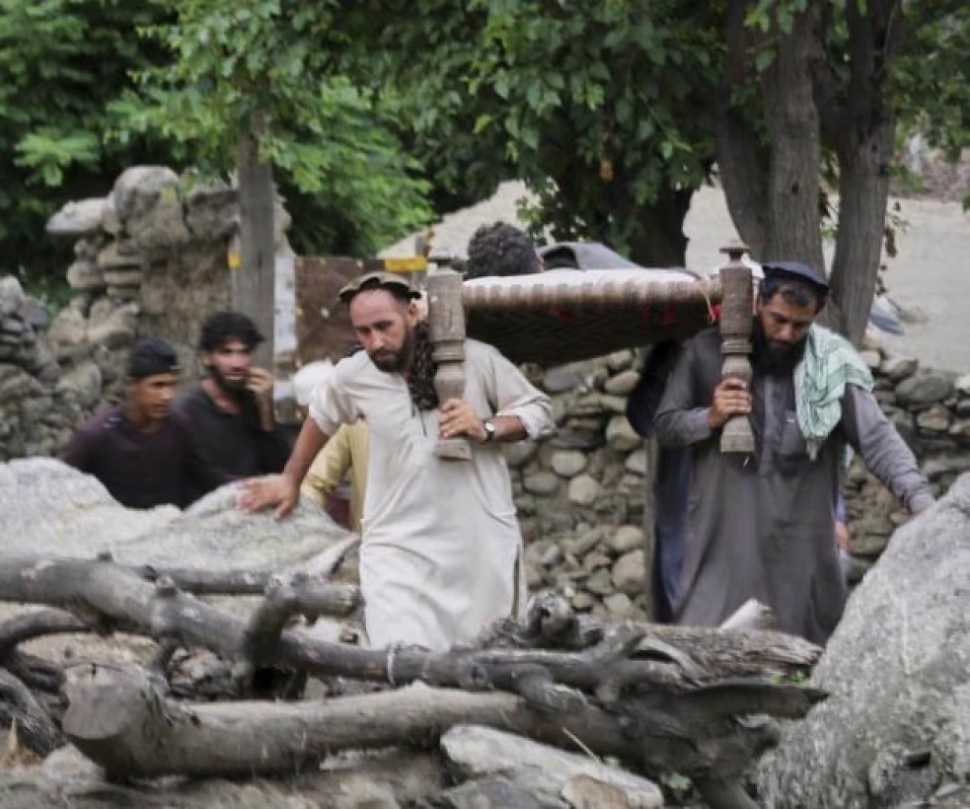
The rugged terrain of the epicentral area has extremely complicated relief efforts and the distribution of humanitarian aid. Rockslides have isolated numerous villages, forcing rescue teams, such as those from Save the Children, to make treks on foot of more than 19 kilometers carrying medical equipment. Authorities have been forced to employ extraordinary methods, such as parachuting commandos to evacuate the wounded from areas where helicopters cannot land.
Faced with this emergency, the Taliban government has formally requested assistance from the international community. The response, although existing, is limited by a complex geopolitical context and competition with other global crises. The UN Office for the Coordination of Humanitarian Affairs (OCHA) initially released $5 million from its emergency fund, an amount that will be matched by the Humanitarian Fund for Afghanistan. Various nations, including the United Kingdom, the European Union, the United Arab Emirates, India and China, have announced financial contributions and the shipment of supplies. The EU, for example, will dispatch 130 tons of emergency material and contribute 1 million euros.
However, this aid collides with an adverse economic and political reality. Afghanistan faces deep cuts in aid funding, a weakened economy and the forced return of millions of people from Iran and Pakistan. Kate Carey, deputy director of OCHA in Afghanistan, highlighted a critical consequence of this lack of funding: more than 420 health facilities have closed or suspended operations, 80 of them in the eastern region, the most affected by the earthquake. “The remaining facilities are overwhelmed, undersupplied and understaffed,” Carey said, underscoring the urgency of providing trauma care in the first 72 hours.
The situation is further complicated by the policies of the Taliban government, whose international recognition is limited (only Russia officially recognizes it) and whose restrictive measures, especially towards Afghan girls and women, have led donor countries to drastically reduce their funding. The United States, for example, implemented major aid cuts earlier this year, partly out of concern that the funds could end up in the hands of the Taliban executive.
Taliban authorities have established a camp in Kunar to organize supplies and have set up two centers to coordinate the transportation of the wounded, the burial of the deceased and the rescue of survivors. Meanwhile, a magnitude 5.2 aftershock recorded Tuesday near the original epicenter added further uncertainty to the operation, although no additional immediate damage was reported.
This seismic event represents the third major earthquake since the Taliban took power in 2021 and demonstrates the deep vulnerability of a country fighting multiple and simultaneous crises. The UN warning of an exponential increase in the number of victims reflects a race against time where topography, poor infrastructure and international financial constraints play against the survival of thousands of Afghans.
Did you find this comprehensive analysis of the situation useful?Share this information on your social networks to help keep the focus on this humanitarian crisis and explore more related content on our site to stay up to date with the latest updates.