Xi, Putin and Kim watch Chinese military parade

A trio of global heavyweights watch as China flexes its muscles in an anniversary loaded with symbolism and messages for the West.

The show must go on

In a twist that no one saw coming (or yes, we all saw it coming), the three musketeers of alternative geopolitics, Xi Jinping, Vladimir Putin and Kim Jong Un, met in Beijing for what was basically the real version of a game of Risk. The reason: to commemorate the 80th anniversary of the end of World War II, a historic event that is, of course, best celebrated with missiles and fighter jets. Because nothing says “never again” like a display of military might that would make a Hollywood blockbuster blush.

The Chinese leader, in a speech that oscillated between a history lesson and a veiled threat, presented humanity with an existential dilemma: peace or war, dialogue or confrontation. A deeply philosophical choice, without a doubt, especially coming from someone who minutes later would review a parade of weapons capable of turning the planet into a parking lot. Irony, like the troops, marched in unison.

RelatedKim Jong Un accelerates missile production before China trip

Protocol, limousines and impeccable choreography

The show began with the elegance that only a totalitarian state can afford. Xi Jinping rode down Chang’an Avenue in a black limousine with more stardom than a rock star, emerging through a hatch in the roof as if he were going to sing a hit from the 80s. Four microphones were waiting for him, because just one is not enough to proclaim the greatness of the Party. The troops, trained to disguise any hint of personality, shouted slogans such as “We serve the people” with a synchronization that made the most professional choirs envious.

The dramatic touch could not be missed: 80 cannon shots to mark the years that have passed. Because, let’s be honest, 79 shots would have been cheesy and 81 would have been directly excessive. The national anthem, composed in the resistance against Japan, played loudly, reminding everyone that neighbors were never welcome. Then, the trio of aces went up to the platform of the Tiananmen Gate, a place with as much history as it is controversial, where they shook hands on a red carpet as long as the list of international sanctions that weigh on them.

The most photogenic (and surreal) moment came when they stopped to greet five centenarian veterans of the war. One can only imagine what those elders thought when they saw this particular group of leaders, one who annexes territories, another who tests ballistic missiles as if they were fireworks, and a third who presides over the country that has grown the most in influence (and debt). The story, of course, has a peculiar sense of humor.

It’s not a show of strength, it’s… well, yes it is

China insisted that all this was a commemorative act, an exercise in historical memory. Sure, and the Roman Colosseum was just a place to exercise. The reality is that the military parade was a full-blown show of force, designed to send a clear message to the world, and especially to the United States: “Hey, look what we’ve got.” Missiles, stealth planes, tanks… all released for the occasion, as if it were the launch of a new season of weapons.

The crowds of spectators, conveniently located in delimited sections (because spontaneism is not welcome), waved red flags to the rhythm of patriotic songs that proclaimed, among other niceties, that there is no new China without the Communist Party. Originality, of course, is conspicuous by its absence in the nomenclature of the hymns.

Internally, the event sought to reinforce support for the Communist Party and its supreme leader, Xi, presenting him as the architect of the new China. A China that is no longer content with being the world’s workshop, but rather aspires to write the rules of the global game. And what better way to demonstrate it than by inviting two of the most controversial leaders on the planet to your private party.

The final wink, of course, was the presence of Putin and Kim, two figures who in any normal international meeting would provoke more avoidance than a handshake. But here, in Beijing, they were the guests of honor. Because when it comes to challenging the world order, family (geopolitics) comes first.

The final result? A perfect day to ride in a limousine, greet veterans, debut new toys and remind the world that, on the global board, there are new (and old) players willing to dance to their own music. And if the music sounds like cannon shots, so much the better.

Did you like this ironic look at current geopolitical events?Share it on your social networks and help us reach more people who appreciate acid humor. Explore more content in our international politics section so you don’t miss any details of this surreal world.
Dog Laila rescued 29 days after earthquakes in Venezuela

A dog survived 29 days under rubble in La Guaira after the June earthquakes.

Rescue of Laila

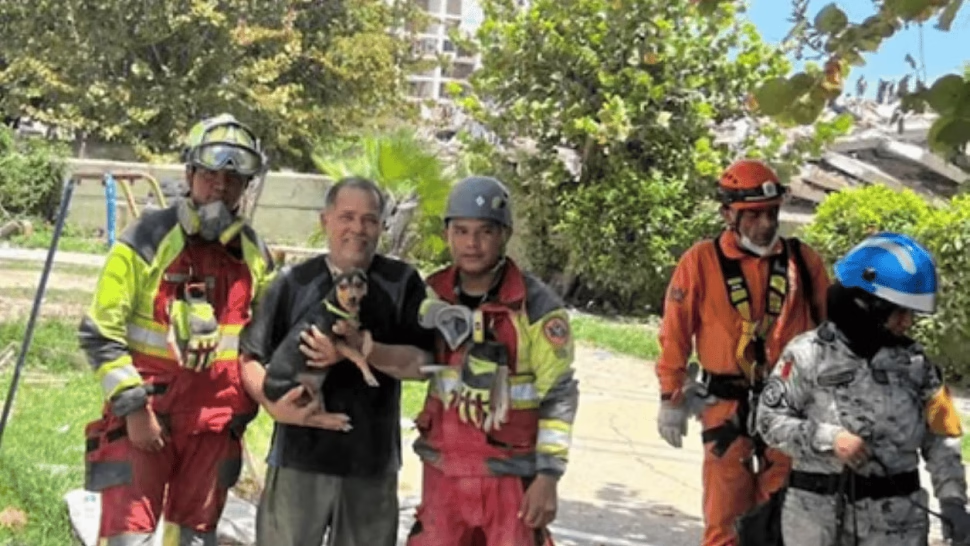
One month after the 7.2 and 7.5 magnitude earthquakes that shook Venezuela on June 24, an unexpected discovery has shocked the networks. A poodle breed dog named Laila was found alive under the rubble in the town of La Guaira, where she remained trapped for 29 days.

The video, released by the “Topos Orientales A.C.” rescue brigade, shows the brigade members resuscitating the animal, offering it water from a bottle. Among those present you hear:

“What a miracle my God”

The dog, although dehydrated and malnourished, was conscious and managed to drink on her own. The team described the event as a sign of hope in the midst of tragedy.

Official figures

According to the latest government report, the earthquakes left at least 5,398 dead and 16,740 injured. About 859 buildings were damaged; 190 collapsed. More than 17,900 people lost their homes and remain in 107 camps in La Guaira, Caracas and Miranda.

Laila’s rescue has been seen as a symbol of resilience, as hundreds of families continue to dig through the rubble in the hope of finding their loved ones.

Continue reading

The US will send a delegation to Brazil to question electronic voting

Two State Department officials will travel to Brasilia to review the electronic ballot box system.

Donald Trump’s government is preparing to send two senior State Department officials to Brasilia. The objective: to question the reliability of the Brazilian electronic voting system, just over two months before the presidential elections on October 4.

United States Mission

The information was published by The Washington Post, which cites American and Brazilian sources. The delegation would consist of Riley M. Barnes, deputy secretary, and Samuel Samson, deputy assistant secretary. According to the newspaper, both plan to meet with critics of the electronic ballot box system and collect information to prepare a report that calls into question the reliability of the voting mechanism.

The government of Luiz Inácio Lula da Silva considers the initiative an attempt to interfere in the electoral process. He assured that he will act to prevent any effect on the elections. Two senior Brazilian diplomats described the mission as:

“Completely incompatible with Brazilian democracy”

And they affirmed that the Executive will protect the integrity of the process.

Reaction and context

The State Department confirmed the trip, but avoided responding to the objective or any possible questions about the integrity of the Brazilian electoral system. The mission occurs amid tensions between Washington and Brasilia, aggravated by the tariffs imposed by the United States on Brazilian products and by the judicial process against former President Jair Bolsonaro for the alleged attempt to prevent Lula’s inauguration after the 2022 elections.

In recent days, Flavio Bolsonaro – presidential candidate and son of the former president – once again questioned the reliability of electronic ballot boxes. He returned to complaints that were already rejected by the Superior Electoral Tribunal (TSE).

The elections will pit current President Lula, who is seeking a new mandate, against Flavio Bolsonaro. The campaign is dominated by polarization and disputes over the transparency of the process. The electronic voting system continues to be supported by the TSE and international observers, who so far have not detected evidence of fraud.

Continue reading

Trump criticizes journalists and opponents at correspondents’ dinner

Trump attacked 'fake news' and opposition politicians before 700 attendees.

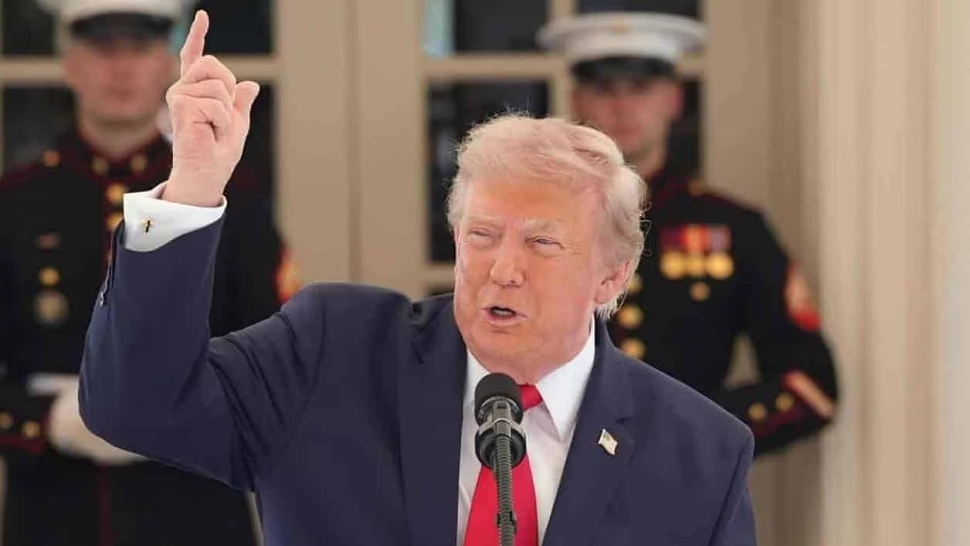
The president of the United States, Donald Trump, took advantage of the correspondents’ dinner in New York to launch criticism against the press and his political adversaries. The event was held at the Waldorf Astoria hotel, three months after an alleged attempted attack on Trump forced its suspension.

Criticism of the press and the opposition

Before about 700 people, Trump adopted a lighter tone than expected, although he did not stop referring to “fake news.” Between jokes, he claimed to have won the elections three times, repeating the theory of fraud in 2020 that he has never been able to prove.

“They have no idea how lucky they are. When I’m gone, they’re going to go bankrupt. Their business model will end. There won’t be anyone to report on. Nobody gives a damn about anyone else,” the president said.

The statements come in a context of tension between the White House and the media, which Trump has repeatedly described as “enemies of the people.” During his speech, he also criticized Democratic politicians and described some Republican opponents as “disloyal.”

The speech, although with a less confrontational tone than on previous occasions, made it clear that Trump maintains his strategy of discrediting the independent press and those who oppose his political agenda.

Continue reading