Iranians fire Ayatollah Khamenei amid anti-Trump slogans

Massive farewell to the Iranian supreme leader amidst slogans against Washington and Tel Aviv.

Funeral of Ayatollah Khamenei in Tehran

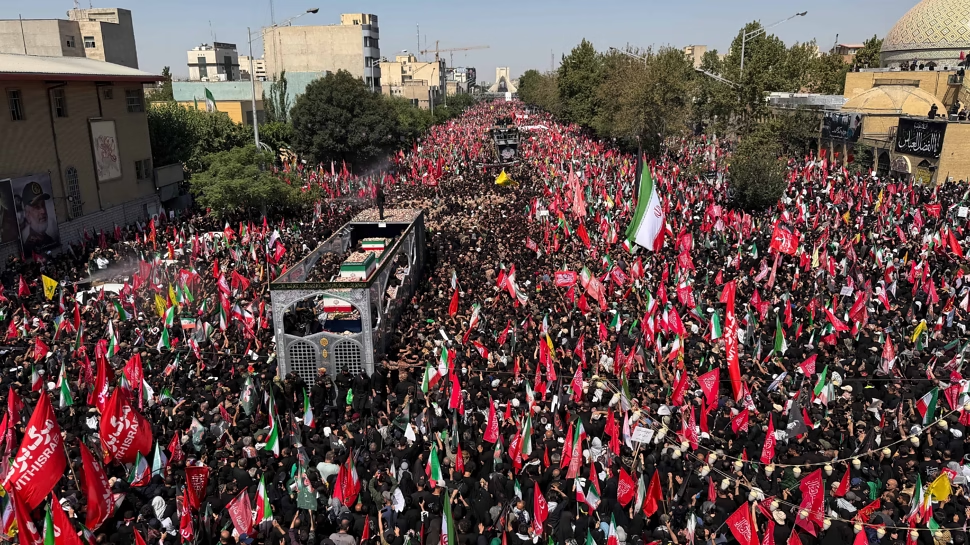
Thousands of people thronged the streets of the Iranian capital on Monday for the funeral of Supreme Leader Ali Khamenei. The procession combined displays of mourning with slogans against the United States and Israel.

The coffin, covered with the Iranian flag, was carried next to the coffins of relatives who died in the bombing of February 28, an attack attributed to Israel and the United States that triggered the most recent war. Images from state television showed a crowd that stretched for kilometers, even larger than that recorded in 2020 for the funeral of General Qassem Soleimani.

RelatedIran begins funeral for Ayatollah Khamenei

During the tour, mourners dressed in black attempted to touch the coffin or pass handkerchiefs over it as a symbol of blessing. Others carried signs with messages against US President Donald Trump and Israeli Prime Minister Benjamin Netanyahu. Slogans were heard condemning both leaders.

The authorities deployed an extensive security operation. They closed streets and suspended public activities during official mourning. Khamenei’s burial will take place in the holy city of Mashhad.

Expressions of retaliation dominated the day. Several attendees affirmed that the loss of the supreme leader will not go unanswered and reiterated their rejection of the United States and Israel. Washington remains vigilant about possible Iranian reactions against Trump and other former officials, stemming from the 2020 order that eliminated Soleimani. However, Tehran has officially denied being involved in plans to attack the US president.
Trans people demand dialogue after cancellation of meeting in Segob

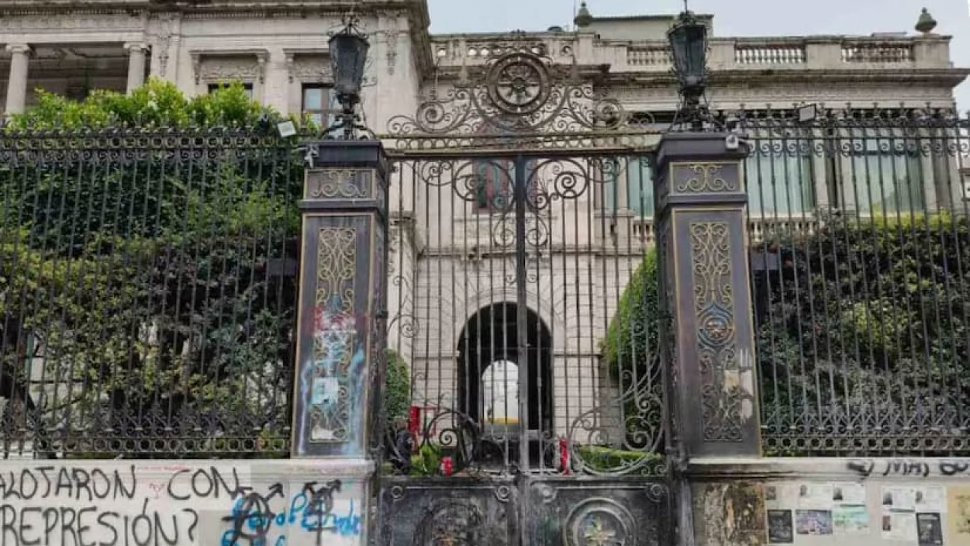
Trans groups denounce cancellation of meeting in Segob and carry out graffiti in Reforma.

Protest in Segob

Trans and non-binary people demonstrated this Thursday outside the Ministry of the Interior (Segob) in Mexico City. They denounced the cancellation of a meeting where they would address demands for health, housing, education and human rights. During the mobilization, they painted and caused damage to street furniture, set fire to objects and broke pedestrian traffic lights in front of the Senate.

Elements of the National Guard tried to disperse the protesters with fire extinguishers and a water hose. According to the participants, the water also wet journalists who were covering the events. The groups advanced towards Paseo de la Reforma and Insurgentes, where they damaged advertisements and glass, as well as the Bienestar Tower.

The protesters demand that the Secretary of Government of Mexico City, César Cravioto, sign a minute to set a new meeting date. They assure that with this they would break up the sit-in and resume the dialogue.

This protest joins other recent actions, such as the occupation of a Segob hall in June and road blockades. Until now, Segob and its head, Rosa Icela Rodríguez, have not issued a position on the alleged cancellation.

Continue reading

Modifications to the T-MEC require approval from the US Congress

Comce specialists warn that profound changes to the T-MEC require approval from the US Congress.

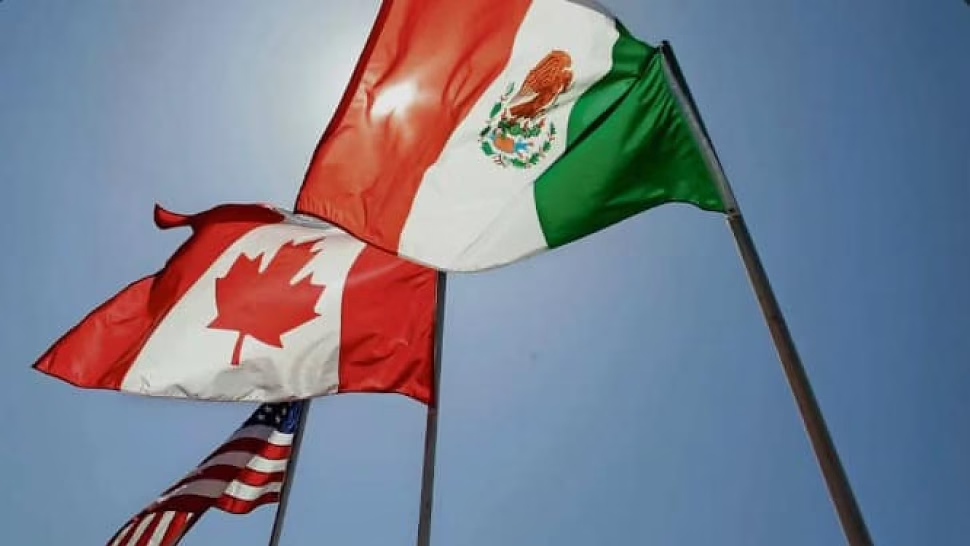
Possible modifications to the Treaty between Mexico, the United States and Canada (T-MEC) could not imply substantive changes without the authorization of the US Congress. This was pointed out by specialists from the Mexican Business Council for Foreign Trade, Investment and Technology (Comce).

Implications of the changes

Kenneth Smith Ramos, president of the Mexico-United States Bilateral Technical Committee of COMCE, indicated that the White House proposals on rules of origin and other chapters of the treaty could face resistance among Democratic legislators. For this reason, he asked not to advance concessions during the negotiation until he had guarantees regarding the reduction of tariffs.

The specialist highlighted that the T-MEC is still in force and represents certainty for companies in the region. He considered it necessary for the US economic sectors to express their rejection of any measure that structurally affects the agreement.

Comce Actions

Smith Ramos stated that, although the United States maintains pressure through trade threats, the chances of it abandoning the treaty are practically zero. However, he acknowledged that annual reviews generate uncertainty for investors and companies that depend on stable rules.

Comce representatives pointed out that the continuity of the T-MEC until 2036 should be seen as a positive aspect. They warned that Mexico and Canada share dependence on the US market, so it will be necessary to strengthen the trade relationship and maintain a negotiation strategy that protects the economic integration of North America.

The annual reviews of the T-MEC generate uncertainty, but the extended validity until 2036 offers a horizon of stability if managed with a strategic approach.

Continue reading

Immigration litigation strains Mexico-US relationship

Specialists warn that complaints against detention centers could generate consequences for fellow citizens.

Implications of immigration litigation

The initiation of legal and civil actions against migrant detention centers in the United States could strain the bilateral relationship. Specialists warn that these complaints have little chance of success and could trigger adverse measures against fellow citizens.

Internationalist Arlene Ramírez Uresti pointed out that turning to the Department of Justice or filing civil complaints faces an unfavorable political and legal scenario. As an alternative, he proposed going to the Inter-American Court of Human Rights. However, he acknowledged that Mexico has pending issues in caring for migrants and complying with international commitments.

Promoting litigation in a restrictive political context towards migration could be counterproductive. Ramírez Uresti affirmed that confrontation with the US government would limit the ability to negotiate and would cause consequences for Mexicans in that country.

UNAM political scientist Sebastián Godínez Rivera agreed that the legal strategy lacks solid technical elements. He warned that, faced with a government like that of Donald Trump, these actions could strengthen arguments to adopt measures against Mexico.

Both experts agree that the current legal path offers few guarantees. The bilateral relationship thus faces a new front of tension in immigration matters.

Continue reading