


A blow that changes the board
The news fell like a missile: Ayatollah Ali Khamenei, the man who had been ruling Iran with an iron fist for decades, was killed in a joint attack by Israel and the United States. Donald Trump announced it on Saturday, saying it gave the Iranians their “best chance” to “take the country back.” But what it really opened was a geopolitical Pandora’s box.
Details of a lethal operation
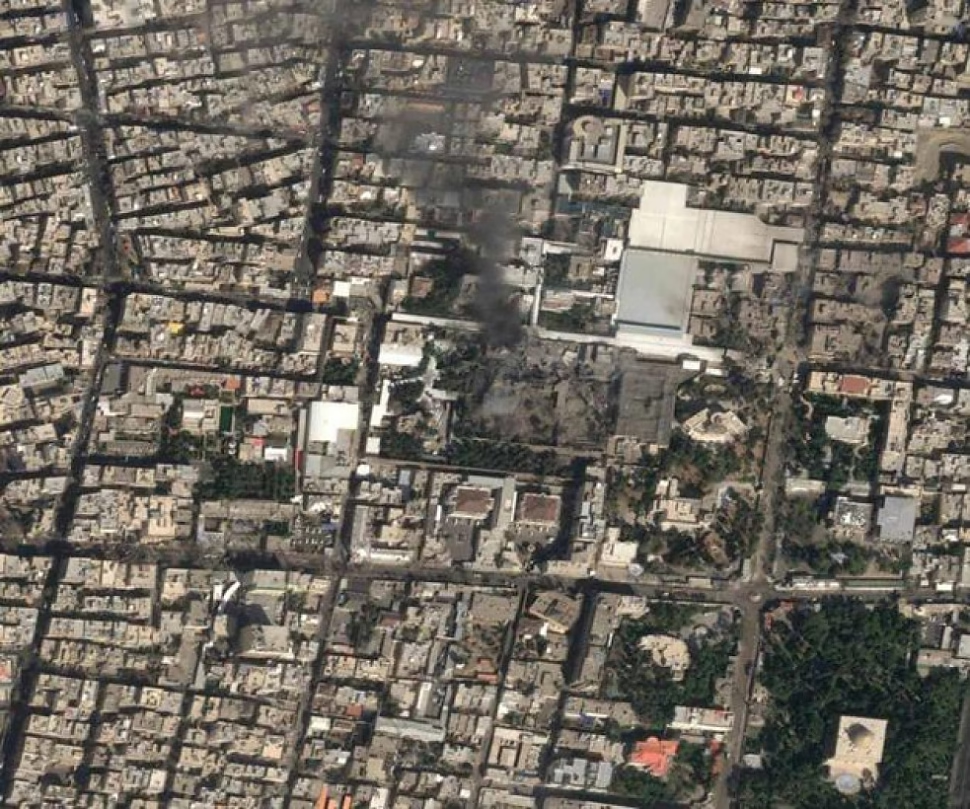
Israeli Prime Minister Benjamin Netanyahu spoke of “growing signs” that Khamenei, 86, had been killed when Israel attacked his compound. Two Israeli officials, speaking on condition of anonymity, later confirmed his death.
Trump urged the Iranian public to “take the reins of their destiny” by rising up against the leadership.
The operation was planned for months and was carried out in the middle of Ramadan. According to an Iranian diplomat to the UN, hundreds of civilians were killed. Iranian state media reported at least 201 deaths and more than 700 injuries.
Iran responded by launching missiles and drones toward Israel and US bases in the region. The US military said there were no casualties and minimal damage, despite “hundreds of attacks.”
The power vacuum and the response
Khamenei had no clear successor. He directed the clerical establishment and the Revolutionary Guard, the two pillars of power. His death creates a huge void.
Among the targets were key military installations and several members of the governing body. Israel said it had killed the commander of the Revolutionary Guard, the defense minister and an adviser close to Khamenei.
Meanwhile, in Tehran, witnesses told the AP that some residents were rejoicing. A brutal contrast with the images coming from the south of the country: at least 85 people died when a girls’ school was hit.
Reactions and dangerous escalation
Democrats in the US denounced that Trump acted without authorization from Congress. Tensions had been rising for weeks.
The trigger appeared to be the recent failed round of nuclear talks. Although Trump declared last year that Iran’s nuclear program was “destroyed,” intelligence showed that Iran had rebuilt capabilities.
Now, the strikes have weakened Iran’s air defenses and its military leadership at an already fragile time. The war unleashed after 7-O has left Iran’s regional allies very shaken.
Immediate and uncertain future consequences
Flights in the Middle East were interrupted. Explosions were heard from Dubai to Qatar. Saudi Arabia said it repelled an Iranian attack on its capital.
Trump acknowledged that there could be American casualties: “that usually happens in war.”
A key fact: a third of the oil transported by sea passes through the Strait of Hormuz. Any threat there shakes global markets.
What is coming is a thick fog. Without Khamenei, without a clear successor, with an economy decimated by sanctions and now under direct attack, the Islamic Republic faces its toughest test since the 1979 revolution. And the entire Middle East is holding its breath.


