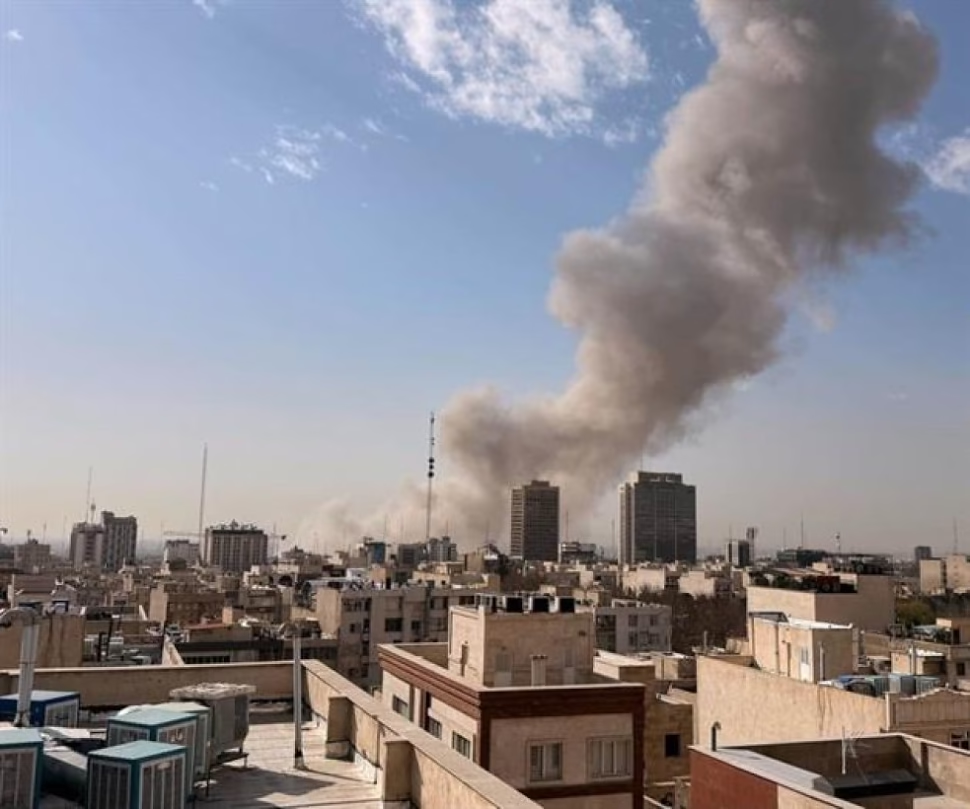
US and Israel launch massive attack against Iran

A coordinated attack by the US and Israel opens a new and dangerous chapter in the Middle East, with immediate retaliation.

A new war front opens in the Gulf

The United States and Israel have opened an astonishing new chapter in war. This Saturday they launched a massive attack against targets throughout Iran, including near the offices of Supreme Leader Ayatollah Ali Khamenei.

From Dubai, where columns of smoke are already visible, the situation is developing at breakneck speed.

“When we’re done, take control of your government. It will be yours. This will probably be your only chance for generations,” Donald Trump said in a video announcing the operations.

Israeli Prime Minister Benjamin Netanyahu echoed the ambitious goal: to create conditions for “the brave Iranian people to take the reins of their destiny.”

RelatedKhamenei’s death in attack opens crisis in the Middle East

The response was immediate

Iran responded as it had threatened for months. First with a wave of missiles and drones against Israel. Then with attacks against US military installations in Bahrain, Kuwait and Qatar.

The state agency IRNA reported the death of 40 students at a girls’ school in the south of the country. At least 45 others were injured in Minab, Hormozgán province.

In a defiant statement, the Iranian Foreign Ministry said it “will not hesitate” in its response. “The time has come to defend the homeland,” they said.

The attack is the second time in eight months that the Trump administration has used military force against the Islamic Republic. It comes weeks after the operation to capture the then president of Venezuela, Nicolás Maduro.

Trump justified the action by alleging that Iran continues to develop its nuclear program and plans missiles capable of reaching US territory.

“They have rejected every opportunity to give up their nuclear ambitions, and we can no longer stand it,” declared the Republican president.

But the reasons seem to go beyond the nuclear program. Trump listed grievances dating back to the 1979 revolution, when Iran went from ally to “fierce enemy.”

The regional board is overheating

Iranian retaliation has set off alarms throughout the region. Bahrain reported a missile attack against the headquarters of the US Fifth Fleet. In Kuwait, explosions were heard near US Army Central Command.

The United Arab Emirates and Iraq closed their airspace immediately. In Jordan, air raid sirens were activated.

Yemen’s Iran-backed Houthi rebels have vowed to resume attacks on shipping in the Red Sea and on Israel.

The economic impact could be enormous if the Strait of Hormuz is endangered. More than 14 million barrels per day of oil pass through this area, around a third of the world’s total transported by sea.

US embassies in Qatar, the United Arab Emirates and Israel told their staff to take cover. They advised all US citizens to “do the same until further notice.”

Meanwhile, Khamenei has not made any public appearances in recent days. During the 12-day war in June, he was believed to have been moved to safety away from Tehran.

Iranian state television reported explosions near its offices, but did not indicate the cause or offer information on casualties.

An official on condition of anonymity confirmed that Israeli targets included the Iranian military, government symbols and intelligence targets.

The international community observes with concern how this coordinated attack redefines the rules of the game in an already turbulent region.
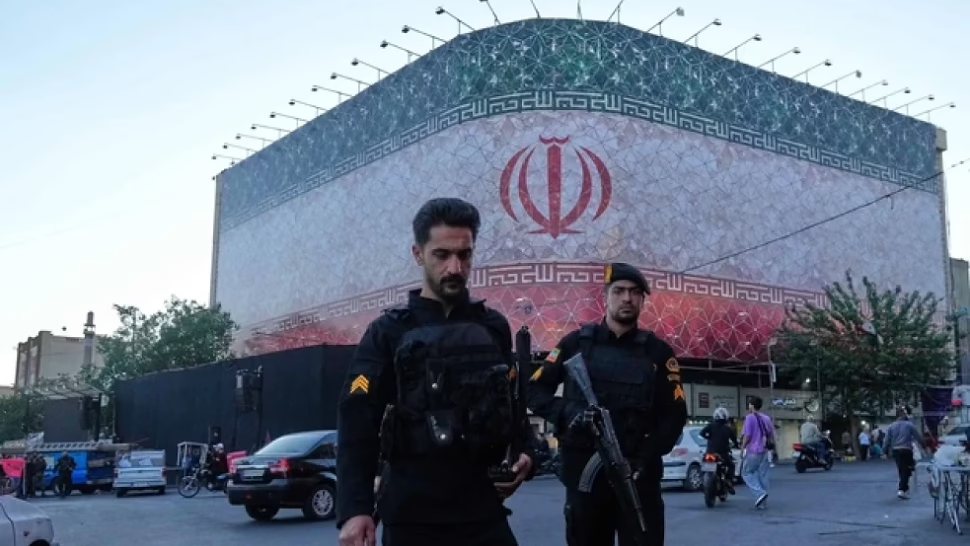
US and Iran reach provisional agreement to reopen Hormuz

The US and Iran agree to reopen the Strait of Hormuz and extend the truce.

The United States and Iran closed a provisional agreement that seeks to end the armed conflict and reopen the Strait of Hormuz, one of the most strategic maritime routes on the planet. The understanding also contemplates extending the fragile ceasefire in force in the region, amid years of military and political tension.

What does the pact contemplate?

The announcement opens the door to a formal signing next Friday in Switzerland, although authorities acknowledge that previous similar attempts have failed. As of Monday, the final content remained in dispute, especially on issues of regional security, nuclear verification and conditions for the lifting of sanctions.

The crisis between both nations has deep roots, from the Iranian nuclear program initiated with international cooperation to the Islamic Revolution of 1979. Since then, relations have been marked by diplomatic ruptures, economic sanctions and indirect clashes in the Middle East. The new agreement could mark a turning point, but doubts remain over its implementation.

Continue reading

Israel criticizes Netanyahu over US-Iran deal

The provisional pact between the US and Iran sparks internal criticism against Netanyahu for possible loss of influence.

Reactions in Israel

Israel is experiencing an intense internal debate after the provisional agreement between the United States and Iran. The pact has generated widespread criticism across the political spectrum, who consider it a strategic setback.

Prime Minister Benjamin Netanyahu has not yet issued an official position. Meanwhile, opposition figures, former officials and analysts react harshly. They point out that the Israeli government overestimated its ability to influence Washington’s strategy during the conflict with Tehran.

Another point of complaint is that the agreement could limit Israel’s freedom of military action, especially on the Lebanon front, where tensions with Hezbollah persist. Government sectors warn that resuming attacks could complicate the relationship with the United States.

International analysts point out that the pact alters the power dynamics in the Middle East. Israel would come under greater strategic pressure. Furthermore, the eventual partial lifting of sanctions on Iran would strengthen its economic and military capacity in the medium term.

Continue reading

Russian attack leaves 11 dead and damages cathedral in Ukraine

The massive bombing of kyiv and Kharkiv affected an 11th century temple.

A cathedral located in one of the oldest religious complexes in Eastern Orthodox Christianity was burned during a wide-ranging Russian attack on Ukraine. The Ukrainian government reported at least 11 people dead and dozens injured.

Details of the bombing

The attack occurred early Monday morning. Russia launched hundreds of drones and dozens of missiles against major Ukrainian cities, including kyiv and Kharkiv. Local authorities reported damage to residential buildings, markets and civil infrastructure.

Emergency teams work to rescue survivors from the rubble. President Volodymyr Zelenskyy condemned the bombing, calling it a new aggression against the civilian population and the country’s cultural heritage.

Continue reading