Houthis impose maritime embargo on Saudi Arabia in regional escalation

The Houthis announce a naval blockade against Saudi Arabia, threatening a key global trade route.

Yemen’s Houthi insurgents announced a maritime embargo against Saudi Arabia on Monday in retaliation for the kingdom’s blockade of Yemen and a recent attack on Sana’a international airport. The move threatens one of the most vital waterways for global transportation and reignites fears of renewed conflict.

The reasons behind the announcement

Yahya Saree, a Houthi military spokesman, said in a video that the naval blockade takes effect immediately, in what he described as a “tit-for-tat equation.” Nasruddin Amer, deputy director of the Houthi media office, said on social network

RelatedHouthis raid UN offices in Yemen and detain employees

Bab al-Mandeb, at the southern tip of the Arabian Peninsula, is the gateway to the Red Sea. 12% of world trade and a quarter of global container trade transit to and from the Suez Canal.

The Saudi response and the impact on oil

The Saudi army assured that it will keep the waterway open. Military spokesman Turki al-Malki stated: “All Houthi threats against transiting vessels will be addressed firmly and expeditiously, as these types of threats are a flagrant violation of international law and fall into the category of acts of maritime piracy.”

Saudi Arabia was already facing pressure by using its East-West pipeline to the Red Sea as an alternative to the Strait of Hormuz, controlled by Iran since the February 28 attack. Rystad Energy estimates that about 2.5 million barrels of oil a day could be at risk.

The Houthis demonstrated their ability to disrupt shipping by attacking more than 100 vessels during the war between Israel and Hamas. It remains unclear whether they will resume that level of attacks against Saudi Arabia.

The truce reached in 2022 has been threatened after the Saudi attack on Sana’a airport, according to the Houthis, and the subsequent launch of missiles and drones against Abha airport. By allowing an international flight without Saudi approval, the Houthis seek to impose their control over Yemeni airspace.

Saree insisted: “We reaffirm the right of our great people to respond to the blockade with a blockade,” and warned that they are prepared for a “comprehensive and decisive escalation” against the “reckless Saudi enemy.”

Disrupting transit through Bab al-Mandeb would force shipping companies to go around the Cape of Good Hope, increasing costs significantly. The United States government has indicated that this route would add about 4,345 kilometers to the trip from Saudi Arabia.

Houthis attack Saudi oil tankers and crude oil exceeds $100

Houthi attacks on Saudi ships raise crude oil prices to $100 and strain the trade route.

Yemen’s Iran-backed Houthis attacked two Saudi oil tankers in the Red Sea. Brent surpassed $100 a barrel, its highest level since May. The conflict threatens to close a second key trade route, following Iran’s blockade of the Strait of Hormuz.

Military and economic escalation

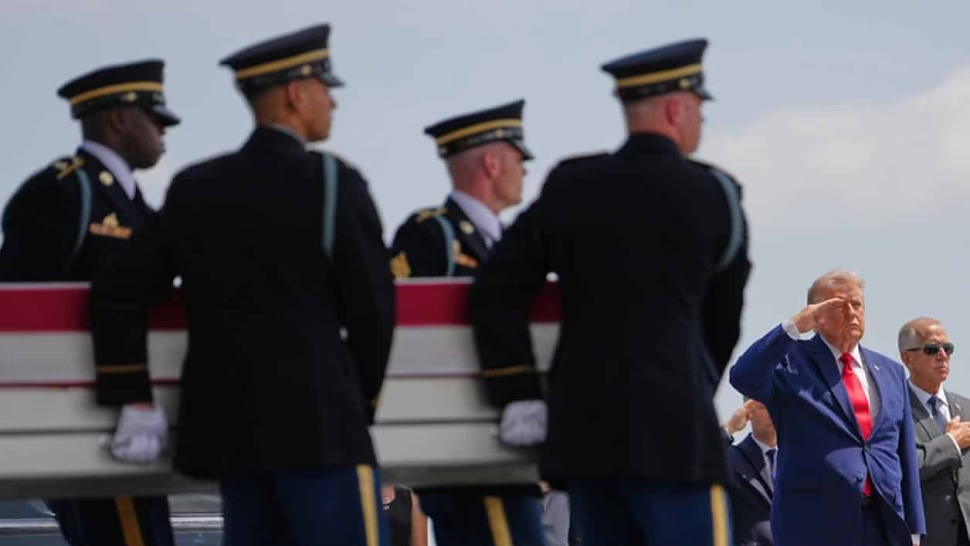
The United States intensified its attacks against Iran for the twelfth consecutive night. President Donald Trump warned of “significant military punishment” if the Houthis persist. “If they do this again, the United States will hold Iran responsible,” he wrote on social media.

The price of Brent crude oil rose more than 6% on Thursday. Last week, the Houthis announced a blockade of Saudi-linked shipping through the Bab el-Mandeb Strait. 12% of world trade and a quarter of container traffic pass through this passage.

The rebels claimed to have hit the Encelia and Layla oil tankers, setting fires. No victims were reported. Lloyd’s List Intelligence said the attacks represent a “double blow” for Saudi oil shipments, which have already diverted millions of barrels via onshore pipeline.

UN Secretary General António Guterres warned that the region is being dragged into an increasingly widening circle of confrontation. “Diplomacy is the only way forward,” he told the Security Council.

Regional reactions

Iraqi Prime Minister Ali al-Zaidi traveled to Tehran to sue for peace and vowed not to allow his territory to be used against Iran. An Arab diplomat, on condition of anonymity, noted that the Gulf states are pessimistic about an exit.

Iran maintains its “tit for tat” policy in the face of US attacks. Secretary of State Marco Rubio responded that Trump’s policy is “head for an eye.” Meanwhile, the Iranian Ministry of Health reported 55 deaths and 629 injuries since US bombing resumed on June 27.

Jordan intercepted three missiles and six drones. Kuwait reported a drone attack on its border with Iraq, without casualties. The war remains unpopular among Americans, reflected in a symbolic vote in the House of Representatives to stop it.

Continue reading

Ecuador agrees with Colombia and Peru to reinforce military and energy

Noboa reaches preliminary agreements on border security and provision of electricity and gas.

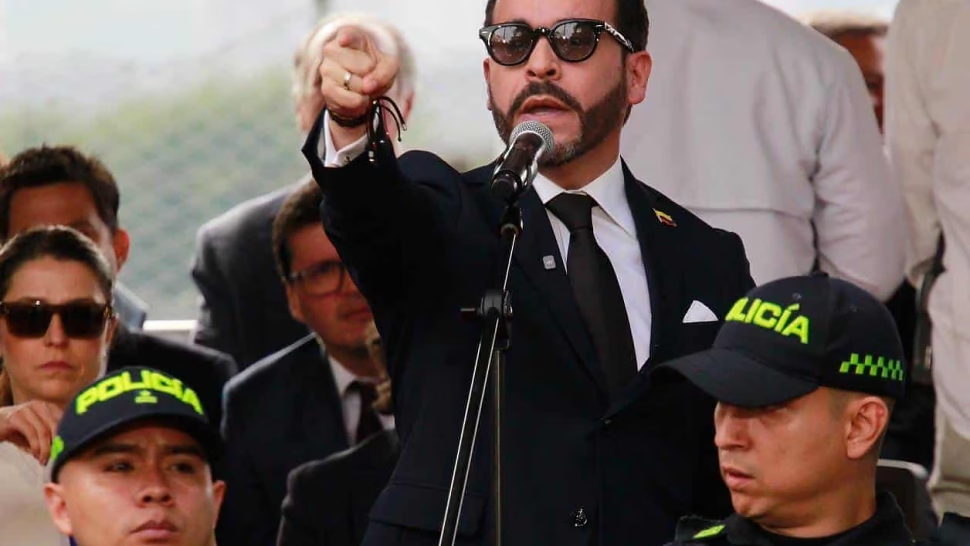
The president of Ecuador, Daniel Noboa, revealed that he held conversations with the elected leaders of Colombia and Peru, Abelardo de la Espriella and Keiko Fujimori. From these dialogues, preliminary agreements emerged on two fronts: border security and energy supply.

In terms of security, Noboa raised the need for a greater military presence of the armed forces of both countries on their respective borders with Ecuador. “Their presence at the border is going to be crucial,” he said in a radio interview. The border area is the focus of activities of drug trafficking groups linked to international cartels. According to the UN, 80% of the narcotics that enter Ecuador come from Colombia and the rest from Peru. The president had previously pressed a tariff war against Colombia, without receiving a response, and recently suspended it following a resolution from the Andean Community.

Regarding energy, Colombia will resume the sale of electricity to Ecuador. Noboa indicated that they will be able to receive up to 380 additional megawatts with a binational rate of about 30 cents per kilowatt/hour. The sale had been suspended by President Gustavo Petro in response to tariffs imposed by Ecuador. Now, with the agreement, the flow resumes. Ecuador faces a dry season that reduces hydroelectric generation – which provides 75% of electricity – and registers a deficit of at least 800 megawatts. At the end of 2024, Ecuadorians suffered blackouts of up to 14 hours a day due to the worst drought in six decades.

With Peru, the agreement consists of the provision of gas to generate electricity more cheaply in Ecuador. “That way we truly work together,” Noboa concluded.

The agreements reflect the political affinity between Noboa, De la Espriella and Fujimori, with a conservative profile, and seek to address two simultaneous crises: insecurity linked to drug trafficking and the energy emergency.

Continue reading

Oil exceeds $100 after Houthi attack on Saudi oil tankers

Houthi attack on two Saudi vessels sends Brent crude oil soaring to $100 and threatens key routes.

Yemen’s Iranian-backed Houthi rebels claimed to have attacked two Saudi oil tankers in the Red Sea. The event raises tension with Iran in the midst of international crude oil that has already exceeded $100 per barrel.

Economic impact on global markets

The price of Brent, an international reference, jumped more than 6% on Thursday to reach around $100. It is its highest level since May, when a preliminary peace agreement was still in force that has collapsed today. The world economy now faces the risk of a new closure of the trade route: the Houthis threaten the Red Sea, while Iran keeps the Strait of Hormuz blocked, through which a fifth of the oil and gas traded in the world normally passed.

Threats from Washington and diplomatic efforts

The United States completed its twelfth night of attacks on Iranian territory. President Donald Trump warned on social media:

“If they do this again, the United States will hold Iran responsible… significant military punishment will be inflicted on Iran and, of course, on the Houthis themselves.”

In parallel, Iraqi Prime Minister Ali al-Zaidi traveled to Tehran to ask for peace and dialogue. His office said he promised not to allow Iraqi soil to be used against Iran. Al-Zaidi had met with Trump in Washington earlier this month.

An Arab diplomat, speaking on condition of anonymity due to the sensitivity of the issue, indicated that the Gulf countries are growing in pessimism. He added that nations like Pakistan and Türkiye continue to push for a de-escalation.

Continue reading