Analysis of the Confrontation Scenario in Yemen
A new episode of military escalation was recorded on Sunday in Sanaa, the capital of Yemen, as a direct consequence of a cycle of attacks and reprisals between the Israel Defense Forces and the insurgent movement Ansar Allah, commonly known as Houthi. The triggering event was the previous launch of a cluster projectile by the rebels into Israeli territory, an event that the Israeli security apparatus categorized as the first incursion of its kind since the start of hostilities.
The Israeli airstrike, carried out by a formation of more than ten combat aircraft, was directed against previously identified strategic objectives. According to official statements from the Israeli army, the selected facilities were the Asar and Hizaz power plants, described as critical infrastructure for Houthi military-logistical support, and a complex adjacent to the presidential palace that houses military facilities. The precision of the operation sought to neutralize operational capabilities with a calculated collateral impact.
Immediate Impact and Humanitarian Repercussions
The Houthi-run Ministry of Health reported a preliminary toll of at least two deaths and thirty-five injuries as a result of the incursion. Testimonies from local residents collected by international agencies described high intensity explosions and columns of smoke visible from central points of the city, such as Sabeen Plaza. Citizens like Hussein Mohamed and Ahmed al-Mekhlafy recounted the immediate effects: deafening roars, shock waves that broke windows and a palpable shaking of the structures, evidencing the power of the weapons used.
Al-Masirah television station, supportive of the rebel cause, reported significant damage to an oil company facility, with audiovisual material broadcast on social networks showing an intense fireball. This point is critical, since the attacks on energy and logistics infrastructure are part of a broader strategy aimed at degrading the group’s financing and sustainability capacity.
Strategic Context and Evolution of the Conflict
This incident is not an isolated event, but one more chapter in a prolonged conflict that spans more than twenty-two months. The Houthis, who control vast areas of Yemen including the capital Sanaa, have consistently justified their offensive actions as an act of solidarity with the Palestinian people in the Gaza Strip. Its arsenal of ballistic missiles, drones and, more recently, cluster munitions, is largely supplied by the Islamic Republic of Iran, its main regional sponsor.
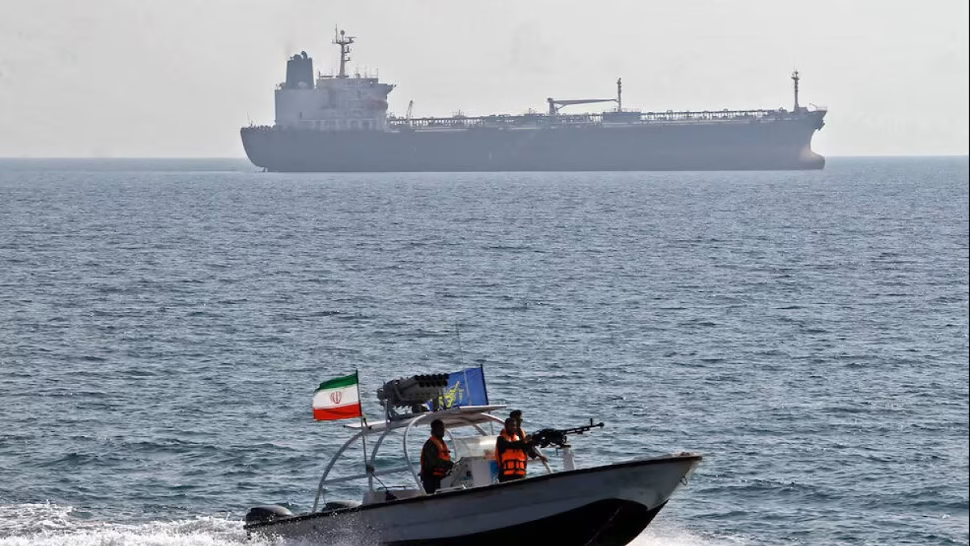
The maritime dimension of the conflict is equally crucial. Houthi attacks on commercial shipping in the Red Sea and Gulf of Aden have dramatically altered global trade routes, affecting the transit of goods valued at trillions of dollars annually. Since November 2023, attacks have been recorded against more than a hundred commercial and naval vessels, a tactic that seeks to exert international economic pressure.
The Introduction of New War Technology
A tactical development of considerable relevance, confirmed by an anonymous Israeli Air Force officer, is the Houthi deployment of a new cluster munition. This device, launched towards Israel the Friday before the bombings, is designed to fragment in the air and disperse multiple explosive submunitions. This technology represents a significant evolution in the threat, greatly complicating interceptions by Israeli air defense systems such as the Iron Dome. Its existence suggests a continuous flow of technological sophistication from Iran to its regional allies.
The Israeli response, therefore, must be analyzed not only as a retaliation for a singular attack, but as a measure within a proactive security doctrine aimed at preventing the consolidation of this new offensive capability. Israeli Defense Minister Israel Katz has reiterated the policy of imposing an effective air and naval blockade, although without disclosing specific operational details.
Geopolitical and Prospective Implications
The dynamics of the conflict are intrinsically linked to the ups and downs of the negotiations and the ceasefires in Gaza. Historically, the Houthis have suspended their operations during periods of truce, only to restart them with greater intensity. The brief 2024 ceasefire was followed by a US airstrike campaign ordered during the Trump administration, demonstrating the internationalization of the Yemeni conflict.
An agreement announced in May between the United States and the Houthis sought to cease air strikes in exchange for stopping the maritime offensive. However, the rebel faction interpreted the terms restrictively, excluding from the truce any entity that, in its opinion, maintained commercial or logistical ties with Israel. The “new phase of operations” announced last month, which threatens any merchant vessel that negotiates with Israeli ports, regardless of its flag, confirms its intransigent stance and its role as a persistent actor on the regional geopolitical chessboard.
The destruction of the Sana’a airport in a previous daytime attack, which disabled the terminal and damaged civilian aircraft, underlines the Israeli willingness to raise the military cost for the Houthi leadership. Each escalation cements a dangerous precedent of normalizing violence and lowers the threshold for future confrontations, with Yemeni civilians caught in the crossfire.
This analysis concludes that the recent exchange of attacks is not an end point, but an indicator of a trend towards a more technological, more internationalized confrontation with greater risks for regional stability and the security of global maritime transport. The international community observes with concern how this local conflict is increasingly intertwined with broader tensions in the Middle East.
Do you consider it crucial to understand the complexities of regional conflicts? Share this analysis to encourage informed discussion and explore more content on geopolitics in our specialized section.