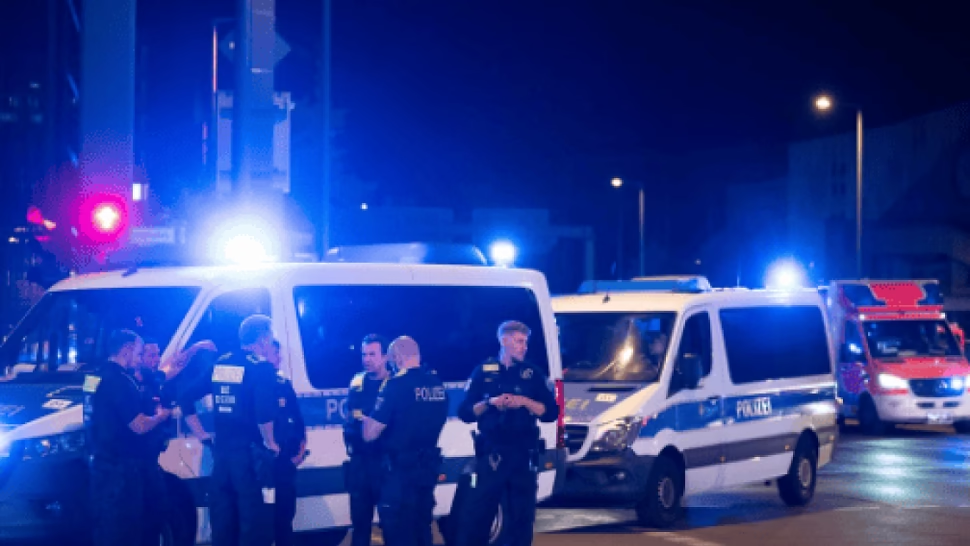
A festive long weekend mitigates immigration tension in the United Kingdom
The last major holiday weekend of the British summer, which runs until Monday, has acted as a mitigating factor in social conflict. This holiday period has significantly reduced the intensity of what was anticipated as a new wave of street violence and protests in the United Kingdom. The scenario evoked the serious unrest that broke out more than a year ago after the tragic murder of three girls in the town of Southport, an event that catalyzed the anger of extremist groups.
Failed calls and judicial response
Throughout Friday and Saturday, demonstrations and counter-demonstrations had been called in the vicinity of at least thirty of the more than two hundred hotel establishments that house asylum seekers in the country. However, the mobilization turned out to be notably lower than expected. The trigger for these calls was an interim order issued by a judge of the High Court of England. Said judicial resolution, issued last Tuesday, required the eviction before September 12 of the 138 migrants in an irregular situation housed in The Bell, a hotel located in Epping. This judicial decision has been interpreted by far-right groups as a victorious precedent, prompting them to try to replicate this legal result in other locations in the coming days.
The citizen response to these calls was, in general terms, weak. Only dozens of people, which in a few cities amounted to a few hundred, went to the protest points. There, they encountered not only the deterrent presence of the security forces, but also organized anti-racist groups that exerted a counterbalancing effect to the rhetoric and presence of the extreme right. This scenario of low participation and organized civil opposition prevented the protests from leading to the episodes of violence that were feared.
The inflammatory role of Nigel Farage and Reform UK
From the political formation Reform UK, its leader, Nigel Farage, has played a crucial role in openly encouraging citizen mobilization in front of accommodation that welcomes migrants. Farage, a populist figure whose political career was cemented during the Brexit campaign, uses inflammatory speech that polarizes British society. His public promises include, in the hypothetical case of coming to power—a possibility that polls are beginning to glimpse—the execution of mass deportations of all irregular migrants and asylum seekers who are in British territory. This radical position represents a turning point in the country’s immigration debate and exerts a direct influence on the climate of public opinion and the action of the most extreme groups.
The analysis of the current situation indicates that, although the underlying tension persists, circumstantial factors such as the festive period and the coordinated response of civil society and the authorities have managed to contain a further escalation. However, the judicial framework established by the recent eviction order sets a potentially dangerous precedent that anti-immigration pressure groups will seek to exploit. The future outlook will depend largely on the evolution of political rhetoric, the real mobilization capacity of these groups and the effectiveness of social and institutional containment strategies.
Was this content enlightening to you? Share this analysis on your social networks to contribute to an informed conversation and discover more research on European political trends in our related content section.