
PAN accuses political persecution against Ernesto Ruffo Appel

The PAN leader denounces political use of justice against the former governor of Baja California.

Accusations of political persecution

The national president of the PAN, Jorge Romero Herrera, assured that Ernesto Ruffo Appel is a victim of political persecution by the federal government. In a statement, the PAN leader pointed out that the admission of the former governor of Baja California to a maximum security prison responds to a political use of justice institutions.

Romero Herrera stated that there is not enough evidence to support the accusations against Ruffo Appel for an alleged tax evasion network. The PAN member maintained that the government has chosen to persecute opponents while ignoring accusations against Morena figures.

RelatedErnesto Ruffo Appel presents new protection against the FGR

Comparison with Morena cases

The PAN leader mentioned Morenoist politicians such as Rubén Rocha Moya, Enrique Inzunza, Américo Villarreal and Marina del Pilar Ávila. He said that they have faced questions about possible links to organized crime without the authorities acting as quickly.

Romero Herrera insisted that the law must be applied without distinctions. He stressed that anyone who commits a crime must respond to justice, but demanded that the criminal system not be used as a tool of political persecution.

Afore withdrawals and unpaid loans put millions at risk

Moreira and experts warn about the impact of early withdrawals and unpaid loans.

Risk for workers’ assets

Rubén Moreira, coordinator of the PRI in the Chamber of Deputies, warned that the increase in the overdue portfolio of mortgage and consumer loans, along with the increase in withdrawals from Afores due to unemployment, puts the assets and future pensions of millions of Mexicans at risk.

During the program “With Pears, Apples and Oranges”, Moreira pointed out:

The lack of employment has forced many families to stop paying their bank loans and resort to their retirement savings to cover basic needs such as food and medicine.

The legislator criticized the fact that there is not enough information about the consequences of withdrawing resources from the Afores, since this reduces accumulated savings for retirement.

He also warned about the growth of loans granted by fintech and digital banks, some of which can handle high financial costs and represent risks for users.

Mario Di Costanzo, specialist, reported that between January and June of this year more than one million workers made partial withdrawals of their Afores due to unemployment. He added that Infonavit’s overdue portfolio reached 410 billion pesos during the first quarter of 2026, while mortgage and consumer loans in arrears exceeded 110 billion pesos.

Miguel Ángel Sulub, for his part, explained that early withdrawals from Afores not only affect the amount available for retirement, but also the weeks of contributions necessary to obtain a pension.

Continue reading

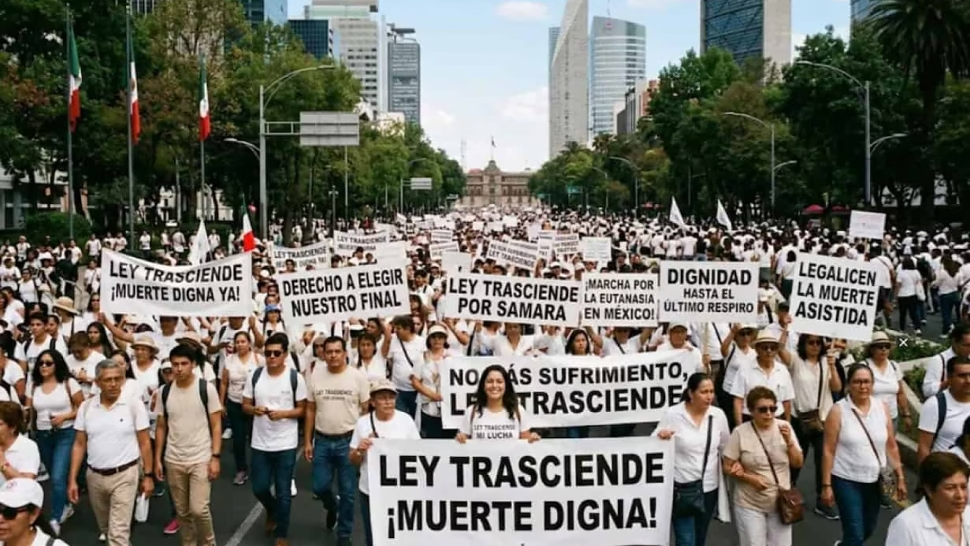
National march for dignified death in Mexico on August 28

Patient with kidney failure leads mobilization to modify the law.

The debate about the end of life regains strength in Mexico. A national march will demand legal changes to allow medically assisted dying in cases of terminal illnesses or irreversible conditions that seriously affect quality of life.

The fight of Samara Martínez

Samara Alejandra Martínez Montaño, a patient with end-stage chronic renal failure and systemic lupus erythematosus, heads the call. He has faced years of treatments: two failed kidney transplants, surgeries, hemodialysis, peritoneal dialysis, chemotherapies and constant use of steroids. His citizen petition, part of the Ley Trasciende project, has gathered more than 170 thousand signatures of support.

Transcend Law and mobilization

The march will take place on August 28 at 9:00 a.m., from the Palace of Fine Arts to the National Palace. It is aimed at patients with chronic diseases, family members, caregivers, academics and anyone who supports the right to decide about the end of life.

Martínez Montaño seeks to make his situation visible and generate legislative change. Its goal is that other patients in similar conditions have the option of a dignified death. The mobilization represents an opportunity for society to support the Transcende Law.

Continue reading

Mexico celebrates grandparents on three different dates

Did you know that in Mexico there is more than one date to celebrate grandparents? We explain the origins of each one.

Dates to honor grandparents

In Mexico there is more than one date to recognize grandparents, which raises doubts among families about which is the correct day. While Sunday, July 26, International Grandparents’ Day is commemorated in several countries, in Mexican territory the date with the greatest roots continues to be August 28.

The difference between both celebrations responds to the origin of each one. July 26 is related to the Christian tradition that remembers Saint Joachim and Saint Anne, parents of the Virgin Mary and considered, according to Catholic tradition, the grandparents of Jesus. The date was promoted in 1998 by the Messengers of Peace organization to recognize the importance of older adults.

In Mexico, Grandfather’s Day is traditionally celebrated on August 28. This date was established in 1983 and was promoted by public institutions and social assistance organizations. Its objective is to highlight the contribution of older people, promote respect and raise awareness about the need to guarantee them a dignified life.

Added to these dates is October 1, declared by the UN as the International Day of Older Persons. This commemoration seeks to make visible the rights of older adults and reflect on the social, economic and health challenges faced by a population that continues to grow worldwide.

Continue reading