Analysis of the Political and Social Crisis in Nepal
Nepal’s political landscape experienced a critical turning point on Tuesday with the resignation of Prime Minister Khadga Prasad Oli. This event, far from constituting a resolution, acted as a catalyst that intensified the massive demonstrations shaking the country. The resignation occurs in a context of profound instability, characterized by violent protests initially triggered by a brief government blockade of several social media platforms, but which quickly evolved into a widespread rejection of the political class, accused of systemic corruption and nepotism.
The digital censorship measure, justified by the executive on the grounds that technology companies had not registered or submitted to state supervision, was perceived by citizens, particularly young people, as a flagrant attempt to silence dissent and restrict fundamental freedoms. This act was the spark that ignited the prairie of discontent accumulated for years, transforming the unrest into an unprecedented mobilization.
Expansion of Protests and State Response
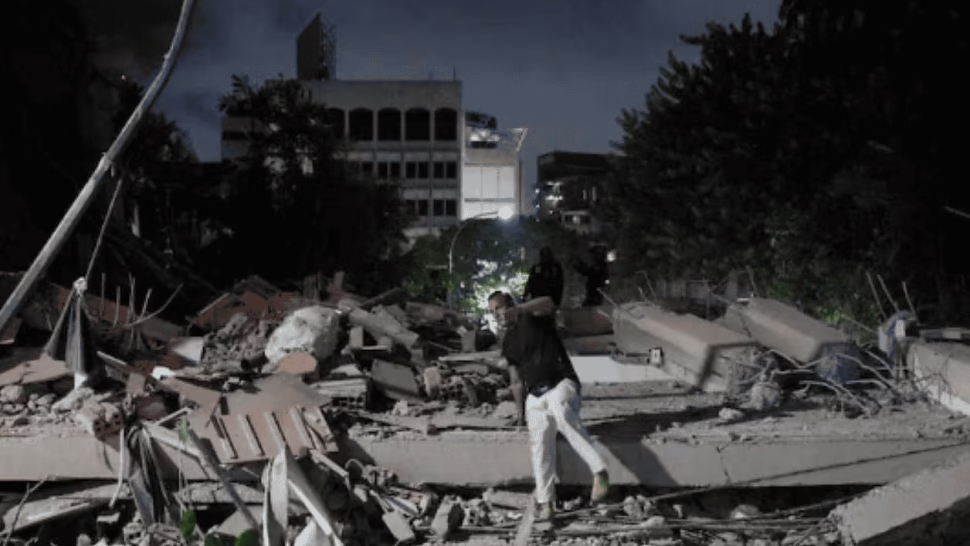
Despite the lifting of the digital blockade and Oli’s subsequent resignation, citizen fury did not subside. Tens of thousands of protesters remained on the streets of Kathmandu and other cities, creating scenes of extreme tension. The protest actions escalated to include the blocking of communication routes, the assault on emblematic government buildings and the burning of private residences of high dignitaries, including those of Oli himself, President Ram Chandra Poudel, the Minister of the Interior and the leaders of the Nepali Congress party.
The most serious episode occurred the day before the resignation, when security forces opened fire on a crowd of protesters, resulting in the death of 19 people and dozens of injuries. This disproportionate use of force by the Nepalese police fueled widespread indignation, transforming protests against censorship into a demand for justice and accountability against a state apparatus perceived as repressive and at the service of an elite disconnected from social reality.
The institutional response was immediate but insufficient. President Poudel, whose position is predominantly ceremonial, publicly called for dialogue to find a peaceful resolution. At the same time, the army chief, Ashok Raj Sigdel, urged in a video message to end the protests to avoid further losses. However, a subsequent statement from the army warned that security forces were committed to preserving public order, leaving open the possibility of military intervention if the situation completely escalated.
The Roots of Discontent: Nepotism and the Economic Crisis
To understand the magnitude of the crisis, it is imperative to analyze the underlying factors that fuel social frustration. The protests, calling themselves the Generation Z movement, transcend the incident of internet censorship. The core of the conflict lies in the deep economic inequality and the perception of a corrupt and clientelistic political system.
A central element of the criticism is the phenomenon of the so-called “Sons of Nepotism”, a colloquial term that refers to the descendants of the political elite who, according to protesters, enjoy opulent lifestyles and unfair privileges. This reality contrasts brutally with the perspectives of the majority of Nepalese youth. According to World Bank data, the youth unemployment rate reached 20% last year. The government estimates that, as a result, more than 2,000 young people leave the country every day in search of job opportunities in the Middle East or Southeast Asia.
This brain drain and young workforce weakens the national economy and creates a vicious cycle of stagnation and hopelessness. Student Bishnu Thapa Chetri’s statement sums up the general sentiment: “The country has deteriorated so much that, for us young people, there is no reason to stay.” Endemic corruption and lack of social mobility are seen as the main obstacles to development and prosperity.
The Attempt to Regulate Social Networks and the Uncertain Future
The blocking of platforms such as Facebook, X and YouTube was not an isolated event, but part of a broader legislative initiative. The government was seeking to push through a bill that would force tech companies to establish a local liaison office within the country, arguing the need for platforms to be “properly managed, responsible and accountable.”
However, human rights groups and freedom of expression have strongly condemned this initiative, calling it an instrument of censorship designed to silence online criticism and punish political opponents. The law would apply to about two dozen widely used digital services in the country. While giants like Meta (owner of Facebook and Instagram) and Google (owner of YouTube) did not respond to requests for comment, platforms like TikTok and Viber have already registered and continued operating normally, raising questions about fairness and the real motives behind the regulation.
The immediate future of Nepal appears extremely uncertain. Oli’s resignation and appointment to lead an interim government lacks clarity regarding the real power he will wield and his ability to stabilize the nation. The violence, far from subsiding, appears to have intensified, with columns of smoke rising from burned government buildings. The citizen demand is clear: they demand justice for the deceased, an end to the impunity of the political elite and the construction of a system that offers a real future for its youth. The international community is carefully watching how this crisis develops in a country of geostrategic importance, nestled between two giants: China and India.
Do you think that the regulation of social networks can be used as a censorship tool? Share this analysis to expand the conversation about freedom of expression and the governance crisis in the world. Explore more content on international politics and social movements in our global analysis section.