Israel’s growing international isolation before the UN

The Israeli prime minister's speech to the UN comes against a backdrop of growing diplomatic pressure and fractured Western support.

A panorama of growing diplomatic pressure

The speech of the Israeli Prime Minister, Benjamin Netanyahu, before the United Nations General Assembly, takes place in a geopolitical scenario marked by an unprecedented international isolation for the Jewish State. The international community, including traditional allies, observes with growing concern the evolution of the conflict in the Gaza Strip, which has generated a tangible diplomatic distance. This phenomenon is not limited to rhetoric, but is manifested in concrete actions that signal a paradigm shift in Israel’s foreign relations.

The analysis of the current situation must consider the immediate antecedents: the military offensive initiated after the attacks of October 7, 2023. The Israeli response, in terms of intensity and duration, has acted as a catalyst for a reconfiguration of alliances and positions that for decades seemed immovable. The perception of Israel as a pariah state, although not yet fully assumed by the Netanyahu government, is gaining ground in multilateral forums and in global public opinion, creating a hostile environment for Israeli diplomacy.

RelatedIsraeli offensive in Gaza leaves 59 dead and collapses health system

The concrete manifestations of global distancing

The evidence of growing diplomatic isolation is multifaceted and extends beyond traditionally critical Arab and Muslim circles. A significant indicator was the joint statement by 28 Western-aligned countries, which after the Hamas attack had expressed solidarity with Israel, subsequently urging the cessation of military operations in Gaza. This call reflects a fracture in the Western consensus, particularly relevant coming from nations with which Israel maintains strong diplomatic relations.

A turning point is the recognition of the State of Palestine by ten nations, including the United Kingdom, France, Canada and Australia, during the last week. This measure, interpreted by the governments involved as an effort to reactivate the stalled peace process, represents a direct challenge to the historical position of Israel and the United States, which oppose unilateral recognition. At the same time, the European Union is evaluating the imposition of trade tariffs and other economic sanctions, a pressure tool that until recently was unthinkable in the context of EU-Israel relations.

The legal field provides another critical dimension to isolation. The International Court of Justice (ICJ), the highest UN court, is evaluating accusations of genocide brought by South Africa, while the International Criminal Court (ICC) has issued arrest warrants related to alleged crimes against humanity. The seriousness of these processes became tangible even in the preparations for Netanyahu’s trip to New York, where it was reported that his plane took an alternative route to avoid European airspace where he could face the risk of arrest, as confirmed by an Israeli official on condition of anonymity.

The evolution of American support and public opinion

The analysis of the case of the United States, a fundamental and unconditional ally of Israel, reveals complex dynamics. While President Donald Trump’s administration has maintained strong support—protecting Israel from UN resolutions, providing military assistance, and sanctioning ICC prosecutors—public opinion data indicates a significant shift in the social base. Polls from the Associated Press-NORC Center for Public Affairs Research show that about half of Americans believe the Israeli military response has “gone too far,” up from 40% in November 2023.

Deeper research from the University of Maryland reveals an even more pronounced generational and partisan divide. Nearly half of Democratic voters are more sympathetic to the Palestinians, compared to just 6% who are more sympathetic to Israel. Among Republicans, the generational gap is notable: while 52% of those over 35 justify Israel’s actions as legitimate defense, only 22% of young people between 18 and 34 share this vision. Shibley Telhami, a professor who authored the study, called this phenomenon a “paradigmatic shift” comparable to the rejection after the Vietnam and Iraq wars, and coined the term “Gaza generation” to describe those who perceive Israel as the source of the problem.

The Israeli position and the allies’ warnings

In the face of this growing pressure, the Israeli government’s reaction has been firm. Netanyahu defends the offensive as a legitimate war of self-defense and attributes the criticism to anti-Semitism and Hamas propaganda. In a recent speech, he even suggested that Israel could become a self-sufficient and militarized “super Sparta“, a statement he later qualified after observing a negative impact on the Tel Aviv stock market. In addition, the government has moved forward with a settlement project in the West Bank that could divide Palestinian territory, and hinted at possible annexations in response to recognition of a Palestinian state.

This position, however, generates increasingly explicit warnings from the allies. French President Emmanuel Macron recently declared that the Israeli government, “especially some ministers,” is destroying the possibility of a two-state solution, warning that it is reaching the “last moment” before such a solution becomes “totally impossible.” Western frustration centers on the risk that, by continuing to rule millions of Palestinians without full rights, Israel will face a future choice between an apartheid-like system or a binational state where Jews may not be the majority.

The conclusion of the analysis indicates that Israel’s isolation is a multi-causal process, driven by military, humanitarian, diplomatic and public perception factors. The interconnection of these elements creates a feedback loop where Israeli actions generate international criticism, which in turn is interpreted by the government as unfair hostility, leading to greater intransigence. This scenario poses an existential challenge for Israeli foreign policy and for the long-term stability of the region, with profound implications that will likely define the geopolitical landscape of the Middle East for decades to come.

Did you find this analysis of Israel’s complex international relations insightful?Share this article on your social networks to contribute to an informed conversation and explore more content related to geopolitics and diplomacy on our website.
UNESCO declares World Heritage sites in the West Bank and Lebanon

UNESCO inscribes archaeological sites in the West Bank and Lebanon despite Israeli objections.

UNESCO includes archaeological sites in the West Bank and Lebanon despite Israeli objections

A United Nations committee inscribed an archaeological site in the West Bank and a group of castles in southern Lebanon on the World Heritage List. The decision was made at a UNESCO meeting in South Korea, days after Israel urged the rejection of the nominations, calling them an attempt to “instrumentalize cultural heritage.”

Sebastia, a hill town 10 km northwest of Nablus (occupied West Bank), is identified as ancient Samaria, capital of the biblical Kingdom of Israel. Its remains range from the Iron Age to the Islamic period. The Palestinian bid, submitted in 2012, argued that World Heritage status would help preserve the site, which remains undeveloped under Israeli control.

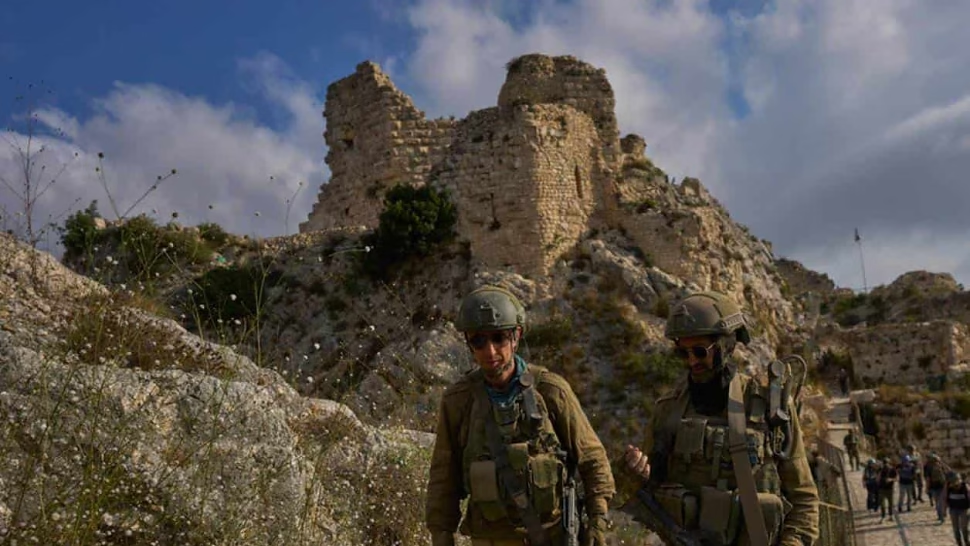
The five castles of Mount Amel, also included, combine influences from Crusaders, Ayyubids and Mamluks. Among them is Beaufort Castle (Al-Shaqif), taken by Israeli forces in May during their deepest incursion into Lebanon in more than 25 years.

Adel Naim Daoud Atieh of the Palestinian delegation said: “who have protected this extraordinary site for generations, despite occupation, restrictions and repeated attempts to separate it from their own heritage.” An Israeli delegate called the decision a “disgrace” and accused it of politicization. Israel withdrew from UNESCO in 2019.

The Israeli Foreign Ministry accused the Palestinian delegation of a “hostile and unilateral campaign” and claimed that Hezbollah has turned Beaufort Castle into a military stronghold. UNESCO responded that all nominations are evaluated under the same criteria and that it does not take a position on political disputes. A Lebanese delegate noted that the castles have been used “only for cultural and tourist purposes” since the Israeli withdrawal in 2000.

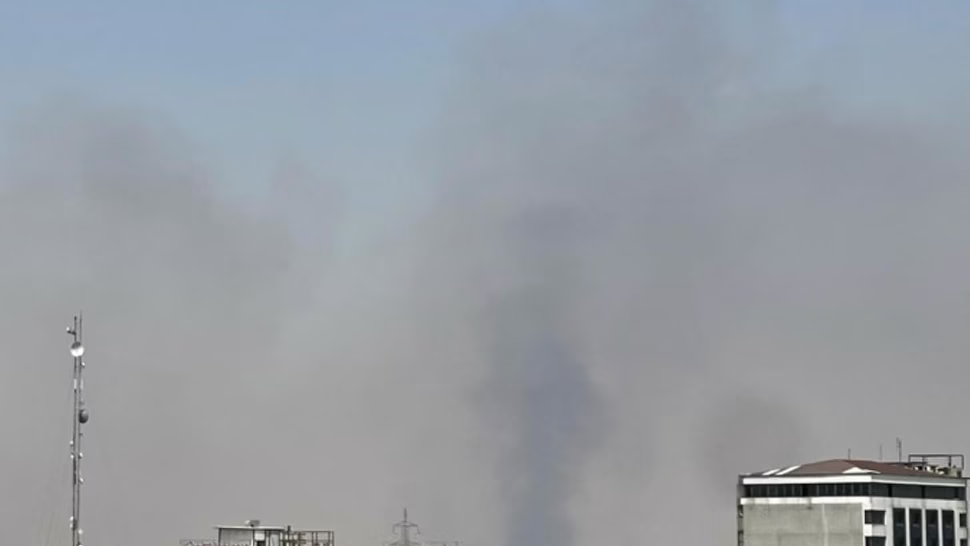
Additionally, the committee included Tyre, an ancient Phoenician city in southern Lebanon, on the List of World Heritage in Danger, following intense Israeli airstrikes during the war against Hezbollah before the June ceasefire.

Continue reading

The United States and Iran escalate hostilities without diplomatic truce

Washington disables a second ship in the Gulf of Oman while Tehran attacks US bases in the region.

The US military disabled the M/T Lavine in the Gulf of Oman on Friday after the vessel attempted to break the Iranian naval blockade four times. US Central Command spokesman Capt. Tim Hawkins told The Associated Press that the crew ignored warnings and were fired upon in the engine room. It is the second commercial ship affected since the blockade was reimposed.

Incident in the Gulf of Oman

Hours earlier, President Donald Trump called the negotiations with Iran “by far the most serious we’ve ever seen,” although he added that he is “in no rush” to end the war. Meanwhile, Iran’s Revolutionary Guard vowed not to bow to pressure and attacked US bases in Iraq, Kuwait and Bahrain. The United States responded by bombing an Iranian naval base in the north of the country and targets on the Qeshm islands and Isfahan province.

The Strait of Hormuz, a key passage for global energy supplies, remains de facto closed due to Iranian attacks. The Houthis, allies of Tehran, attacked two Saudi oil tankers in the Red Sea, increasing pressure on shipping. Brent crude fell slightly to $96 per barrel, well above $72 before the conflict. In the United States, a gallon of gasoline averages $4.11, according to AAA.

Human cost and diplomatic stagnation

Iran’s Ministry of Health reports 3,434 deaths since the start of hostilities. The International Maritime Organization estimates that 6,000 seafarers are stranded on 400 vessels near the strait. The UN high commissioner for human rights, Volker Türk, called for urgent measures to help them.

There are no signs of diplomatic progress. Iranian Foreign Minister Abbas Araghchi told local media that he “will not be intimidated by threats” and downplayed mediation efforts. A delegation from Oman arrived in Tehran to discuss maritime traffic, but the talks show no results. Israel announced that Prime Minister Benjamin Netanyahu will travel to Washington next week to meet with Trump.

Continue reading

Venezuela announces its definitive withdrawal from the International Criminal Court

The Venezuelan government makes its departure from the international court official after criticizing geographical biases.

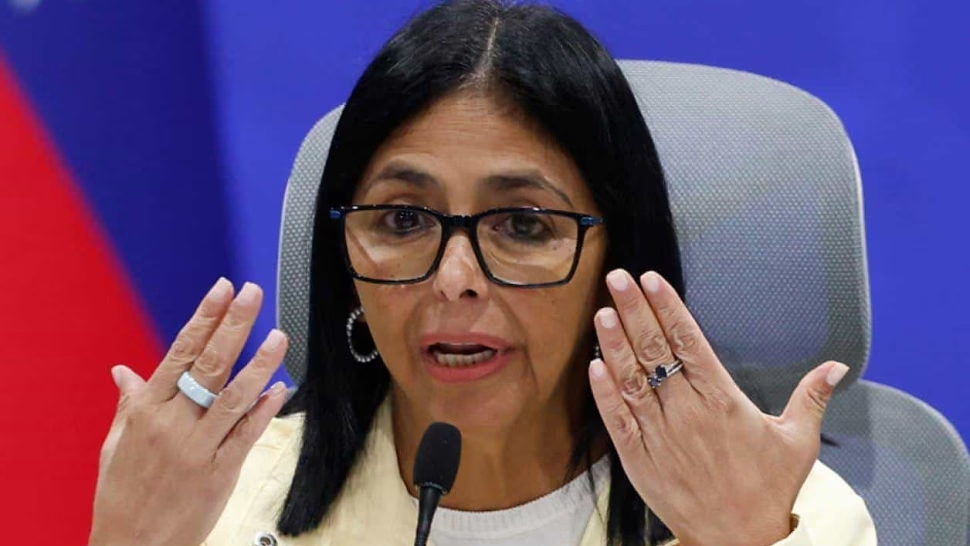
The government of Venezuela’s interim president, Delcy Rodríguez, announced on Friday its “firm and definitive” decision to withdraw from the International Criminal Court (ICC).

Foreign Minister Félix Plasencia explained in

The reasons behind the departure

The decision comes seven months after the National Assembly, with a pro-government majority, approved a law to repeal accession to the Statute. Plasencia accused the court of “geographical bias” and of concentrating its work “disproportionately in African and Latin American countries.” He added that the ICC has been “instrumentalized to deepen inequalities” and rejected the use of “lawfare”, a term that describes the use of the law as a political weapon.

Venezuela ratified the Statute in June 2000 during the mandate of Hugo Chávez. The ICC investigates war crimes and crimes against humanity when countries are unable or unwilling to do so.

Tensive relationship with the Prosecutor’s Office

The now former president Nicolás Maduro had criticized the Prosecutor’s Office in The Hague for closing its office in Caracas last December. The court argued “lack of real progress” in cooperation. Despite the closure, the investigation into the violence following the 2017 protests “remains active,” according to the ICC.

The investigation was opened in 2021 after a request from Argentina, Canada, Colombia, Chile, Paraguay and Peru. So far there are no arrest warrants.

In parallel, former chief prosecutor Karim Khan was dismissed on Friday for “serious misconduct”, in an unprecedented decision. Khan had already been suspended last June.

Continue reading