UNESCO declares World Heritage sites in the West Bank and Lebanon

UNESCO inscribes archaeological sites in the West Bank and Lebanon despite Israeli objections.

UNESCO includes archaeological sites in the West Bank and Lebanon despite Israeli objections

A United Nations committee inscribed an archaeological site in the West Bank and a group of castles in southern Lebanon on the World Heritage List. The decision was made at a UNESCO meeting in South Korea, days after Israel urged the rejection of the nominations, calling them an attempt to “instrumentalize cultural heritage.”

Sebastia, a hill town 10 km northwest of Nablus (occupied West Bank), is identified as ancient Samaria, capital of the biblical Kingdom of Israel. Its remains range from the Iron Age to the Islamic period. The Palestinian bid, submitted in 2012, argued that World Heritage status would help preserve the site, which remains undeveloped under Israeli control.

RelatedLebanon and Israel approach positions in pilot areas under US mediation

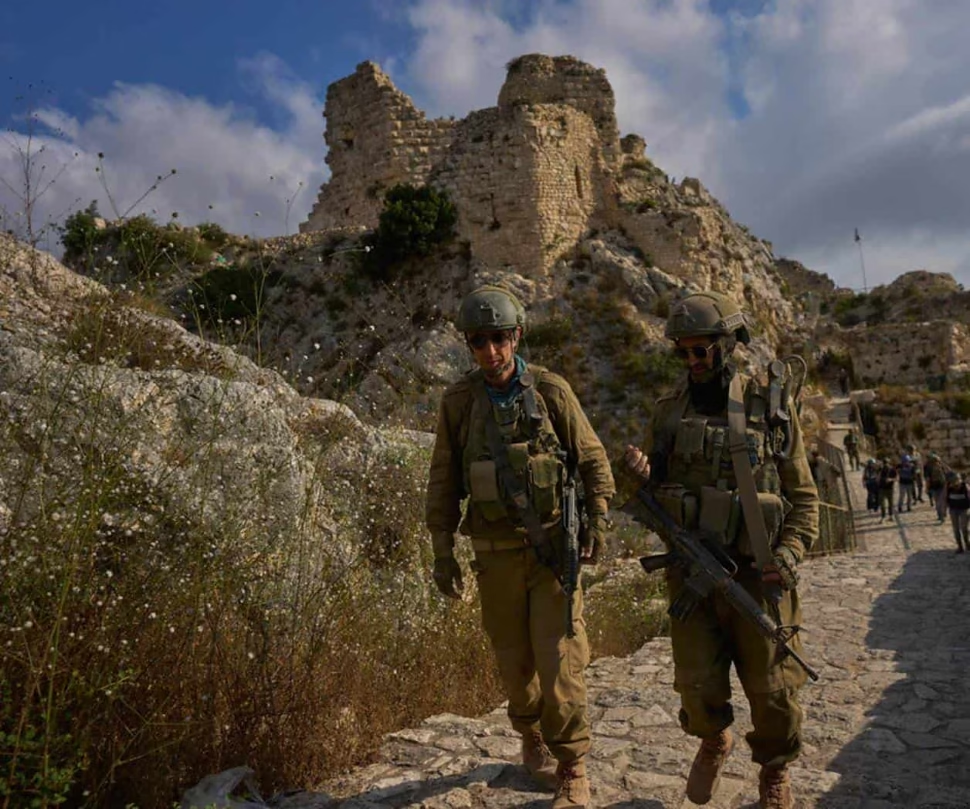
The five castles of Mount Amel, also included, combine influences from Crusaders, Ayyubids and Mamluks. Among them is Beaufort Castle (Al-Shaqif), taken by Israeli forces in May during their deepest incursion into Lebanon in more than 25 years.

Adel Naim Daoud Atieh of the Palestinian delegation said: “who have protected this extraordinary site for generations, despite occupation, restrictions and repeated attempts to separate it from their own heritage.” An Israeli delegate called the decision a “disgrace” and accused it of politicization. Israel withdrew from UNESCO in 2019.

The Israeli Foreign Ministry accused the Palestinian delegation of a “hostile and unilateral campaign” and claimed that Hezbollah has turned Beaufort Castle into a military stronghold. UNESCO responded that all nominations are evaluated under the same criteria and that it does not take a position on political disputes. A Lebanese delegate noted that the castles have been used “only for cultural and tourist purposes” since the Israeli withdrawal in 2000.

Additionally, the committee included Tyre, an ancient Phoenician city in southern Lebanon, on the List of World Heritage in Danger, following intense Israeli airstrikes during the war against Hezbollah before the June ceasefire.

Trump tariffs face new legal challenge

Two small business lawsuits challenge Trump's new tariffs in court.

Two lawsuits filed by small businesses challenge the tariffs Donald Trump announced Thursday. The levies, in the double digits, apply to 60 trading partners under Section 301 of the Trade Act of 1974.

The government argues that it seeks to stop imports linked to forced labor. Critics say the real goal is to replace global tariffs that the Supreme Court struck down in February. The new tariffs arrive just when the temporary 10% tariffs, also contested, expire.

Learning Resources, an educational toy company that already won a case in the Supreme Court, filed a new lawsuit before the International Trade Court. Other small companies join.

A second lawsuit was filed by Burlap and Barrel, a spice company, and Collective Horology, a watch retailer. They are represented by the Liberty Justice Center, a libertarian-oriented group.

Both lawsuits allege that the government failed to justify its actions against each country or explain how the tariffs will eliminate forced labor, as Section 301 requires.

“Forced labor is morally indefensible, but an important goal does not give the government permission to ignore the law,” said Sara Albrecht, president of the Liberty Justice Center. “The government let a global tariff expire and immediately replaced it with another under a different law. Changing the law does not change the right.”

The White House did not respond to requests for comment.

Experts warn that challenging these tariffs will be more difficult than on previous occasions. Trump used Section 301 in his first term against China and the tariffs survived the courts.

No short-term relief

Unlike the Section 122 levies that expired Friday, “these tariffs are going to be with us for a long time,” said Patrick Childress, a lawyer and former U.S. trade official.

Even if countries adopt the policies Washington demands, Childress explained that they will have to demonstrate compliance to the satisfaction of the United States before sanctions are removed. “This suggests that no short-term, country-level relief from the new Section 301 tariffs will be available.”

Continue reading

Oil tanker is detained while trying to evade blockade in Hormuz

US forces fired on a ship trying to break the blockade in the Strait of Hormuz.

Armed intervention in the Strait of Hormuz

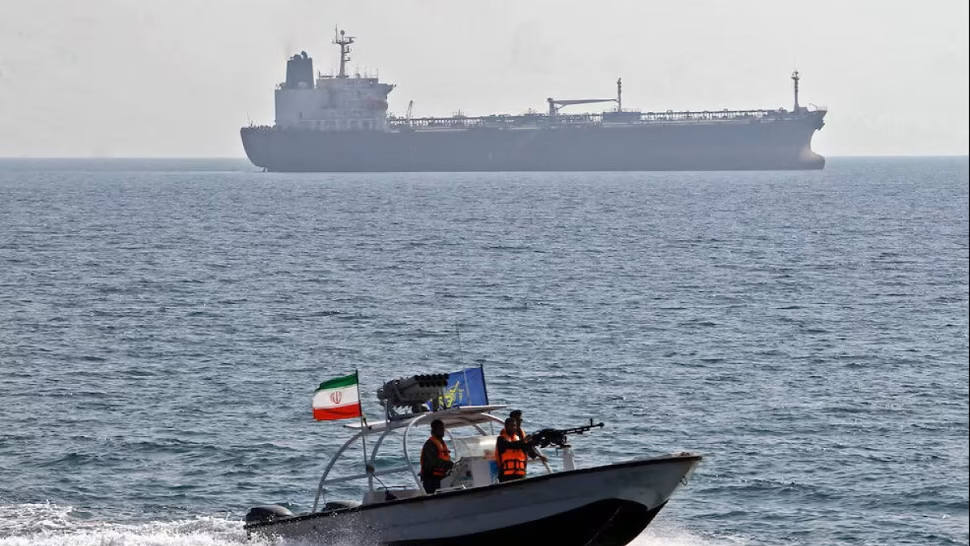
The United States Armed Forces used forceful measures to stop an oil tanker that sought to circumvent the US blockade in the Strait of Hormuz, bound for Iran. This was reported by the media citing the Central Command (Centcom).

The ship, identified as Lavine, had a history of evasion attempts. Capt. Tim Hawkins, a Centcom spokesman, said the crew had tried to break the siege “at least four times” despite prior warnings.

Details of the operation

According to The New York Times, US forces finally acted after the ship again tried to pass through the security device. Hawkins reported that warnings were issued before the intervention, which were not followed. “The ship is no longer in transit to Iran,” he declared, without detailing any damage or possible effects on the crew.

This episode marks a new escalation in tensions around the Strait of Hormuz, a key maritime artery through which a fifth of the oil consumed globally passes. The road connects the Persian Gulf with the Sea of ​​Oman and the Indian Ocean.

Pressure context

Washington maintains a naval and air presence in the region, with restrictions on traffic to Iranian ports as part of its strategy of economic and military pressure. At the same time, President Donald Trump affirmed that there are contacts with Iranian representatives to seek an agreement, although he considered that Tehran “is not yet prepared to close a negotiation.” Trump reiterated that any understanding must guarantee that Iran does not have atomic weapons, while US forces maintain control of strategic sea routes.

Continue reading

Dog Laila rescued 29 days after earthquakes in Venezuela

A dog survived 29 days under rubble in La Guaira after the June earthquakes.

Rescue of Laila

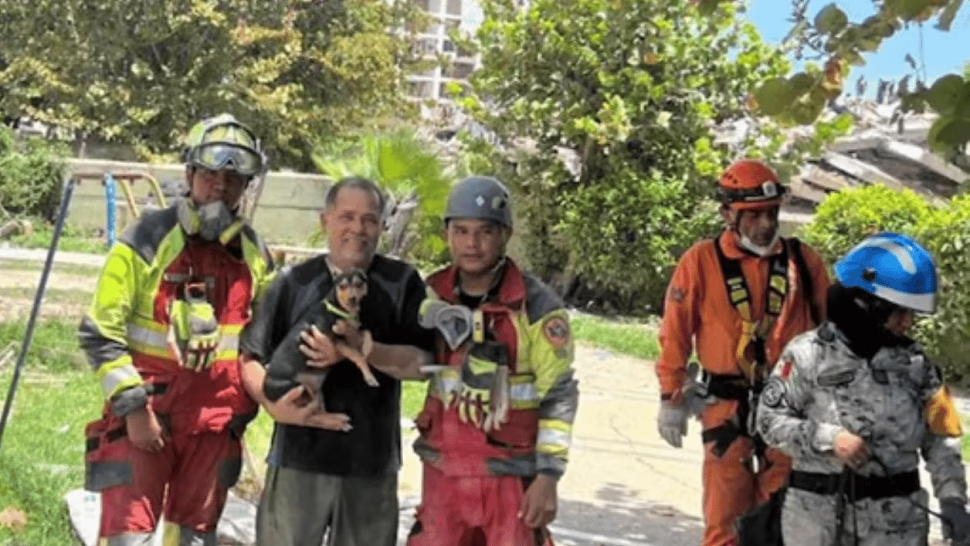
One month after the 7.2 and 7.5 magnitude earthquakes that shook Venezuela on June 24, an unexpected discovery has shocked the networks. A poodle breed dog named Laila was found alive under the rubble in the town of La Guaira, where she remained trapped for 29 days.

The video, released by the “Topos Orientales A.C.” rescue brigade, shows the brigade members resuscitating the animal, offering it water from a bottle. Among those present you hear:

“What a miracle my God”

The dog, although dehydrated and malnourished, was conscious and managed to drink on her own. The team described the event as a sign of hope in the midst of tragedy.

Official figures

According to the latest government report, the earthquakes left at least 5,398 dead and 16,740 injured. About 859 buildings were damaged; 190 collapsed. More than 17,900 people lost their homes and remain in 107 camps in La Guaira, Caracas and Miranda.

Laila’s rescue has been seen as a symbol of resilience, as hundreds of families continue to dig through the rubble in the hope of finding their loved ones.

Continue reading