A global recognition of a centuries-old tradition
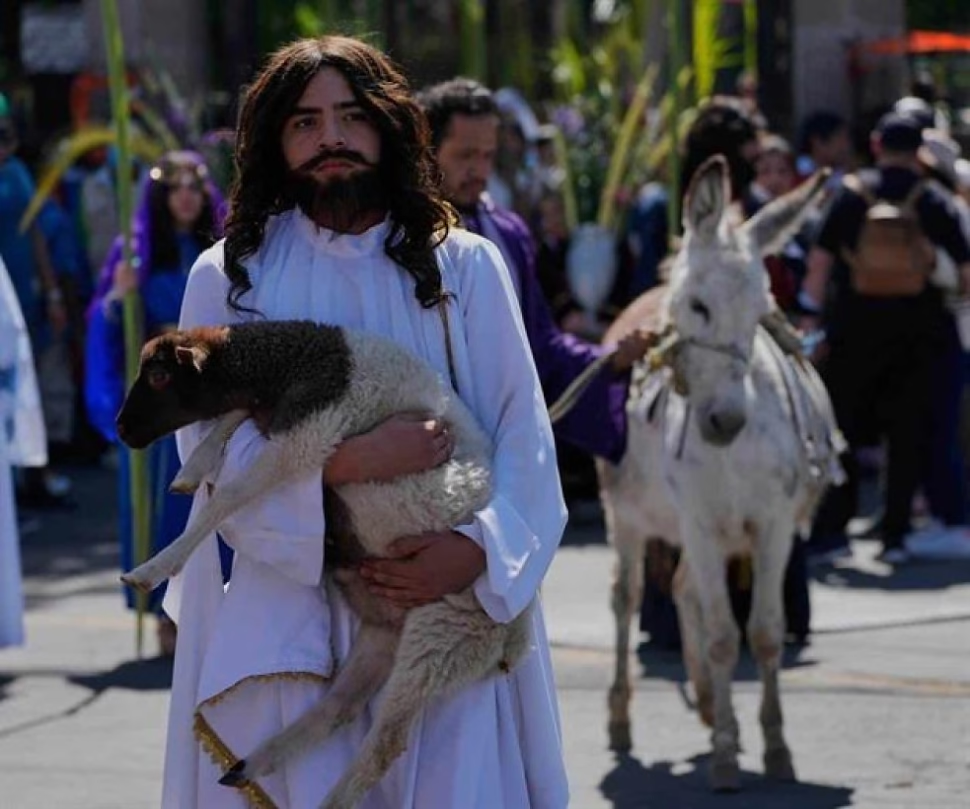
The United Nations Educational, Scientific and Cultural Organization (UNESCO) has officially registered the representation of the Passion, Death and Resurrection of Christ of Iztapalapa, Mexico City, in its Representative List of the Intangible Cultural Heritage of Humanity. This opinion, issued during the 20th session of the Intergovernmental Committee in New Delhi, India, confers a status of protection and universal value to this cultural and religious manifestation, highlighting its role in promoting peace, social cohesion and the exercise of cultural rights.
This community expression has its roots in 1833, originating as a vote of gratitude to the Señor de la Cuevita after overcoming a devastating cholera morbus epidemic. What began as a promise of faith was consolidated, starting in 1843, into a structured annual tradition, inspired by the evangelizing theater of the viceregal period. For the inhabitants of Iztapalapa, this event transcends the religious; It is a fundamental pillar of their collective identity, a mechanism of cultural resistance and a space for social organization that reinforces community ties.
Community structure and contemporary meaning
The execution of this monumental staging falls on the organization and direct participation of the eight original neighborhoods of Iztapalapa: San Lucas, San Pedro, San Miguel, San Pablo, San Ignacio, San José, La Asunción and Santa Bárbara. Thousands of residents collaborate voluntarily and altruistically, assuming roles as actors, set designers, costume designers, logistical coordinators and custodians of tradition. This self-managed and collective management model is precisely one of the values most praised by UNESCO, as it guarantees the intergenerational transmission of knowledge and preserves traditional crafts.
International recognition takes on an even deeper symbolic dimension when considering the socioeconomic context of Iztapalapa, one of the most populated and complex municipalities of the Mexican capital. Frequently associated with challenges such as water scarcity and marginalization, this demarcation finds in its Holy Week a powerful instrument of vindication and pride. The UNESCO declaration not only validates a religious practice, but also dignifies the organizational capacity and living heritage of a working community, counteracting stigmas and projecting an image of cultural wealth.
An institutional safeguarding process
Inscription on the UNESCO list is the culmination of a systematic documentation and safeguarding process driven by multiple actors. The Holy Week Organizing Committee in Iztapalapa A.C., in collaboration with the federal Ministry of Culture, the Government of Mexico City and the local mayor’s office, worked on the technical file that demonstrated the exceptional value of the tradition. This path included fundamental previous milestones: in 2012 it was declared Intangible Cultural Heritage of Mexico City, and in 2023 it was incorporated into the National Inventory of the Intangible Cultural Heritage of Mexico, essential steps for its subsequent international candidacy.
From a technical perspective, the declaration entails commitments. Mexico, as a State Party to the 2003 UNESCO Convention, must implement a specific management plan that guarantees the protection of the viability of this cultural expression without fossilizing it. This implies supporting the bearers of the tradition, rigorously documenting its variants and meanings, and promoting its continuity in an urban environment in constant transformation. The challenge will be to balance the growing tourist and media attention with the preservation of the authentic and community character of the event.
This achievement positions the Passion of Iztapalapa alongside other great manifestations of Mexican living heritage, such as the ritual ceremony of the Voladores de Papantla or traditional Michoacan cuisine. Beyond the religious sphere, it stands as a paradigmatic case study on how popular traditions can constitute resilient mechanisms of social cohesion, territorial management and peacebuilding in challenging urban environments. Its global recognition reinforces the idea that intangible heritage is a key driver for the sustainable development of communities.
Do you think it is valuable that popular traditions with deep community roots receive this type of global recognition? Share this news on your social networks to make visible the cultural wealth of Mexico and explore more content on other expressions declared World Heritage.