Trump suspends bombing in Yemen after agreement with Houthis

An unexpected turn in the Yemen conflict: Trump announces the cessation of bombings after a mysterious promise from the Houthis.

The “pact” that no one saw coming: Trump and the Houthis sign peace (or something like that)

In a move that left everyone as confused as when Netflix cancels your favorite series without warning, Donald Trump announced that the US would stop bombing the Houthis in Yemen. The reason? According to him, the rebels promised to behave and stop attacking ships. Of course, because in the Middle East promises are always kept… *wink, wink*.

“They don’t want to fight anymore” (or so they say)

Between laughter and that air of “trust me, I have a *very good* source,” Trump dropped the bomb (pun intended) during a meeting with the Canadian prime minister. According to the magnate, the Houthis told him that they are “fed up with war.” Kind of like when you say you’re going to delete Tinder… but then you come back two days later.

RelatedHouthis raid UN offices in Yemen and detain employees

The curious thing is that, hours before, Israel had launched its own air strikes against the Houthis. Coordination? Zero. Israeli annoyance? Total. An anonymous official admitted that Tel Aviv found out about it on Twitter, basically. #Awkward.

The cost of playing war (and losing very expensive drones)

Here is the fact that hurts: the US spent more than $750 million on ammunition since March. But that doesn’t include the seven Reaper drones (at $30 million each) that the Houthis turned into scrap metal, or the F/A-18 that ended up in the sea. Result? A “ceasefire” that, according to analysts, only benefits the Houthis. Because, spoiler: they haven’t attacked ships since December. Trump selling smoke? Nah, never.

And while Oman celebrates the agreement on X (formerly Twitter), the Houthis clarified: “We will continue shooting at Israel.” Because in this geopolitical reality show, the drama never ends.

Moral: If you think your ex is complicated, try negotiating in the Middle East.

Were you surprised by this script twist? Share this note and tag that friend who always says “I saw this coming.” Do you want more analysis with satire included? Explore our content on international politics… where fiction surpasses reality. #GeopoliticsWithFlavorAMeme

*Note: No drones were harmed during the writing of this article (lie, they all exploded).

Evacuation paused in the Strait of Hormuz after attack on ship

UN suspends maritime rescue plan after shooting at ship in the Persian Gulf.

The International Maritime Organization (IMO), a UN agency, paused the evacuation of ships stranded in the Strait of Hormuz. The decision was made after the British military reported that a ship was hit by a shell off the coast of Oman.

The Secretary General of the IMO, Arsenio Domínguez, explained that the plan will be suspended until security guarantees are confirmed. The attacked ship was not part of the evacuation effort.

Warnings from Iran and new routes

Hours before the attack, Iran threatened to prohibit passage through the strait without permission from Tehran. The new Persian Gulf Strait Authority, created by the Iranian government, warned in X that transit outside its designated routes “will not be covered by the guarantee of safe passage.”

The United Kingdom’s Maritime Trade Operations center indicated that the ship suffered damage, but with no casualties or environmental impact.

Opening an alternative passage would ease pressure on the global economy and reduce Iran’s influence in peace negotiations. The US Secretary of State, Marco Rubio, assured during a visit to the Persian Gulf that Washington is committed to the new route.

“If that stops, then we’re going to have a problem,” Rubio said.

The price of oil briefly fell below $73 a barrel, a sign that the market is seeing improvement.

Negotiations and regional tensions

The United States and Iran are discussing the terms of a provisional peace agreement, with a period of 60 days to define details such as the passage of ships and the future of Iranian enriched uranium.

Meanwhile, the escalation of fighting in Lebanon threatens the truce. The Lebanese Ministry of Health reported five deaths from Israeli attacks in the last two days. Hezbollah called the actions violations of the ceasefire, but has not responded.

The Israeli army confirmed the death of a reservist soldier and another wounded in southern Lebanon.

Maritime transit in figures

Despite the incident, more ships are crossing the strait, although far below pre-war levels. Shipping company Maersk managed to remove its container ship Maersk Baltimore and another ship on Thursday.

According to Lloyd’s List Intelligence, 125 vessels crossed last week, up from 33 the week before. S&P Global reported 78 transits on Wednesday, the highest number since the conflict began, but still far from the daily average of 130.

Iran considers the new route “unacceptable and completely dangerous.” The naval arm of the Revolutionary Guard warned that “action will be taken against violators.” On Wednesday, they threatened an oil tanker by radio: “they are within range of my missiles,” according to the security firm Ambrey.

Rubio met with Gulf Cooperation Council ministers to ensure their interests will be protected. Bahraini Foreign Minister Abdullatif bin Rashid al-Zayani said the deal brings hope, but it is “critical that Iran fulfills its obligations.”

Continue reading

Earthquakes in Venezuela: 188 dead and 40 thousand missing

Two earthquakes in Venezuela leave 188 dead and 40,000 missing, according to estimates.

Official balance and independent estimates

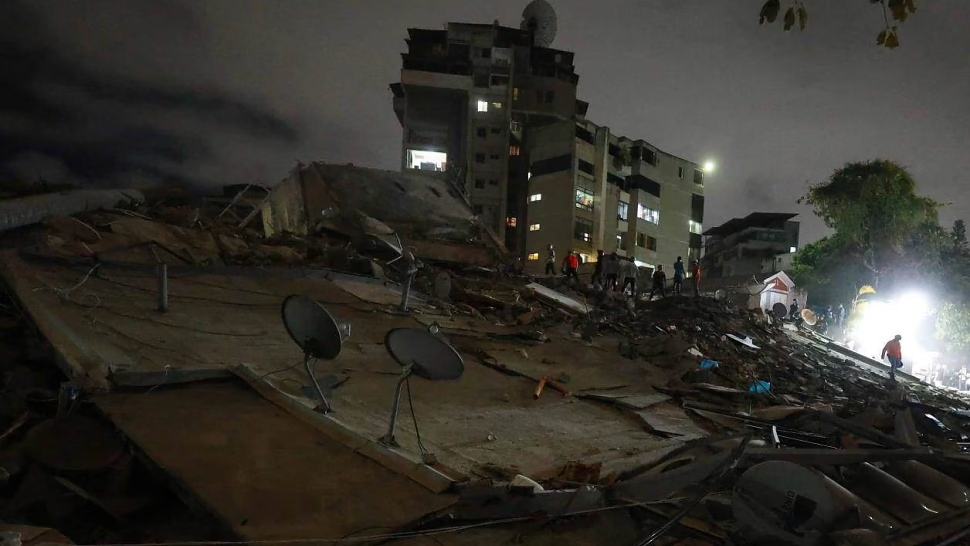
Two earthquakes of magnitude 7.1 and 7.5 shook Venezuela on Thursday, leaving a provisional toll of 188 dead and 1,520 injured, according to Jorge Rodríguez, president of the National Assembly. Around 2,000 families lost their homes. The first tremor occurred at a depth of 20 km; the second, stronger, only 10 km away.

An independent civil initiative estimates that the missing people could reach 40,000. The government has not validated that figure. The coastal area of ​​the state of La Guaira and the west of Caracas were the most affected.

“Everything was falling on us. It looked like a horror movie. It lasted about two minutes,” a resident told the local press.

International response and solidarity

Interim President Delcy Rodríguez declared a state of emergency, closed schools and courts, and mobilized all health personnel. Communications and the airport are collapsed; many bridges were damaged.

International help arrived quickly: rescue teams from the United States, the European Union, Türkiye and Mexico. The IMF allocated 200 million euros for reconstruction. Italy will send firefighters and civil protection.

The lack of supervision in construction—few projects meet anti-seismic standards, without urban planning—would have aggravated the damage, according to local complaints. Venezuela is located on the fault between the Caribbean and South American plates, an area of ​​high seismic risk.

Continue reading

Earthquakes in Venezuela: damage to more than 700 buildings according to citizen reports

Volunteers document 204 total collapses and hundreds of damages in La Guaira and Caracas.

Citizen report after the earthquakes in Venezuela

An open source platform, driven by civilian volunteers, has recorded as of Thursday afternoon 204 total building collapses, 216 with serious structural damage and 298 with partial damage. The information comes from the site earthquakevenezuela.com.

The damage is mainly concentrated in La Guaira and the east-north of Caracas. The tool allows you to collaboratively document damage in homes, hospitals, schools and businesses.

The news outlet El Bus TV validated the initiative by broadcasting it publicly this Thursday and confirmed the responsible actions of the activists. Journalist Tony Frangie Mawad endorsed the open data map, highlighting its usefulness in assessing the extent of infrastructure damage.

These citizen actions complement official efforts in the face of the emergency. The authorities have momentarily reported 188 deaths and some 2,000 homeless families, although it is estimated that the numbers will increase. The platforms continue to receive reports to locate affected people and coordinate humanitarian aid.

The collaboration of the population is key to evaluating the magnitude of the crisis. Tools like earthquakevenezuela.com provide updated information on the hardest hit areas.

Continue reading