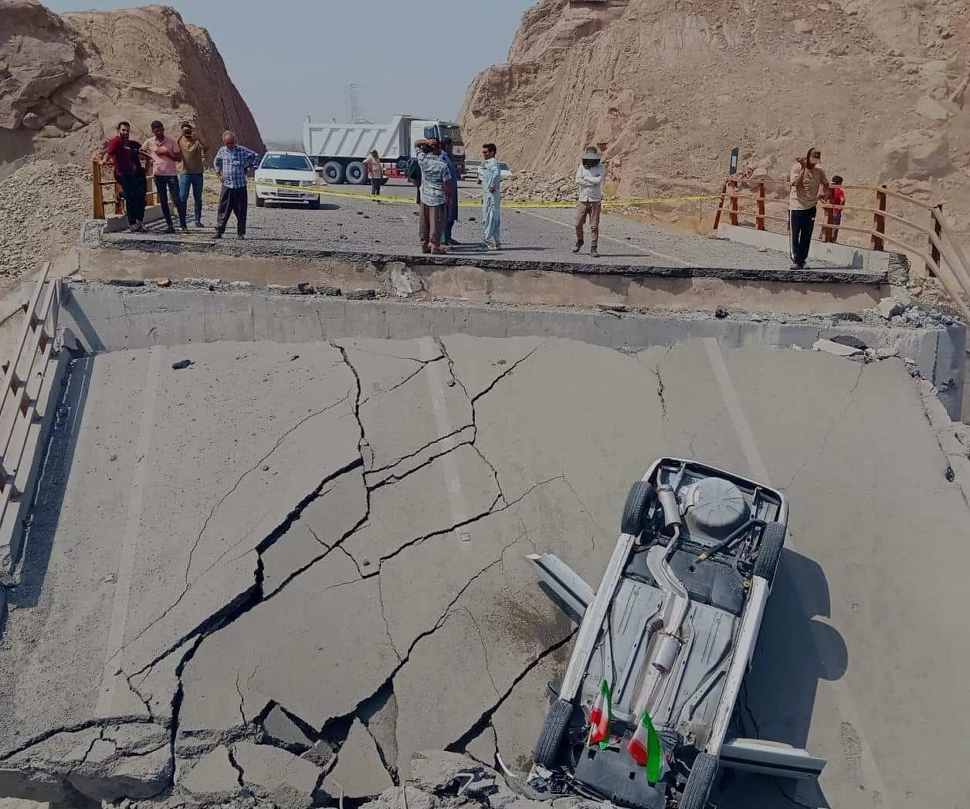
US attacks on Iran raise tension in the Middle East

Bombings against the Iranian Revolutionary Guard escalate regional conflict.

On Sunday, the United States launched airstrikes against targets of Iran’s Revolutionary Guard. The action responds to the death of American soldiers in Jordan.

According to US Central Command, the attacks damaged coastal surveillance, air defense facilities and missile depots. The objective: to weaken Iranian control over the Strait of Hormuz, a key route for oil trade.

RelatedUS and Iranian attacks threaten Middle East ceasefire

The offensive totals eight days. Washington has attacked Iranian strategic infrastructure. Tehran responded with bombings against facilities in Kuwait, in addition to threatening other US allies in the region.

US officials said the bombing was retaliation for an Iranian attack on a military base in Jordan. Two American soldiers died there, one is missing and four were wounded. Since the beginning of the conflict, the US reports 16 military deaths and more than 430 injuries.

Iran said the bombings left at least 50 people dead and more than 500 injured. Iran’s atomic energy agency confirmed that an attack hit the construction site of the Darkhovin nuclear power plant in the southwest of the country.

Impact on the Persian Gulf

Kuwait and Bahrain activated anti-aircraft defenses against Iranian drones and missiles. Kuwaiti authorities reported new attacks against a power and desalination plant, vital infrastructure for drinking water.

The United Arab Emirates called for restraint from all parties, after Iranian media broadcast threats against Emirati airports and ports. Tension remains high, with control of the Strait of Hormuz as a central factor.
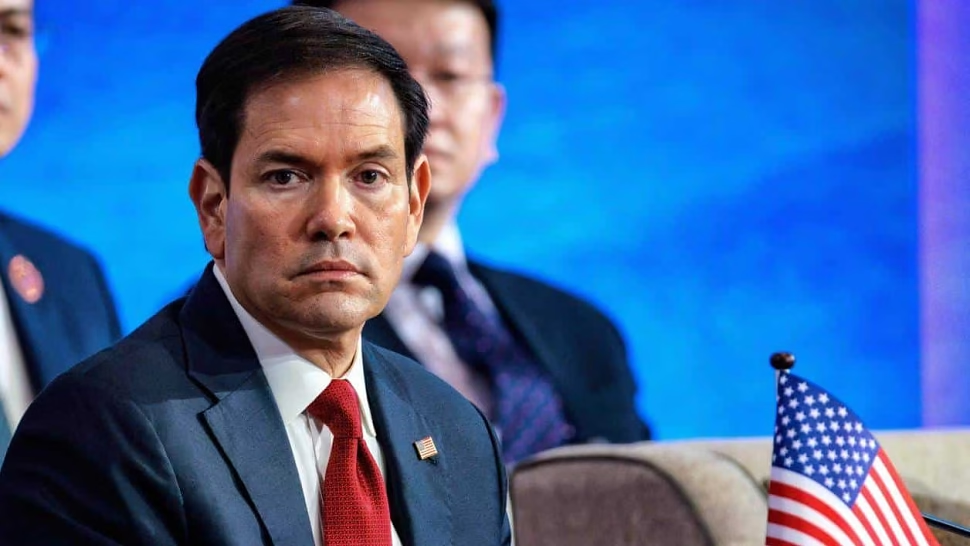
Marco Rubio recognizes difficulties in resolving the conflict in Ukraine

Rubio seeks diplomatic alternatives for Ukraine at ASEAN summit.

Rubio at the ASEAN summit

US Secretary of State Marco Rubio participated in the 33rd ASEAN Regional Forum. During the meeting, he addressed the conflict in Ukraine with his Russian counterpart, Sergei Lavrov. Rubio assured that his country remains willing to collaborate to end the war, although he acknowledged that there is no quick solution. He stated that new diplomatic alternatives are required to reach an agreement acceptable to both parties.

Previous attempts at mediation have had limited results, the official admitted. However, Washington will continue to promote negotiations if favorable conditions exist. Russia, for its part, reiterated its willingness to seek a political solution, but insisted on rejecting the shipment of more Western weapons to Ukraine. Rubio responded that it will be necessary to present new proposals that can be accepted by both Moscow and kyiv, without modifying US military support for the Ukrainian government.

Regional tensions

As part of the summit, Rubio also met with Chinese Foreign Minister Wang Yi. He described the recent incident between Chinese and Philippine vessels in the South China Sea as “escalatory.” Despite the simultaneous conflicts in Ukraine, Iran and other regions, the Secretary of State affirmed that the United States maintains its strategic commitment to Asia. He stressed that diplomacy will continue to be a priority to reduce international tensions.

Continue reading

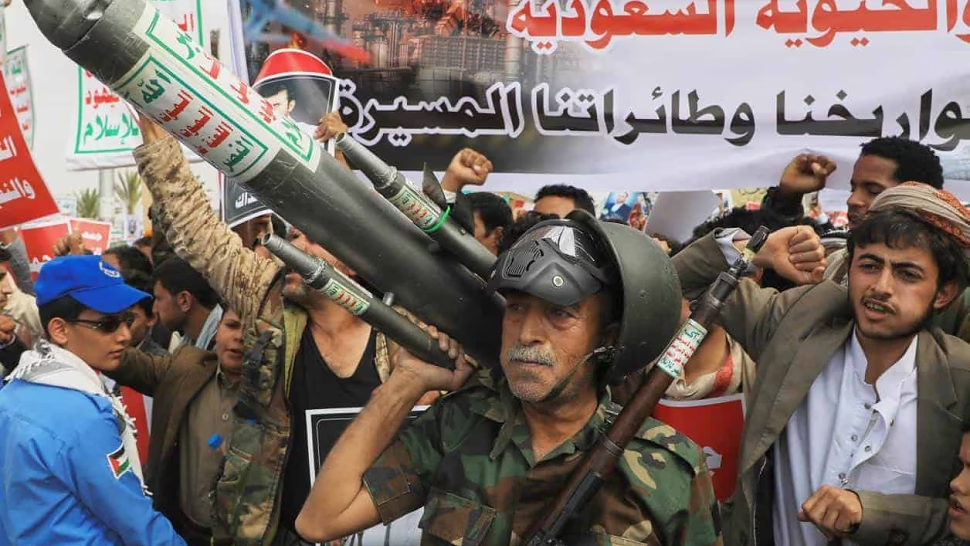
Houthis attack Saudi oil tankers in the Red Sea and raise regional tension

Houthi rebels hit two Saudi ships in the Red Sea; There are no deaths reported.

Attack in the Red Sea

Yemen’s Iran-backed Houthi rebels claim to have hit two Saudi oil tankers in the Red Sea. The action raises tension in the Middle East and threatens to extend the regional conflict.

According to the Houthis, the ships Encelia and Layla were hit and caught fire. No deaths were reported.

The incident occurs while the international price of oil exceeded $100 per barrel. Fear of new interruptions in energy supply intensifies.

It is the first hit against Saudi vessels since the rebels announced a maritime blockade in the Bab el-Mandeb Strait. This route is strategic for world trade and the transit of oil to various regions.

This attack could have significant repercussions on the global energy market. The Bab el-Mandeb Strait is crucial for the flow of crude oil. The international community is closely watching the Houthis’ next steps and Saudi Arabia’s response.

Continue reading

Cáritas distributes US humanitarian aid in Cuba

Hundreds of boxes with food and hygiene reach Cuban families.

The Cáritas organization began distributing hundreds of boxes with humanitarian aid sent from the United States. The first delivery occurred in the municipalities of Bejucal and Alquízar, near Havana.

The packages contain food and hygiene items. They seek to cover basic needs of vulnerable families on the island.

Context of assistance

The distribution occurs in the midst of a severe economic and energy crisis facing Cuba. It also coincides with the historic political tension between Washington and Havana.

Cáritas explained that the modules include rice, beans, spaghetti, oil, tuna, sardines, sugar and salt. In addition, soap, detergent, toothbrushes, sanitary towels, solar lamps and tablets to purify water.

The aid was sent from the United States. Local authorities and volunteers participate in the delivery logistics. It is expected that in the coming weeks it will spread to other communities.

The crisis in Cuba has generated shortages of basic products and electricity outages. Humanitarian assistance represents temporary relief for many families.

Cáritas is an organization linked to the Catholic Church. Their work in Cuba includes food support and attention to vulnerable sectors.

The delivery of these supplies reflects the humanitarian cooperation that persists despite the political differences between both countries.

Continue reading