Hormuz: Trump assures it is open, Iran closes it

Trump insists that the crossing is operational, while Iran declares it closed. Tension escalates in the Gulf.

Pulse through the Strait of Hormuz

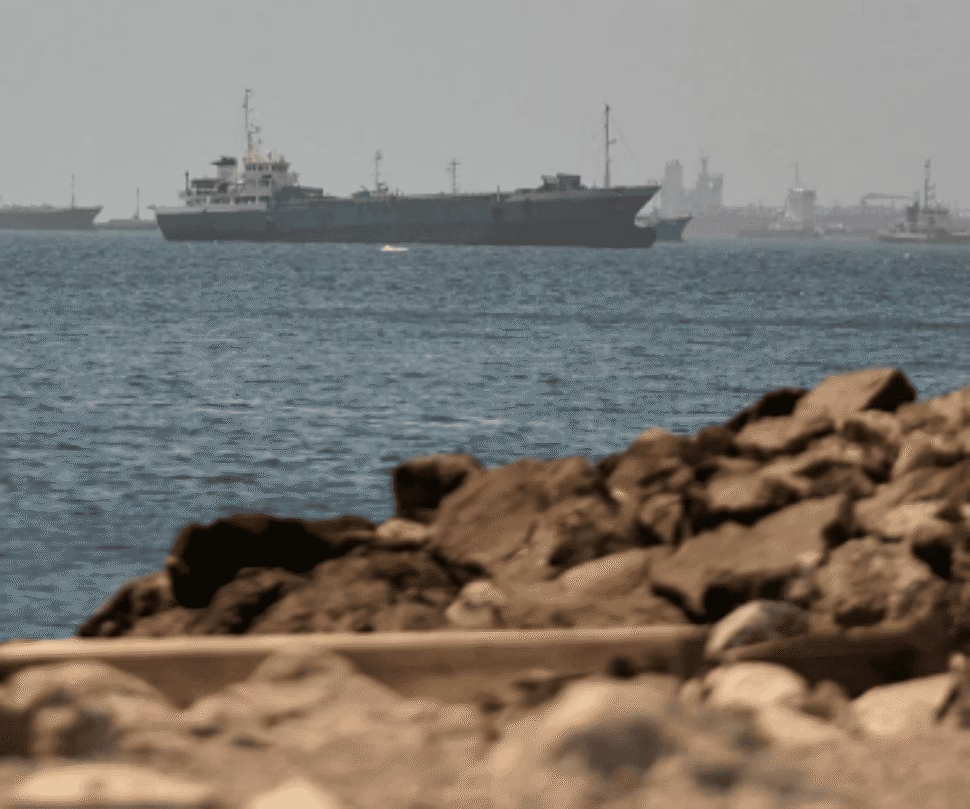
The struggle between Washington and Tehran for control of the Strait of Hormuz escalated this week with attacks and crossed statements. “Hormuz is open. We hit them hard,” said President Donald Trump at the end of a night of bombings against Iran. Tehran “does not control the strait,” he added.

The US Central Command (CENTCOM) endorsed the position: US forces are deployed to “ensure freedom of navigation, despite Iran’s unjustified aggression, threats and arbitrary statements.” Shortly after, the military command reported new attacks against missile systems, air defense and vessels of the Islamic Revolutionary Guard.

RelatedTrump issues naval ultimatum to Iran in the Strait of Hormuz

Hours earlier, an apparent calm and talks in Muscat – mediated by Oman and Qatar – had raised hopes of detente. But in the early hours of Saturday to Sunday, Iran announced the closure of the strait after attacking a Cyprus-flagged ship with a drone.

Washington’s response was immediate: a third round of attacks against 140 Iranian facilities in the vicinity of the pass, raising the weekly total to 310 targets. “Iran made the wrong decision. Now it is paying the consequences,” said Defense Secretary Pete Hegseth.

Tehran counterattacked with missiles towards US bases in the Middle East. Three fell in Jordan, and Qatar reported three injuries – including a minor – from shrapnel during the interception. Oman denounced having been the target of Iranian attacks and summoned the Iranian ambassador for a formal protest. Saudi Arabia condemned “Iran’s persistent destabilizing behavior.”

Trump expressed frustration: “On Saturday night we had a deal with Iran. It was perfect for us. No nuclear program, none of this, none of that. Iran gave in on everything, but they walked out of the room and an hour later they launched a drone at a ship. They’re sick.”

The Iranian Supreme Leader’s military advisor, Mohsen Rezaei, warned: “This strategic step is worth more than dozens of atomic bombs and the Islamic Republic will protect it.”

For Trump, keeping Hormuz open is key to avoiding a global economic depression. However, the fifth section of the memorandum – which addresses control of the strait – has generated controversy. Analysts point out that its wording gives Iran some influence over the step that it did not previously have, and its ambiguity could fuel new friction.

The scenario complicates negotiations on the Iranian nuclear program, where pessimism is growing even within the US administration.
Leo XIV warns about wars and calls for dialogue in his summer Angelus

Pope Leo XIV presided over his first summer Angelus and warned about conflicts in the Middle East and Ukraine.

Pope Leo XIV and his call for peace from Castel Gandolfo

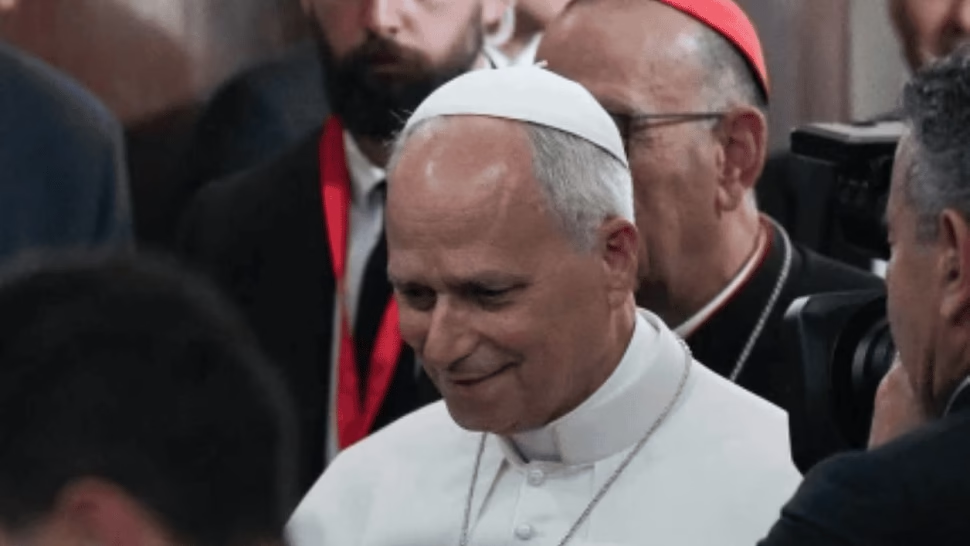
Pope Leo XIV presided this Sunday over his first summer Angelus from the Castel Gandolfo residence. Unlike the traditional popemobile, the pontiff toured the streets in a golf cart to greet the faithful and highlighted the place as a place to rest.

However, the summer season did not diminish his concern about global conflicts. During his reflection, the Pope expressed concern about the wars that affect various regions.

“Unfortunately, the winds of war are blowing again in the Middle East, in Ukraine and in many other parts of the world, sowing violence, terror and death, and once again hitting so many innocent people. Let us not allow these winds to extinguish the small flame of hope and peace,” he stated.

The Pontiff insisted that dialogue is the only way to a lasting solution.

“I renew my desire to persevere on the path of dialogue, encounter and diplomacy, the only path capable of leading to a just and lasting peace,” he said.

International peace summit in Castel Gandolfo

As part of Sea Sunday, Leo XIV also sent a message to maritime workers, affected by the remoteness and fear of conflicts on routes such as the Strait of Hormuz.

The promotion of peace will be the focus of a high-level summit to be held this week at the Borgo Laudato Si’. For three days, some 30 Nobel laureates, former heads of state and representatives from more than 30 universities will debate international security, governance of artificial intelligence, disarmament and economics for peace. Among the attendees are leaders from OpenAI, Google DeepMind, Aaru and Anthropic.

The opening of the meeting will be on Tuesday, July 14, with the participation of Cardinals Fabio Baggio, Silvano Maria Tomasi and Ángel Fernández Artime, as well as Nobel Prize winners Muhammad Yunus, Juan Manuel Santos and James Muller.

Although an intervention by the Pope has not been confirmed, the fact that the summit will be held in Castel Gandolfo and that the encyclical Magnifica Humanitas is the central theme generates expectations. Sources indicate that a possible announcement regarding his presence could be made this Monday.

Continue reading

The death toll from the double earthquake in Venezuela increases to 4,490

Official report raises the death toll to 4,490 and the number of victims to 17,907 after the June 24 earthquake.

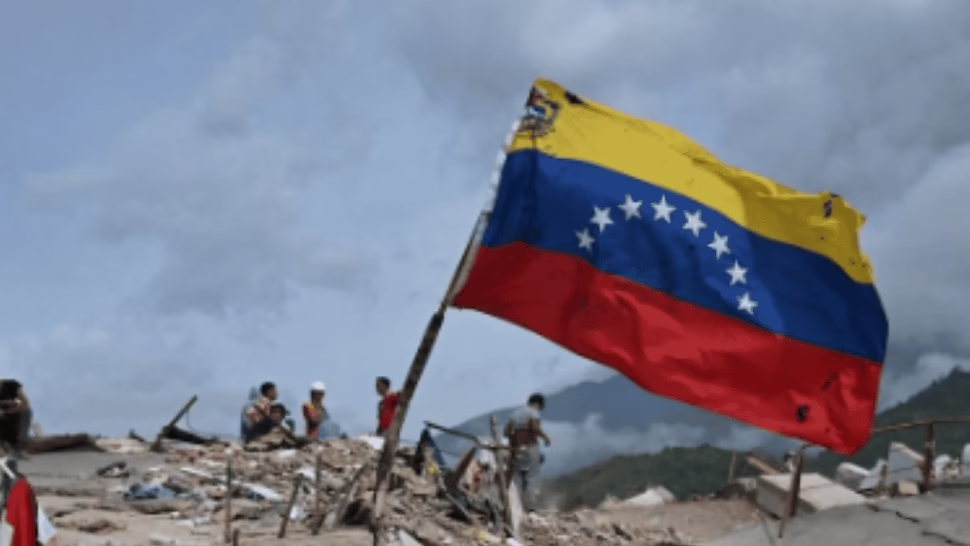
The number of victims from the June 24 earthquake in Venezuela continues to rise. Authorities updated the official balance this Monday: 4,490 people lost their lives and 17,907 were left homeless.

Updated figures

Jorge Rodríguez, president of the National Assembly and head of the cabinet for temporary camps, spread the new report through Telegram. The number of deaths increased by 157 compared to the previous day.

The injured remain at 16,740. So far, 32,401 people have received medical attention in hospitals since the beginning of the emergency.

Government response

The interim president, Delcy Rodríguez, reported that 19,583 people remain in 108 temporary camps distributed throughout the country. More than half – 10,908 – are in La Guaira, the most affected coastal area. Another 6,429 are staying in Caracas.

Authorities have recorded 1,222 aftershocks throughout Venezuelan territory since the June 24 earthquake, according to official data.

Continue reading

El Salvador deploys humanitarian hospital in Venezuela

El Salvador installs humanitarian hospital in Venezuela after the double earthquake on June 24.

Immediate response after the earthquake

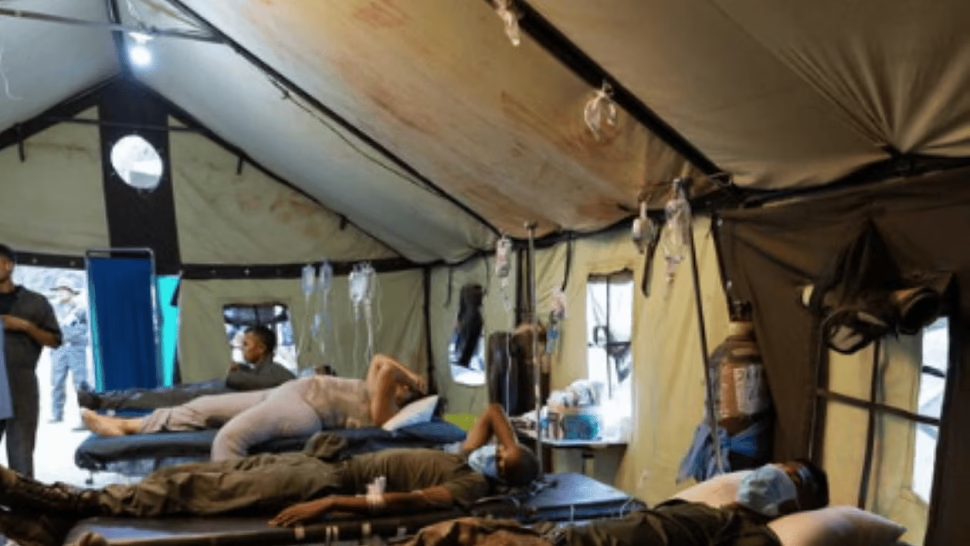
The government of El Salvador installed a humanitarian hospital on the main avenue of Playa Grande, La Guaira state, to respond to the emergency caused by the double earthquake that shook northern Venezuela on June 24.

The initiative responds to a direct order from Salvadoran President Nayib Bukele, who monitors the situation and coordinates the distribution of aid, according to an official statement.

Details of the Salvadoran contingent

The temporary hospital seeks to relieve pressure on the local health system in one of the areas most affected by seismic activity. The team is made up of doctors, paramedics and a team of veterinarians.

Medical care is provided 24 hours a day. Veterinary services for pets and companion animals are available from 8 a.m. to 6 p.m. (local time).

The Salvadoran government’s commitment to the emergency is reflected in the rapid installation of this center, which seeks to mitigate the impact of the earthquake on the affected community.

Continue reading