US and Iranian attacks threaten Middle East ceasefire

New US airstrikes on Iran and Iranian retaliation put the truce in the region at risk.

New attacks and reprisals

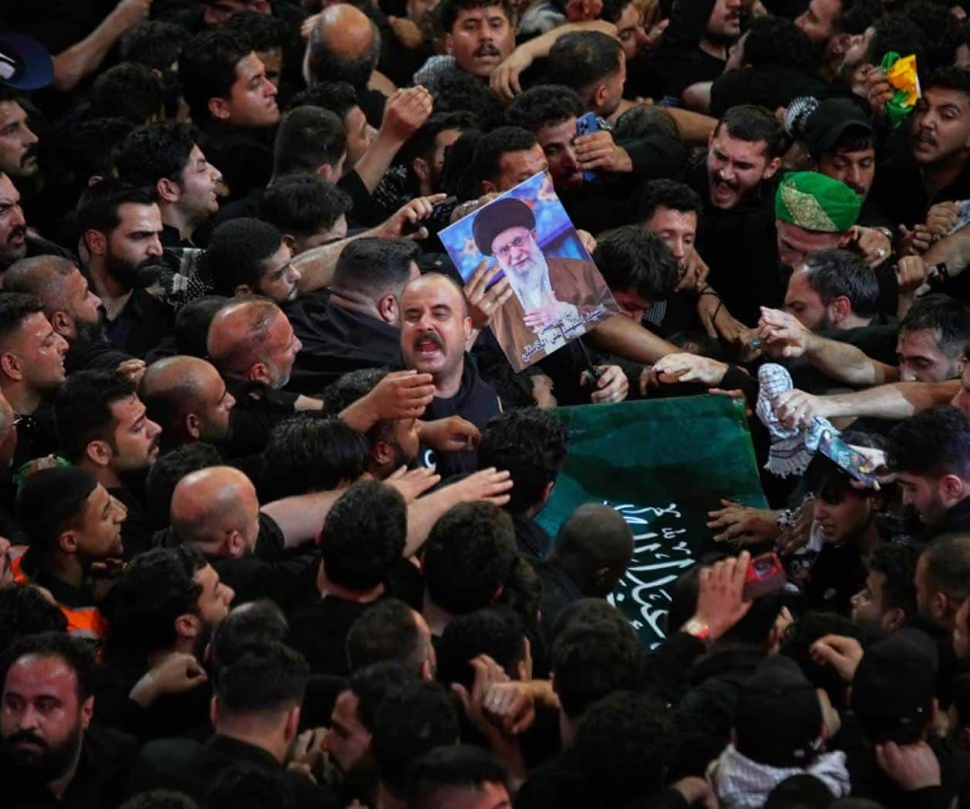
Early Thursday morning, the United States launched new airstrikes against Iran. In response, Tehran attacked Persian Gulf countries allied with Washington. The escalation puts at risk a provisional agreement that sought to end the war in the region.

Warning sirens sounded at least three times in Bahrain, headquarters of the US Fifth Fleet. Missiles also hit Kuwait and Qatar. Later, Jordan, where the US has troops and aircraft, also raised its alarms.

RelatedIran attacks US bases in the Gulf after Israeli offensive

Iranian reaction and victims

An Iranian official accused Washington of attacking the area around the country’s only nuclear power plant. During the afternoon, more explosions were reported in other areas.

According to Iran’s Ministry of Health, the two days of bombing have left at least 14 dead and 78 injured. The majority belonged to the armed forces.

In Kuwait, one person was injured by debris when air defenses shot down three ballistic missiles, a cruise missile and 10 drones. Bahrain reported that it intercepted incoming fire, without further details. Jordan, through its spokesman Mohammad al-Momani, confirmed that all Iranian fire was intercepted.

Iranian state television reported that the Revolutionary Guard fired missiles at a US base in Jordan. So far there are no reports of damage in Qatar.

The actions come hours after President Donald Trump warned that Iranian attacks on ships in the Strait of Hormuz meant the end of the fragile ceasefire. He threatened to escalate the conflict if the attacks did not stop. The international community fears that the region will once again fall into a multiple war, which could block energy shipments through the strait, vital for the global economy.
Sheinbaum reveals pending issues with Trump after invitation to the World Cup

Sheinbaum reveals that he asked Trump to return to issues of trade, security and migration.

Call or meeting waiting

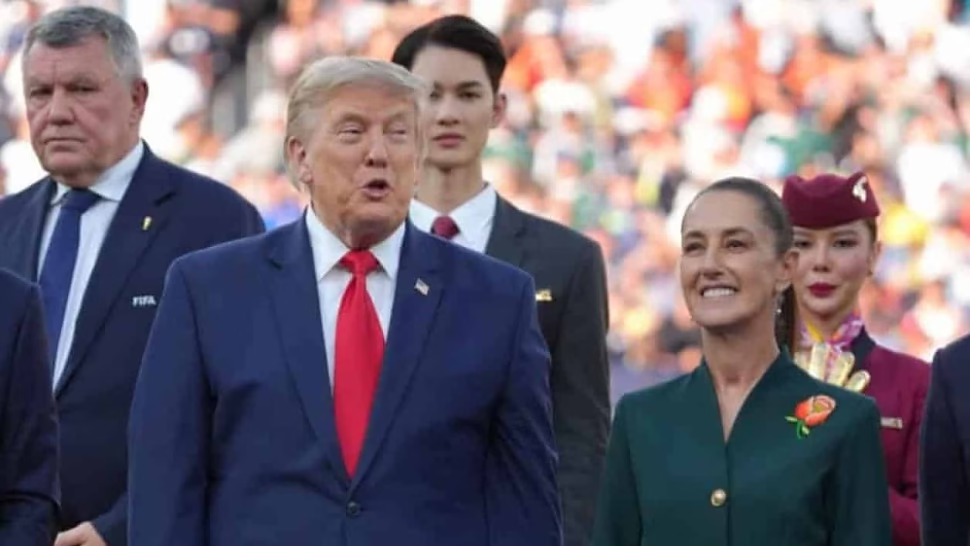
President Claudia Sheinbaum confirmed that during the telephone conversation with Donald Trump, in which the American president invited her to the closing of the 2026 World Cup in New York, he told her that there are several bilateral issues to be resolved.

“It’s not about having a meeting in the middle of the soccer game about tariffs or other issues. But I did tell him: ‘we have several things pending,’ and I hope we can call each other again by phone,” he declared from the National Palace.

Sheinbaum maintained that the bilateral relationship must be based on respect and constant dialogue. He pointed out three key reasons: the geographical proximity, the need to prioritize diplomacy and the 40 million Mexicans who reside in the United States.

“We may disagree on issues with President Trump, but we don’t have to make this a personal matter. It’s a bilateral relationship,” he added.

The president highlighted that the teams from both countries are holding talks on issues such as trade, security, arms control and migration. He stressed that his attendance at the sporting event was due to a diplomatic act, not a partisan political gesture.

Criticism from the opposition

Sheinbaum responded to criticism from the opposition, which questioned his decision to attend the closing of the World Cup alongside the Prime Minister of Canada, Mark Carney, and King Felipe VI of Spain.

“It is a diplomatic matter, above sports,” she stated, and reiterated that Trump has maintained respectful treatment towards her.

The president made it clear that, despite the differences, her government will act to protect Mexicans in the United States without personalizing the conflict.

Continue reading

Venezuela withdraws 346 million dollars from the IMF to rebuild La Guaira

Venezuela accesses 346 million dollars from the IMF for reconstruction after earthquakes.

Own funds for the emergency

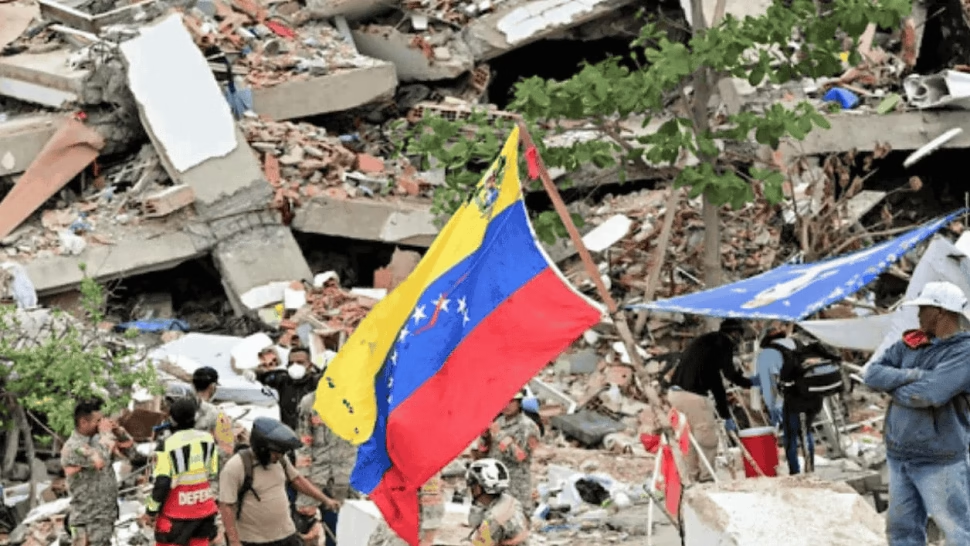
The executive vice president of Venezuela, Delcy Rodríguez, reported that the country obtained access to 346 million dollars of its own resources in the International Monetary Fund (IMF). The objective: attend to the recovery after the earthquakes of June 24.

The funds come from the reserve tranche. They are not a new loan, but rather resources that already belonged to the Venezuelan State. IMF Managing Director Kristalina Georgieva confirmed the move and explained that they worked with key counterparts “to help Venezuela access its own resources in the Fund for Urgent Humanitarian Needs.”

Support for families and reconstruction

Rodríguez explained that the money will be used for housing, infrastructure and essential public services for affected families. “This will allow affected families to be supported in housing, infrastructure, essential public services, among other requirements,” he wrote on his social networks.

Access to these resources came after the IMF and Venezuela resumed relations in April 2026, after seven years of suspension. At the beginning of July, the organization’s spokesperson, Julie Kozack, had already announced that there were talks to unfreeze the funds.

According to data from the president of the National Assembly, Jorge Rodríguez, the earthquakes left thousands of victims, including deaths, injuries and homeless families. The most devastated area was La Guaira, on the central coast, about 30 kilometers north of Caracas.

The Venezuelan government stated that these resources will strengthen the immediate response and contribute to the reconstruction of the impacted areas. The IMF reserve tranche functions as immediate liquidity, without conditionalities associated with financing programs.

Continue reading

Mayo Zambada receives life sentence in the US

Court in Brooklyn confirms life imprisonment for the historic leader of the Sinaloa Cartel.

Life sentence for El Mayo Zambada

A federal court in Brooklyn has handed down the final sentence for Ismael El Mayo Zambada, 76 years old. Judge Brian Cogan confirmed this Monday the life imprisonment for the historic leader of the Sinaloa Cartel.

Zambada pleaded guilty last year to drug trafficking conspiracy and directing a criminal organization. Prosecutors estimate that for decades he moved hundreds of tons of cocaine, heroin and fentanyl.

In addition to the sentence, the US government is demanding a fine of $15 billion as compensation for the damage caused. The figure reflects the scale of their illicit operations.

Zambada’s situation is now identical to that of his former partner, Joaquín El Chapo Guzmán, who has been serving a life sentence since 2019. Both led the most powerful criminal organization in Mexico for years.

The plea deal reached by Zambada included a key guarantee: the US Department of Justice agreed not to seek the death penalty. In exchange, the boss accepted the charges that carry mandatory life imprisonment.

The conviction closes a chapter in the fight against organized crime, but leaves open questions about the future of the Sinaloa Cartel and its trafficking routes to the United States.

Continue reading