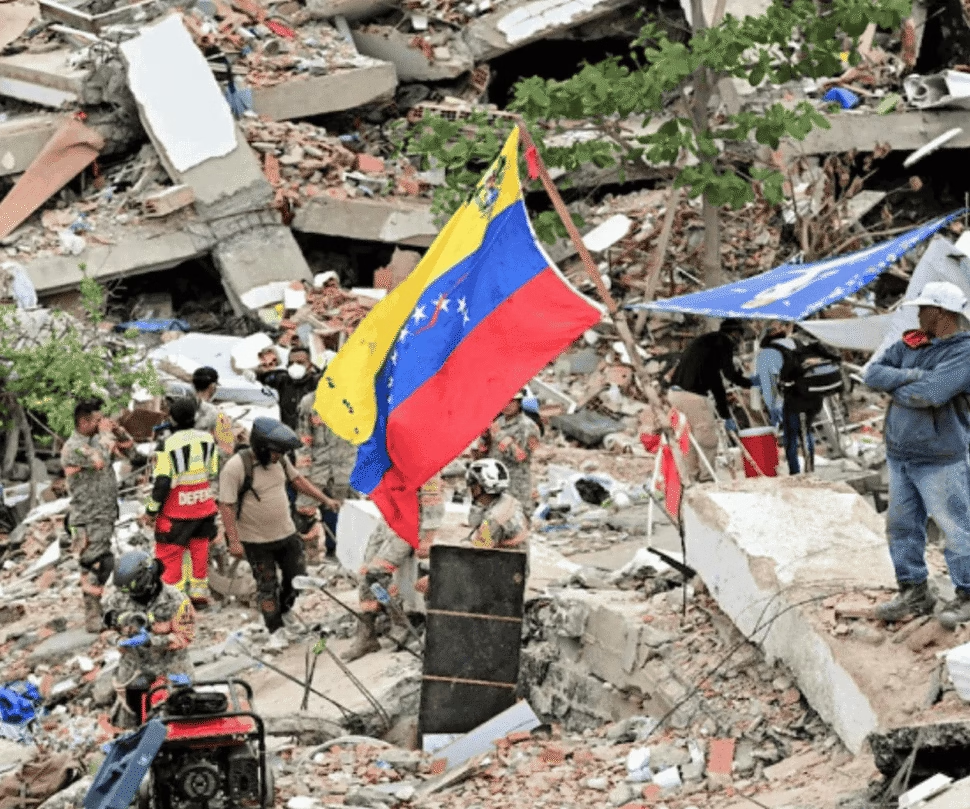
Venezuela withdraws 346 million dollars from the IMF to rebuild La Guaira

Venezuela accesses 346 million dollars from the IMF for reconstruction after earthquakes.

Own funds for the emergency

The executive vice president of Venezuela, Delcy Rodríguez, reported that the country obtained access to 346 million dollars of its own resources in the International Monetary Fund (IMF). The objective: attend to the recovery after the earthquakes of June 24.

The funds come from the reserve tranche. They are not a new loan, but rather resources that already belonged to the Venezuelan State. IMF Managing Director Kristalina Georgieva confirmed the move and explained that they worked with key counterparts “to help Venezuela access its own resources in the Fund for Urgent Humanitarian Needs.”

RelatedIMF and Venezuela: call for emergency funds after earthquakes

Support for families and reconstruction

Rodríguez explained that the money will be used for housing, infrastructure and essential public services for affected families. “This will allow affected families to be supported in housing, infrastructure, essential public services, among other requirements,” he wrote on his social networks.

Access to these resources came after the IMF and Venezuela resumed relations in April 2026, after seven years of suspension. At the beginning of July, the organization’s spokesperson, Julie Kozack, had already announced that there were talks to unfreeze the funds.

According to data from the president of the National Assembly, Jorge Rodríguez, the earthquakes left thousands of victims, including deaths, injuries and homeless families. The most devastated area was La Guaira, on the central coast, about 30 kilometers north of Caracas.

The Venezuelan government stated that these resources will strengthen the immediate response and contribute to the reconstruction of the impacted areas. The IMF reserve tranche functions as immediate liquidity, without conditionalities associated with financing programs.
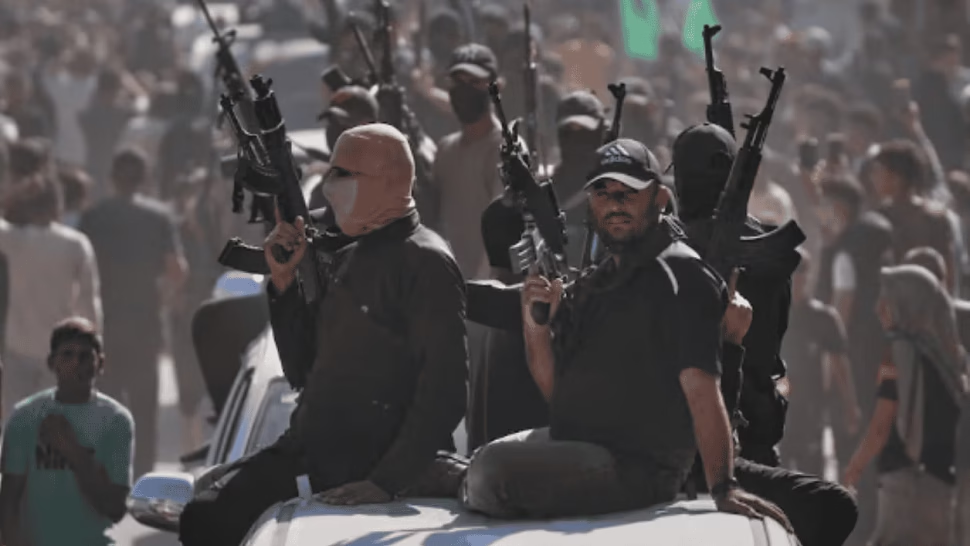
Hamas elects Khalil al-Hayya as new political leader

The Palestinian movement appoints Sinwar's dolphin in an internal vote.

The new leadership of Hamas

The Palestinian organization Hamas announced the election of Khalil al-Hayya as head of its political office. The position had been vacant since October 2024, when Yahya Sinwar was killed in an Israeli operation in Rafah.

Al-Hayya prevailed over Khaled Mashal in an internal vote that the organization described as “highly complex and secret for security reasons.” Representatives of Palestinians detained in Israeli prisons also participated.

According to internal sources cited by agencies, Al-Hayya won “by an overwhelming majority.” However, the Qatari newspaper Al-Araby reported that the difference was “barely one vote,” citing another movement source.

Continuity in the political line

The appointment of Al-Hayya implies continuity with the strategy of Sinwar and the previous leader, Ismail Haniyeh, who also died in an Israeli operation in Tehran in July 2024. Both maintained alignment with the so-called “axis of resistance” led by Iran, despite the fact that Hamas has a Sunni majority.

His arrival reinforces Gaza as the central axis of the Palestinian cause, in contrast to the current of Mashal, born in the West Bank and considered closer to Qatar and Turkey. During his leadership until 2017, Mashal broke with Syrian President Bashar al Assad, distancing the movement from the Iranian axis.

At the same time, Hamas has reinforced its presence in its headquarters in Istanbul, to the detriment of its center in Doha.

Impact on negotiations with Israel

Al-Hayya, 64, is a founder of Hamas and was Sinwar’s top deputy in Gaza. Before October 7, he left the Strip on instructions from Sinwar to direct affairs from abroad. According to The New York Times, in July 2023 he discussed attack plans with a general in the Iranian Revolutionary Guard.

He has survived several attacks attributed to Israel, including one in Doha in September 2025 where his son Hamman died. Three other children also died in Israeli attacks.

Currently, Al-Hayya is Hamas’ main negotiator in indirect contacts with Israel, which last October led to a ceasefire agreement and the release of hostages. He has met personally with US envoys Steve Witkoff and Jared Kushner.

In the talks that continue in Cairo, Al-Hayya maintains an inflexible position and rejects the disarmament of Hamas. According to various assessments, the stalemate could lead to a new Israeli offensive on the Strip.

Continue reading

The US accuses Cuba of historical infiltration and espionage

The US accuses Cuba of decades-long infiltration of its government. Havana denies it.

Washington’s accusations against Havana

The United States Department of State has denounced that Cuba carried out an espionage campaign for decades. According to the official report, Havana managed to infiltrate the highest levels of the US government.

“Cuba infiltrated the highest levels of the US government, recruited and trained generations of activists, and supported an unprecedented wave of left-wing political violence on US soil,” the document states.

The report calls the operation “one of the most protracted and damaging foreign intelligence infiltrations in U.S. history.” He adds that the Cubans developed a model of attrition based on espionage, sabotage and networks of allies.

Secretary of State Marco Rubio reiterated these accusations in a meeting with officials from more than 60 countries. “The intelligence and ideological networks of the Cuban regime helped build the extreme left in our country and in the hemisphere,” he stated.

Context of political pressure

The accusations are part of the growing pressure from Donald Trump’s administration against Cuba. In May, President Trump issued an executive order calling the island an “unusual and extraordinary threat” to US national security, expanding sanctions.

Cuba faces its worst economic crisis in decades and has vigorously rejected the accusations. Cuban authorities insist that the country does not represent a threat to the United States.

Tensions between both countries date back to the triumph of the Castro revolution in 1959. Since then, Washington imposed sanctions, there were attempts to attack Fidel Castro and Havana supported guerrilla movements in Latin America and the Caribbean. The current report revives that history of confrontation.

Continue reading

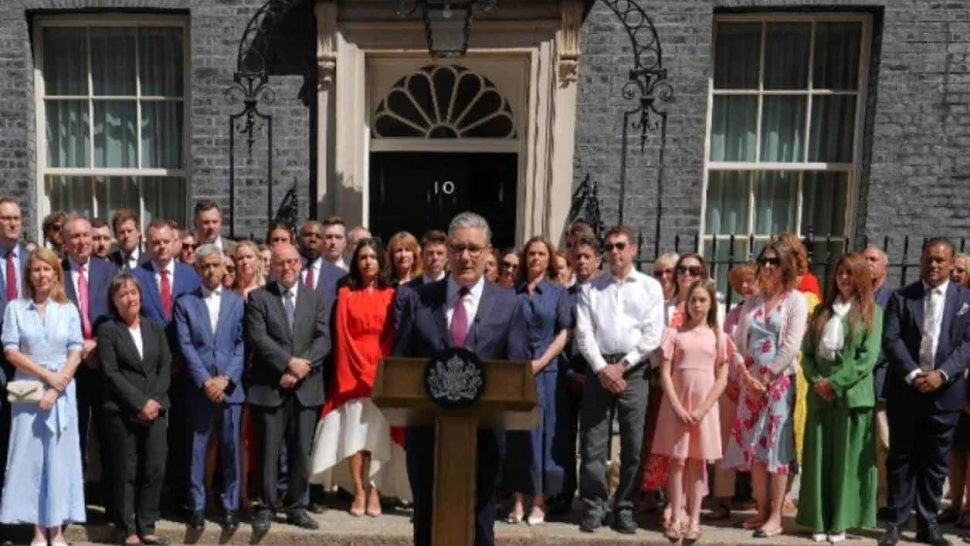
Andy Burnham takes over as UK Prime Minister

The former mayor of Manchester becomes the seventh British head of government in ten years.

Andy Burnham, former mayor of Greater Manchester, took office this Monday as prime minister of the United Kingdom. He is the seventh head of British government in the last decade.

The replacement comes after the resignation of Keir Starmer, who led the government for two years. Starmer resigned after Burnham was elected as the new leader of the Labor Party.

In her first Downing Street speech, Burnham, 56, declared:

“My mandate will represent a turning point focused on recovering the political and economic stability of the country.”

He detailed a 10-year strategic plan that prioritizes national reindustrialization, public control of essential services, combating the cost of living and greater powers for local governments.

Starmer, before resigning, defended his management:

“The return to economic growth, international support for Ukraine and the internal reconfiguration of Labor after the 2019 defeat.”

He presented his formal resignation to King Charles III at Buckingham Palace. This closed a cycle marked by internal political turmoil after the local elections in May.

The monarch led the investiture ceremony for Burnham. He is the fourth prime minister he has appointed in his four years of reign.

Burnham is expected to name her cabinet this Monday to begin the implementation of the new economic model.

Continue reading