Structured Advance in the National Railway Reactivation
The Government of Mexico, through the Rail Transport Regulatory Agency (ARTF), dependent on the Ministry of Infrastructure, Communications and Transportation (SICT), has communicated a significant milestone in the recovery plan for the passenger train network. This December 5, the public tender for section A of the Saltillo-Nuevo Laredo railway will be published, while the process for section B is already underway. Both segments are located within the Metropolitan Area of Monterrey, an economic center of vital importance.
President Claudia Sheinbaum Pardo has highlighted this progress within the comprehensive project of the northern trains, framing it in the policy of the Fourth Transformation that seeks for the Mexican State to recover a leading role in the generation of infrastructural development. During his morning conference, he argued that the privatization of the rail system led to the abandonment of passenger service and the communities that depended on it. “We believe that we must continue building trains in the country and that the State must have a train company; private companies can also have one, but the State must have trains that allow development,” the president stressed.
Technical Details and Progress of Strategic Projects
Andrés Lajous Loaeza, head of the ARTF, provided a meticulous breakdown of the status of the projects. For the Gulf of Mexico Train on the Saltillo-Nuevo Laredo route, section A to be tendered covers 18.1 kilometers. At the same time, section B, of 30.7 km, is in the bidding process. Additionally, a public tender is being held for the stations between Derramadero and García, in Coahuila. It is crucial to note that the Environmental Impact Statement for the entire route has already been approved, and work is being done to free the road on ejidal lands.
The progress of detail engineering is diverse: section I (Saltillo-Santa Catarina) presents 8.18% progress; Section IV (San Javier-Arroyo El Sauz) reaches 51.06%, and section V (Arroyo El Sauz-Nuevo Laredo) reports 18.17%. In another priority corridor, the Querétaro-Irapuato, the detailed engineering of section I is 65.15% complete, while section II is 6.08% complete. At this site you can already see embankment work and preparation for a railway bridge.
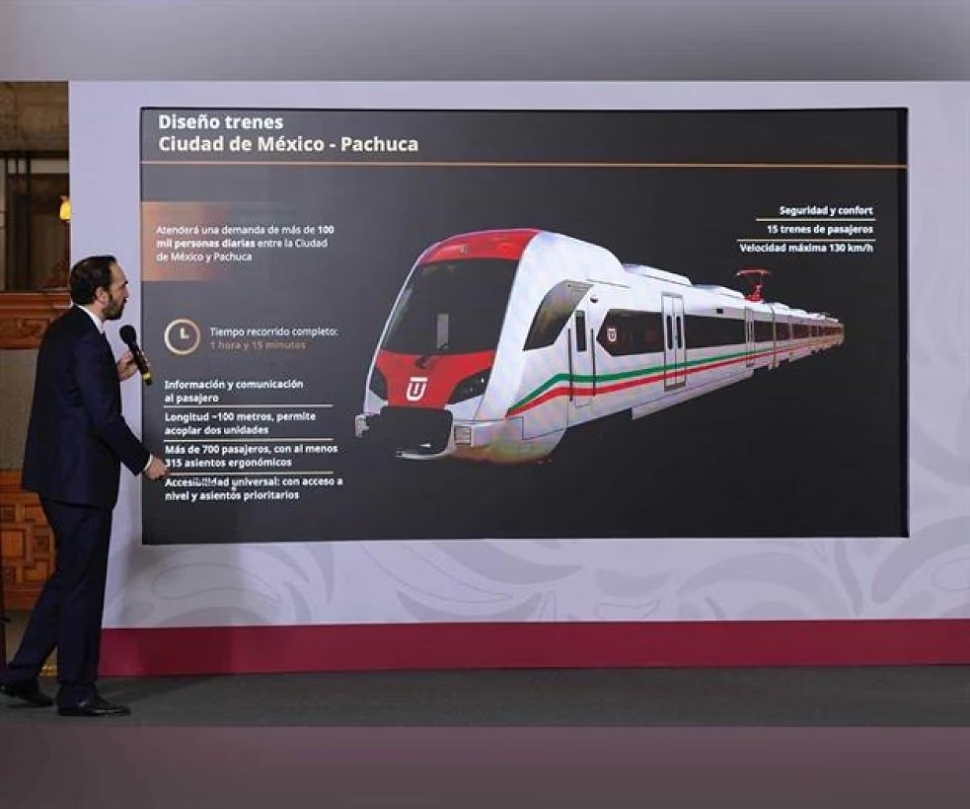
An announcement of great operational relevance was the failure of the tender, on December 3, for the acquisition of 47 passenger units with 65% national content. These convoys, destined for the Mexico City-Querétaro-Irapuato route, will serve an estimated demand of more than 100,000 people daily. Each 100 meter long formation, with capacity for 700 passengers (including 315 ergonomic seats) and universal accessibility, can be coupled in a double unit to increase its capacity.
Future Expansion and Immediate Socioeconomic Impact
The railway strategy contemplates an expansion coordinated with the Secretariat of National Defense. The next construction stages include the Querétaro-San Luis Potosí and San Luis Potosí-Saltillo sections of the Gulf Train, as well as the start of work on the Irapuato-Guadalajara corridor. Simultaneously, demand, social and urban impact studies and economic analysis are carried out for the Mazatlán-Los Mochis section.
The impact on job creation is already a tangible reality. According to Commander Gustavo Ricardo Vallejo Suárez, of the “Felipe Ángeles” Group of Engineers, the Mexico City-Pachuca train, with five fronts of heavy work, generates more than 9,000 jobs. For its part, the Mexico City-Querétaro project, with 14 work fronts, supports more than 11,000 jobs. Finally, basic engineering studies have begun for 1,409 kilometers of track in the Irapuato-Guadalajara, Querétaro-San Luis Potosí, San Luis Potosí-Saltillo and Mazatlán-Los Mochis corridors, laying the foundations for the next phase of this transportation transformation.
This systematic approach demonstrates rigorous planning that prioritizes not only connectivity and regional economic development, but also the recovery of a strategic state capacity in terms of mobility, with direct benefits in employment and community integration.
Are you interested in the future of mobility in Mexico? Share this analysis on the renaissance of the railway system and explore more content on infrastructure and national development on our social networks.