The United States carries out a military operation and captures Maduro in Venezuela

A night operation shakes Caracas and culminates with the extraction of the Venezuelan president, unleashing a crisis of global reach.

Any Saturday in geopolitics, or not

It seems that someone in Washington decided that the third day of 2026 was the perfect time for a high-impact military intervention. While most mortals were trying to recover from the festivities, the United States launched what we will kindly call an air and ground assault of epic proportions against Venezuela. The stated target: President Nicolás Maduro, who, after months of being the favorite villain in White House speeches, had the unenviable experience of being captured and extracted from his country in what can only be described as a luxury forced move. All of this, of course, was announced with the characteristic subtlety of a tweet (or a ‘truth’, to be exact) by Donald Trump himself in the early hours of the morning. Because, what better way to confirm a status operation than with a post on social networks?

Residents of Caracas were awakened not by the crowing of a rooster, but by the roar of at least seven explosions and the hum of low-flying planes. Imagine waking up like this on a Saturday. The Venezuelan government, with admirable speed, wasted no time in pointing the finger at the United States, calling the event an imperialist attack and urging people to take to the streets. Because, clearly, the most sensible thing to do during a bombardment is to go out and get some air.

RelatedMilitary operation in Venezuela captures Maduro and divides the world

The art of capture and advertising on networks

As the city shook, the big mystery was: who is in charge now? And, more importantly, where the hell did they send Maduro and his wife? Trump, acting like the host of a geopolitical reality show, was quick to give the ‘spoilers’ on Truth Social. According to his story, the operation was a resounding success and carried out in conjunction with US security forces. He promised more details later, probably at a news conference from Mar-a-Lago, because nothing says “national security issue” like an announcement from a private club. The Federal Aviation Administration, in a move that smacks of “something big is coming,” had banned flights over Venezuela hours earlier, citing “ongoing military activity.” A minor detail that surely went unnoticed by everyone.

This show didn’t come out of nowhere. It was the culmination of months of escalating pressure and veiled (and not so veiled) threats from Washington. Maduro was already accused of narcoterrorism in US courts, and the CIA had been doing its own ‘little jobs’ in Venezuelan territory. Trump’s rhetoric had been warming up for months, attacking ships and promising stronger action. Maduro, for his part, denounced everything as a blatant attempt at overthrow. And boy were they right.

The circus of international reactions

As expected, the international panorama exploded with the force of one of the explosions in Caracas. From the immediate condemnation of the Mexican government to the furious statements of figures like Evo Morales and Gustavo Petro, who spoke of imperial aggression and showed images of supposed civilian victims. The Venezuelan defense minister, in an emergency speech, denounced the attack as an attempt to seize the country’s natural resources. Meanwhile, in Washington, a congresswoman was already tweeting about the illegality of the operation, because in the midst of chaos, there is always room for a constitutional debate in 280 characters.

The Venezuelan government, now without its visible leader, described the attack as an attempt at destabilization and called emergency meetings. The million dollar question is: what’s next? An interim government? A power crisis? More operations? Trump said that the operation was a “success,” but in geopolitics, as in bad marriages, what for one is a success, for the other is the beginning of a protracted conflict. The geopolitical implications of this action are enormous, a dangerous precedent of direct intervention that redefines the rules of the international game and that will undoubtedly generate replicants in relations with allies and adversaries alike.

In summary, the world woke up to a new and alarming chapter of military interventionism. An action that, regardless of the opinion one has about Maduro, marks a turning point. The national sovereignty of a country was violated in a lightning operation, and the leader was removed like an old piece of furniture. All announced on social networks. Because that’s how things are done in the modern era: first act, then tweet. The message is clear and the precedent more than established.

Did this news impact you? Geopolitics does not stop. Share this analysis on your social networks to generate conversation and explore more content related to international crises here.


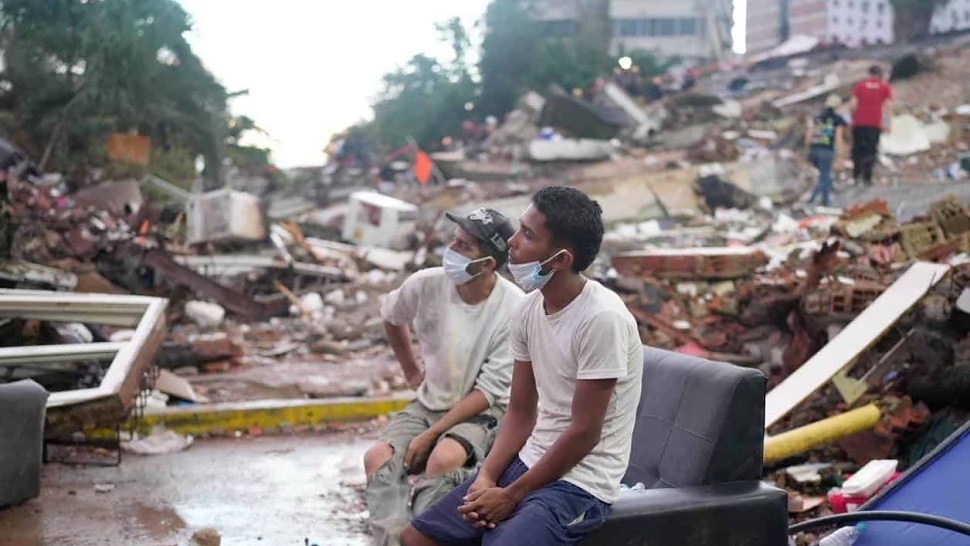
Venezuela: hospital crisis after earthquakes and thousands of people affected

The earthquakes in Venezuela left more than 1,700 dead and a health crisis that overwhelmed hospitals.

Last week’s earthquakes in Venezuela have collapsed the health system. More than 1,700 people died and thousands were injured. Hospitals operate at their limit, according to international organizations.

Hospital damage and disease risk

The WHO reports dozens of hospitals affected, several out of service. Those that work face overcrowding, lack of staff and delays in surgeries. In addition, thousands of displaced people live in makeshift shelters. The UN warns of possible outbreaks of measles, dengue, malaria and yellow fever due to overcrowding.

Figures and call for help

Venezuelan authorities count more than 15,000 affected, but the number could be higher, according to international organizations. NASA estimates that 59,000 buildings were damaged or destroyed. UNICEF estimates that 680,000 children need humanitarian assistance. While search and rescue efforts continue, national and international organizations are asking to reinforce humanitarian and medical aid. The priority is to care for the affected population, prevent the spread of diseases and strengthen the response capacity of the health system to the magnitude of the emergency.

Continue reading

The ‘Flemish Revolution’ shakes Albania against Kushner’s project

Albanian environmentalists use foam flamingos to protest a tourism project linked to Jared Kushner.

The ‘flamingo revolution’ that challenges a Kushner project in Albania

Thousands of people have demonstrated in Tirana against a luxury tourism megaproject linked to Jared Kushner, son-in-law of US President Donald Trump. The mobilizations, baptized as the “flamingo revolution”, have a peculiar symbol: figures of flamingos made of foam by the activist Natma Paja, used to make visible the rejection of development.

The project includes hotels, villas, apartments and a marina on Sazan Island and Narta Lagoon, a protected area that is home to migratory birds. Civil organizations denounce a risk to biodiversity and demand the suspension of the works.

The government defends investment

Prime Minister Edi Rama has backed the project, arguing that it will boost high-end tourism, strengthen the economy and support Albania’s aspiration to join the European Union. But the opposition does not give in.

As protests continue, the Special Prosecutor’s Office against Corruption and Organized Crime opened an investigation into the case, without revealing details. The European Union, for its part, monitors that the initiative complies with the environmental standards required of the candidate country.

Rama has reiterated that he will not stop the project, which he describes as a historic opportunity. The conflict keeps open the debate between economic growth, environmental protection and transparency in large investments.

Continue reading

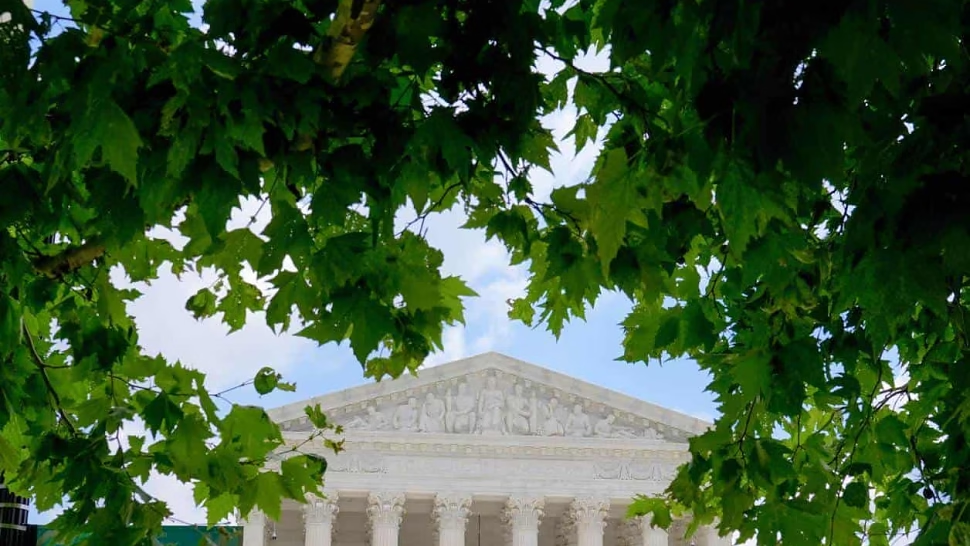
US Supreme Court rejects Trump order on citizenship

The highest court maintains the right of birthright citizenship with a vote of 6-3.

The United States Supreme Court confirmed this Tuesday the principle of citizenship by birth. With a vote of 6-3, the highest court rejected President Donald Trump’s executive order that sought to deny nationality to children of people in an irregular immigration situation or with temporary status.

The weight of the Fourteenth Amendment

The president of the Court, John Roberts, noted that citizenship represents “the right to have rights.” He recalled that the Fourteenth Amendment extended that guarantee to every person born in United States territory. The decision reaffirms that, with limited exceptions — such as children of diplomats or occupying forces — anyone born in the U.S. acquires nationality at birth.

The executive order never went into effect. It was suspended by federal courts considering that it contravened the Constitution and the precedent of the case United States v. Wong Kim Ark(1898). The Trump administration argued that children of non-citizens or temporary residents were not fully under the country’s jurisdiction. But the majority of the justices rejected that interpretation.

Impact on the migrant community

According to estimates by specialized organizations, the measure would have affected more than 250,000 babies born each year in the United States to non-citizen parents. It includes children of undocumented migrants, foreign students and people waiting for permanent residency. The decision represents a setback for one of Trump’s most visible immigration proposals.

Continue reading