A military operation in Venezuela leaves dozens of dead and global tension

A nighttime raid unleashes a hemispheric crisis and leaves a high human cost, while the world watches the consequences.

A Night that Shook the World

In the deep darkness of a Caracas night, the fate of a nation was decided with the roar of explosions and the hum of war planes. At least twenty-four brave Venezuelan security officers fell, becoming martyrs in an instant, during a covert military operation of epic proportions. Their mission, as audacious as it was controversial, was to capture Nicolás Maduro himself and extradite him to US soil to face federal charges of narcoterrorism. The Venezuelan government, with a broken heart, confirmed the news that would shake the foundations of continental geopolitics.

The attorney general, Tarek William Saab, with a deep voice full of indignation, declared that “dozens” of souls, including officials and civilians, had perished in what he described unequivocally as a “war crime“. The shadow of the tragedy lengthened even further with the previous announcement by the Cuban government: thirty-two soldiers and police officers from the island, deployed in Venezuela, had also died. The news plunged Cuba into two days of national mourning, a mourning that resonated throughout the Caribbean.

RelatedThe United States carries out a military operation and captures Maduro in Venezuela

A moving tribute video, published on the official account of the Bolivarian Army on Instagram, immortalized the faces of the fallen. His images, superimposed on black and white scenes of soldiers, American planes flying over the capital and armored vehicles reduced to scrap, were a heartbreaking testimony. “His shed blood does not cry out for revenge, but for justice and strength“, read the legend, an oath of unbreakable loyalty to rescue his president and defend the sullied sovereignty.

A Captured President and a World on the Edge

As the smoke cleared over Caracas in Washington, President Donald Trump stood defiant. He vehemently rejected the criticism of the Democratic opposition, remembering that his rival, Joe Biden, had also demanded the apprehension of the Venezuelan president for the same drug trafficking charges. At a retreat for Republican lawmakers, Trump complained bitterly about the lack of recognition for a successful military mission that culminated in the removal of Maduro, despite a bipartisan consensus that denied its legitimacy.

The shadow of the accusations dated back to 2020, when a North American court charged Maduro with narcoterrorism. The White House revealed that the outgoing Biden administration had raised the reward for his capture, a figure that the Trump administration later doubled to fifty million dollars. “At some point, they should say, ‘You did a great job. Thank you,'” Trump declared, in a tone somewhere between frustration and triumphalism.

However, anxiety was growing in the halls of the Capitol. Following a confidential briefing, Democratic leaders expressed concern about a new era of American expansionism undertaken without a clear vision. The Speaker of the House, Mike Johnson, tried to calm things down, assuring that there would be no massive deployment of troops and that it was not a “regime change” operation.

The American public, according to a survey by The Washington Post, was deeply divided. Almost half opposed the United States taking control of Venezuela to install a new government, overwhelmingly advocating that it be the Venezuelan people who decide their own destiny.

Chain Repercussions and a Hemisphere on Alert

Maduro, already in custody, pleaded not guilty before a US federal court. Meanwhile, in Caracas, his loyal collaborator Delcy Rodríguez was sworn in as interim president, trying to take the reins of a turbulent country. But the shock waves of the operation did not stop there. The world watched nervously as the Trump administration renewed its controversial calls to acquire Greenland and launched veiled threats against Colombia, accusing it of facilitating drug trafficking.

The international response was immediate and firm. The Minister of Foreign Affairs of Colombia, Rosa Villavicencio, summoned the chargé d’affaires of the US embassy to present a formal protest. Simultaneously, major European powers, including France, Germany and the United Kingdom, joined Denmark in a unanimous defense of the sovereignty of Greenland, making it clear that the autonomous island, part of NATO, was not up for discussion. “Greenland belongs to its people,” read the joint statement, a diplomatic warning as clear as the Arctic ice.

The geopolitical chessboard of the Western Hemisphere had been shaken to its foundations. A military raid to capture a president had unleashed a storm of unforeseeable consequences, leaving a trail of pain, a power vacuum and a question floating in the air: had a new and dangerous stage of interventionism begun?

Do you think this event marks a turning point in international relations? Share this analysis on your social networks and explore more content on geopolitics and global conflicts in our dedicated section.
Israel-Lebanon peace framework faces resistance from Hezbollah

Agreement seeks to disarm Hezbollah and restore Lebanese sovereignty, but the group rejects it and warns of civil war.

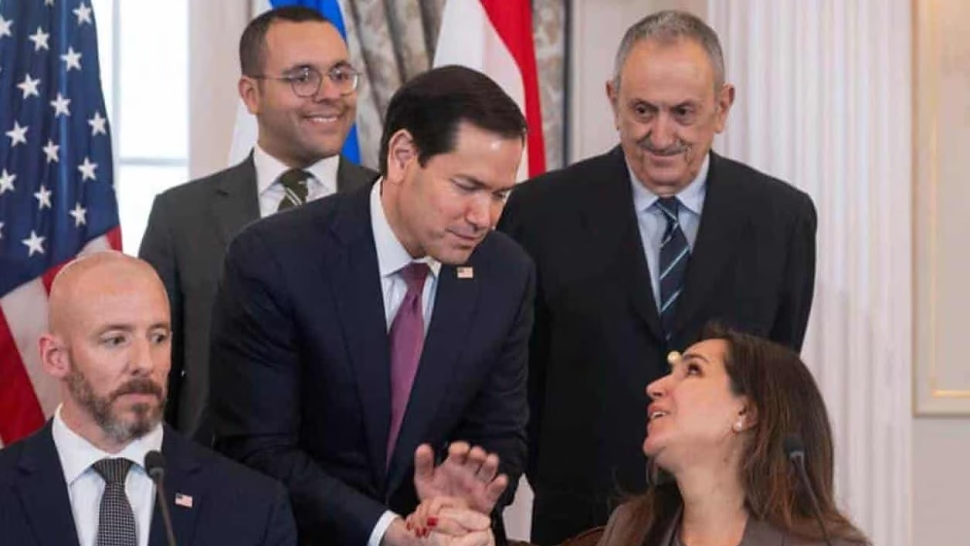
The US Secretary of State, Marco Rubio, announced together with the ambassadors of Israel and Lebanon a framework agreement that he described as a first step towards peace. The pact seeks to dismantle Hezbollah and return to Lebanon the territories occupied by Israel during the fighting.

The agreement excludes Hezbollah, which does not support it. Hassan Fadlallah, a member of the group’s parliamentary bloc, warned on Al-Mayadin TV that if the pact is imposed “it could spark a civil war.” He also called the deal an attempt to derail negotiations between the United States and Iran.

A framework with American backing

The State Department detailed that the framework creates a process to eliminate the threat of Hezbollah. Washington will facilitate a new “Military Coordination Group for Lebanon” and committed $100 million in humanitarian assistance.

“For Lebanon, this framework provides a genuine path out of a long-standing crisis,” the State Department said. “For Israel, it creates a verifiable path to eliminating the persistent threat on its northern border.”

Ambassadors Yechiel Leiter (Israel) and Nada Hamadeh Moawad (Lebanon) signed the document before Rubio. Leiter stated that the final destination is peace: “We want to get in our car in Tel Aviv and drive to Beirut.” However, he conditioned that advance on the disarmament of Hezbollah.

Hezbollah refuses to lay down its arms

The group maintains that it should only disarm south of the Litani River, near the border with Israel, in accordance with previous agreements and UN resolutions. Fadlallah reiterated that they reject Lebanon’s direct negotiations with Israel.

The most recent conflict erupted on February 28, when Hezbollah launched rockets into Israel days after the start of the war between Israel and Iran. Since then, more than 4,000 people have died in Lebanese territory and at least 37 Israeli soldiers have fallen in combat.

Position of Israel and Lebanon

Israeli Prime Minister Benjamin Netanyahu called the pact a “great achievement.” In a video, he assured: “Israel will remain in the security zone in southern Lebanon as long as Hezbollah has not been disarmed.”

For his part, Lebanese Prime Minister Nawaf Salam stated that the agreement aims to achieve the Israeli withdrawal from all Lebanese territory and restore the sovereignty of the State. President Joseph Aoun mentioned that the proposal for “pilot zones” controlled by the Lebanese army is under discussion.

Direct talks between Israel and Lebanon are moving forward separately from the interim US-Iran deal signed last week. The Lebanese government sought to negotiate directly with Israel so as not to be tied to Iranian interests.

Continue reading

Double earthquake shakes Venezuela: more than 900 dead

Hundreds of dead and thousands of injured after two consecutive earthquakes on the northern coast of Venezuela.

Devastating double earthquake

An unusual double earthquake hit Venezuela on Wednesday, with magnitudes of 7.2 and 7.5 just 39 seconds apart. According to the United States Geological Survey (USGS), the earthquakes occurred along the San Sebastián fault, on the north coast of the country. The first earthquake was located near Morón, about 170 kilometers west of Caracas, while the second, the most intense, had an epicenter 16 kilometers southwest of that town.

Authorities reported at least 920 deaths and more than 3,360 injuries, although it is feared that the number will increase. The most affected region is La Guaira, north of Caracas, where dozens of buildings collapsed. The president in charge, Delcy Rodríguez, declared the area a disaster and deployed rescue teams. Thousands of families spent the night in parks, highways and open spaces. Caracas’ main airport closed due to damage, the subway suspended service and gas and electricity supplies were cut off in some areas.

International aid

The international community responded quickly. The International Red Cross launched an emergency appeal for 50 million Swiss francs and sent 17 tons of supplies from Panama. The United States contributed 150 million dollars, two urban search and rescue teams, specialized dogs and logistical support. The European Union sent 520 troops from eight countries, activated its Copernicus satellite service and offered geospatial images.

The United Kingdom allocated 2 million pounds, a rescue team with 68 members and drones. China promised emergency humanitarian aid. Brazil dispatched a plane with firefighters, water purifiers and medical equipment. India sent two C-17 aircraft with a field hospital and 30 tons of supplies. Italy and Türkiye also mobilized rescue personnel and equipment.

Humanitarian situation

Classes were suspended and schools became shelters. In La Guaira, families settled on baseball fields with sheets and plastic bags. Rodríguez announced a reconstruction fund of 200 million dollars for hospitals and housing. The seismic crisis adds to the complex political situation facing the government, amid internal and external tensions.

Continue reading

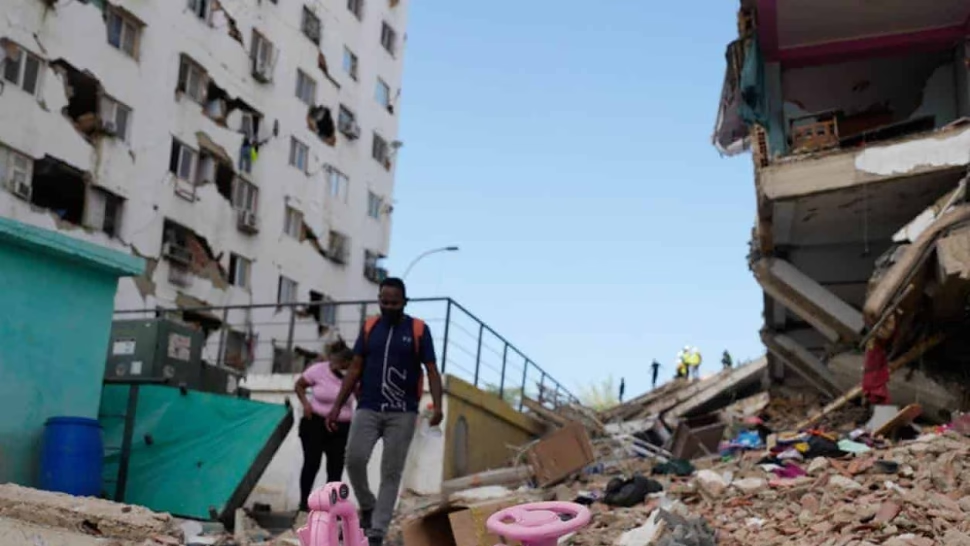
Earthquakes in Venezuela: citizens search for missing people in rubble

More than 920 dead and 51 thousand missing after two earthquakes in Venezuela.

The devastation caused by two consecutive earthquakes of magnitude 7.2 and 7.5 left at least 920 dead and more than 51,000 missing in Venezuela, according to official reports on Friday. The number of injured exceeds 3,300, while 243 people have been rescued alive.

Citizens take the search into their own hands

Inhabitants of areas such as La Guaira and Catia La Mar denounce the scarce presence of government rescue teams. With hammers and power tools, neighbors try to remove concrete slabs from collapsed buildings.

“My God, how do we get all the people out of there?” muttered Nazareth Jiménez, who is waiting for news of her brothers and nephews.

Omar Reyes walked among the rubble where two of his children are buried: “I was practically alone in this life.” He stated that about 20 relatives died.

Official response and international aid

The acting president Delcy Rodríguez assured that her government is deploying a total response in these “critical hours for the rescue.” He announced the militarization of La Guaira and the arrival of humanitarian aid. As of Friday, 861 international volunteers from Mexico, the United States, El Salvador, Switzerland and Colombia were working in the country. The UN reported that 25 search and rescue teams with 1,000 personnel are on the way.

However, residents consider the assistance insufficient. In Catia La Mar, looting of basic goods was recorded and the population improvised shelters in parking lots.

Stories among the rubble

Yuleidy Cadenas, 28, looks for her son, her mother and her brother in a collapsed tower in La Guaira. Friday was her son’s 12th birthday.

“I went up to the rubble and told them to yell at me, and no, no one. I just hope they get them out,” he said through tears.

The state press reported moments of hope: the rescue of a young man in Caracas and a girl covered in dust who emerged from a 10-story building. “We want to highlight this girl’s strength and desire to live,” said José Luis Núñez, head of the metropolitan rescue group.

Impact on the region

The International Organization for Migration estimates that up to 6.76 million people could be affected, about 2 million in Caracas alone. Loyce Pace of the Red Cross said: “People are still terrified to go back into their homes.”

The epicenter of the earthquakes was located near Morón, on the Caribbean coast, 170 kilometers west of Caracas. The superficiality of the movements amplified the destruction, explained geophysicist Marcos Ferreira of the Geological Survey of Brazil.

Continue reading