


Strategic Deployment of American Naval Power
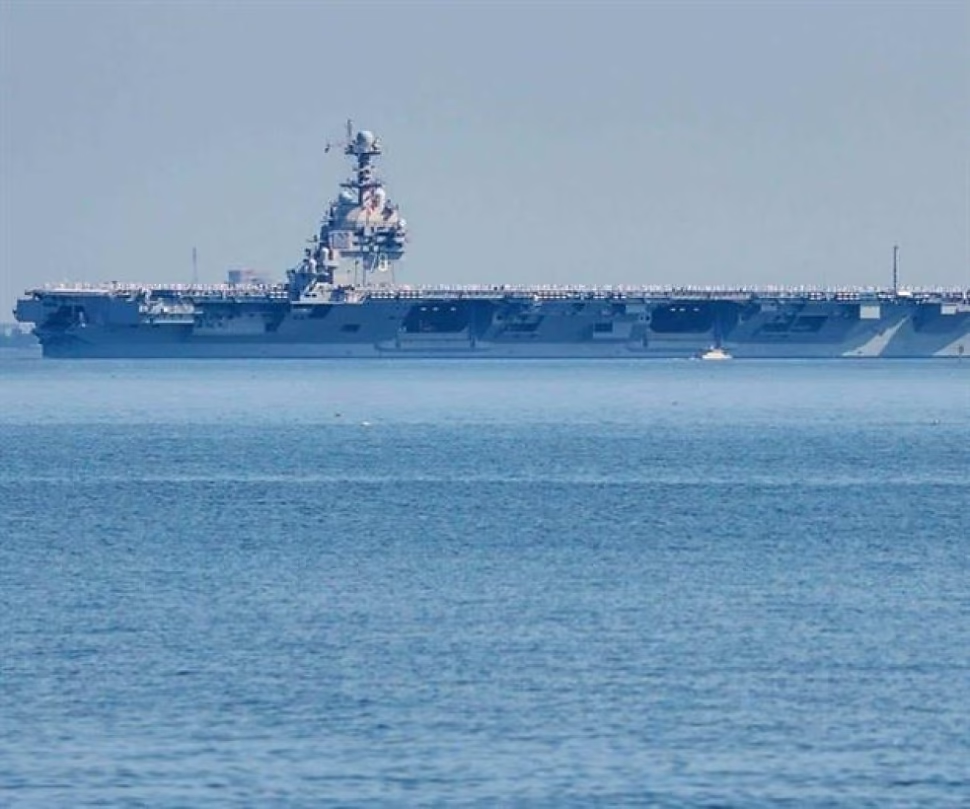
The most advanced aircraft carrier in the United States Navy, the USS Gerald R. Ford, arrived in the Caribbean Sea in a demonstration of high-level military capabilities. This tactical move generates an intense analysis of the strategic intentions of President Donald Trump’s government in South America, in the context of a military offensive against vessels suspected of drug trafficking.
The arrival of the flagship and its battle group, officially announced by the US Navy, constitutes a significant milestone within the so-called Operation Southern Lance. Although the administration insists on the character of an anti-drug operation, international observers interpret it as a maneuver of upward pressure against the government of Venezuelan president Nicolás Maduro.
Operational Capabilities and Military Context
The USS Gerald R. Ford consolidates the largest deployment of US military power in the region in decades. This mission includes almost a dozen warships and approximately 12,000 troops, including sailors and marines. The crossing of the strike group, which includes combat aviation squadrons and guided missile destroyers, was carried out through the Anegada Pass, near the British Virgin Islands.
At the same time, the Southern Command reported a new lethal raid against a speedboat, allegedly loaded with illegal shipments, in international waters of the eastern Pacific Ocean. This episode, documented in a video broadcast on the X platform, resulted in the death of three individuals. Since the beginning of these operations in September, the 21 attacks carried out by the United States in the Caribbean and the eastern Pacific have left at least 83 dead.
Official Positions and Regional Reactions
Rear Admiral Paul Lanzilotta, commander of the strike group, stated that their mission is to reinforce a flotilla of warships to “protect the security and prosperity of our nation against narcoterrorism in the Western Hemisphere.” For his part, Admiral Alvin Holsey, head of the Caribbean and Latin America, declared that US forces “are ready to combat transnational threats that seek to destabilize our region.” Holsey, who will retire soon, called the deployment “a critical step in reinforcing our resolve to protect the security of the Western Hemisphere.”
In Trinidad and Tobago, a nation located just 11 kilometers from Venezuela, authorities confirmed the start of joint “training exercises” with the US army. Foreign Minister Sean Sobers explained that these maneuvers, the second in less than a month, seek to address violent crime in the archipelago, which functions as a transit point for drug shipments bound for Europe and North America. The exercises involve marines of the 22nd Expeditionary Unit, deployed for months on ships off the Venezuelan coast.
The government of Venezuela has classified these training exercises as an act of aggression. So far, Caracas has not made an official statement about the arrival of the aircraft carrier.
Strategic Implications and Geopolitical Analysis
Army Secretary Dan Driscoll highlighted that US troops have been training in Panama, reactivating their jungle school, underscoring the government’s increasing focus on Latin America. He assured that the forces are prepared to act in any scenario that Trump and Secretary of War Pete Hegseth determine.
Although the US administration insists that the central objective is to interrupt the flow of narcotics, it has not provided public evidence to support its claims that the people neutralized in the attacks were “narcoterrorists.” Trump has signaled that military action will expand beyond maritime attacks, declaring that the United States will “stop drugs coming in by land.”
Historically, the United States has used its aircraft carriers as instruments of deterrence and pressure, given the ability of its aircraft to hit targets inside other countries. Analysts point out that the USS Gerald R. Ford, although it is not the ideal platform to confront the cartels, represents an extremely effective tool of intimidation against the Maduro regime.
The Secretary of State, Marco Rubio, has reiterated that the United States does not recognize Maduro – accused of electoral fraud – as the legitimate leader of Venezuela, labeling his government as a “transshipment organization” that openly collaborates with drug traffickers. Maduro, who faces narcoterrorism charges in the United States, accuses the North American government of inventing a war against him. On his social networks, the Venezuelan president wrote: “The people are awake, willing and prepared to defend our Homeland against any threat and criminal aggression.”
Venezuela has promoted a “massive” mobilization of troops and civilians to defend itself from potential attacks. Maduro and other senior officials participated in demonstrations to support the creation of neighborhood committees aimed at strengthening the ruling party.
Trump’s justification for the attacks is based on the existence of an “armed conflict” with the cartels, which he considers terrorist organizations. However, this position has met with resistance among regional leaders, the UN High Commissioner for Human Rights and US legislators of both parties, who demand greater trans


