A Steel Giant Sails Towards Chaos (and Perhaps a Coup)
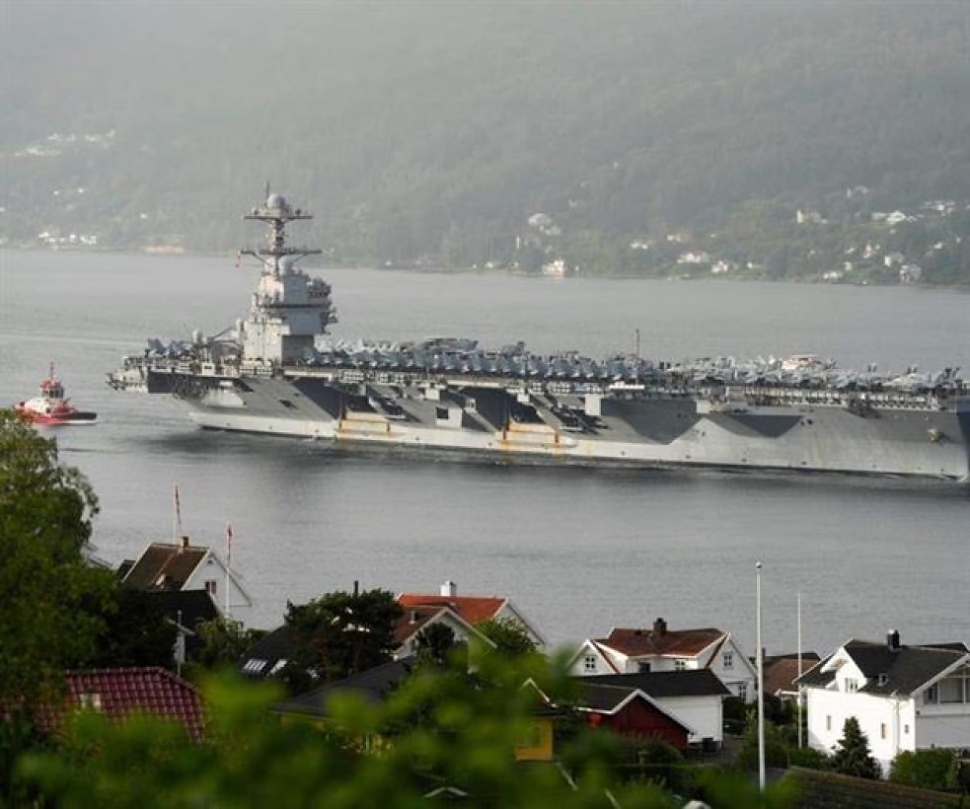
Well, it turns out that the Latin American neighborhood is about to receive a not-so-surprise visit: the USS Gerald R. Ford, basically the US Navy’s most expensive and lethal folding cell phone, is en route to the waters off Venezuela. This is not a simple patrol; It is the most intense demonstration of military power the region has seen in generations. And everyone, from the pundits to your Facebook-reviewing uncle, is wondering if this is a high-level geopolitical bluff or the prelude to a Netflix-style drama.
Those in the know do not agree. Will fighter planes take off from Ford to bomb targets inside Venezuela and pressure the departure of the authoritarian president, Nicolás Maduro? Or, in a less apocalyptic twist, will he just patrol the Caribbean while the United States destroys ships it accuses of trafficking narcotics? Whatever the script, the mere presence of this 100,000-ton warship is screaming, “Hey, we’re here, and we didn’t come for coffee.”
“This is the anchor of what it means to have United States military power once again in Latin America,” said Elizabeth Dickinson, an analyst with the International Crisis Group. “And this has generated a lot of anxieties in Venezuela, but also throughout the region. I think everyone is watching this with some expectation to see how willing the United States is to actually use military force.” I mean, we’re all in airplane mode, watching the drama unfold.
Anti-Drug Operation or Mission: Regime Change?
The imminent arrival of the Ford is the high point of the Trump administration’s campaign in South America, which they sell as an epic anti-drug operation. This escalates an already massive buildup of power in the area, which includes bomber training near the Venezuelan coast, publicly authorized CIA operations within the country, and attacks on vessels that have left more than 75 dead. A complete combo of geopolitical tension.
The United States has a long history of using aircraft carriers as deterrence tools to influence other nations, often without even firing a shot. They are basically floating cities that transport thousands of sailors and dozens of combat aircraft capable of attacking targets in the heart of a country. The message is clear: persuasion is best when backed by a ton of explosives.
Secretary of State, Marco Rubio, insists that President Donald Trump is focused on stopping the entry of drugs into the United States by combating “organized criminal narcoterrorists.” “That is what he has authorized. That is what the Army is doing. That is why our assets are there,” he declared. But, in a plot twist that no one saw coming, Rubio also claims that the United States does not recognize Maduro as a legitimate leader and has called his government a “transshipment organization” that openly cooperates with traffickers. In other words, it is an anti-drug operation that conveniently targets the government that they don’t like. What a coincidence, right?
And this is where analysts take out their magnifying glasses. “There is nothing that an aircraft carrier provides that is useful in combating drug trafficking,” Dickinson said. “I think it is clearly a message much more aimed at putting pressure on Caracas.” Basically, it’s like bringing a flamethrower to a pillow fight.
War Games and Real Risks
Bryan Clark, a former submariner and Hudson Institute analyst, was more direct: the Trump administration would not have deployed the Ford “if they didn’t intend to use it.”“I think this administration is very open to using military force to achieve particular objectives,” he added. “I think they’re going to want to do some military operations unless Maduro resigns in the next month or so.” In other words, they are putting a clock on the matter.
Meanwhile, the Venezuelan government, in an episode of pure geopolitical theater, promoted a “massive” mobilization of troops and civilians to defend itself against possible attacks. Defense Minister Vladimir Padrino López spoke of deploying “land, air, naval, river and missile means” in a two-day preparation effort to “confront imperial threats.” State television showed formations of soldiers and militias, because nothing says “we are ready” like a good propaganda display.
But not everything is so simple. Mark Cancian, a retired colonel, noted that Venezuela has relatively sophisticated air defense systems, purchased from Russia, that could put US pilots at risk. “Because they have so many systems, some are relatively new and all are mobile, we probably wouldn’t get them all,” he admitted. “So there is some risk that we could lose some planes.” Translation: this wouldn’t be a free military ride.
The situation has generated resistance in the region and in the US Congress. Colombia, under its president Gustavo Petro (sanctioned by the US), temporarily suspended the intelligence exchange, although it later softened its position. Mexico, for its part, decided to play a more active role, with President Claudia Sheinbaum announcing an agreement for its navy to intercept ships in international waters and thus prevent more attacks near its coasts. The regional message is clear: no one wants an open conflict, but everyone is preparing for the worst.
At the end of the day, the Ford deployment is a high-risk move on the geopolitical chessboard. As Cancian summarized, “It’s a use it or lose it situation.” The aircraft carrier cannot prowl the Caribbean indefinitely; It is too valuable an asset that could be needed in another hot spot in the world, such as the Middle East. This leaves a limited window of time where the show of force must achieve its objective, or risk becoming an expensive light show.
Do you think this is a masterstroke or an epic miscalculation? Share this analysis on your social networks and stay up to date with more content that deciphers global dramas.