A Deployment That Smells More Like Geopolitical Chaos than ‘War on Drugs’
Well, apparently the Caribbean is the new setting for the ‘Top Gun’ spin-off that no one asked for. This Thursday, Cuba, with all the diplomatic sarcasm that characterizes it, strongly rejected the deployment of warships and troops by the United States in the region. Havana did not bite its tongue and described Washington’s arguments as, and I quote, an “absurd excuse.” Because, let’s be honest, using the excuse of fighting drug trafficking to send a flotilla of warships is like saying that you are going to put out a fire with a gas station. It sounds suspicious from minute zero.
The presence of this military fleet has not gone unnoticed. In recent days, it has generated palpable concern in several Latin American and Caribbean nations that, spoiler alert, have no interest in becoming the battlefield of a geopolitical battle between two titans. Who was going to say it?
In an official statement that mixes formality with a subtext of “seriously, again?”, the Cuban Foreign Ministry went straight to the point: “This dangerous act represents a serious threat and an aggressive demonstration of force that threatens the sovereignty and self-determination of the peoples of Latin America and the Caribbean.” Basically, the geopolitical equivalent of your neighbor parking a tank in your yard and saying it’s for hunting moles.
The Pretext (Sorry, the “Justification”) of Washington
According to the Cuban authorities, the US accusation of associating the government of Nicolás Maduro with “criminal organizations of illicit drug trafficking constitutes an absurd pretext that lacks foundation.” In other words, the classic strategy of creating a villain to justify your own action movie. Last week, the Trump administration ordered the deployment of three warships to Caribbean waters off the Venezuelan coast. All of this, supposedly, to combat the threats of Latin American drug cartels. Because nothing says “fight drug trafficking” like battleships and marines.
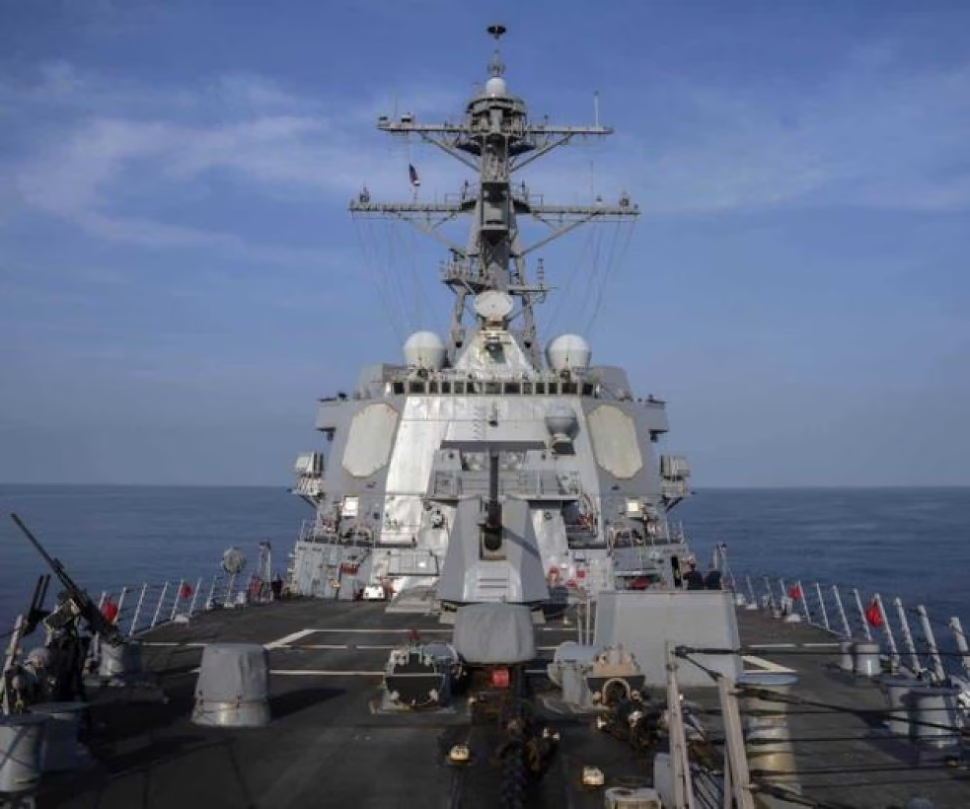
An anonymous official from the United States Department of Defense (because in the drama there is always a mysterious character) confirmed on Wednesday that the Navy already has two ships – the USS Gravely and the USS Jason Dunham – plying Caribbean waters, plus the destroyer USS Sampson. And if that were not enough, the USS Lake Erie prowls the Pacific off Latin America. Because when it comes to showing muscle, more is more.
But here comes the plot twist: the Department of Defense did not specify what the real mission of the working group will be. Despite reports insisting that they are part of a force intended to combat cartels, the vagueness is so evident that even a character in a spy novel would be stumped. Meanwhile, three amphibious assault ships and more than 4,000 sailors and Marines who deployed from the east coast of the United States will enter South American waters next week. Nothing like a vacation in the Caribbean, but with canyons.
Logically, this advance of ships sailing through the Caribbean towards South America further raised the tension between Washington and Caracas. Maduro, who does not remain silent or underwater, maintained that Washington’s accusations against him are unfounded and that they seek to destabilize his government. In a speech that mixes indignation with textbook anti-imperialist rhetoric, he dropped this gem: “Let the war they want be waged in the United States against the mafias of the United States that control the entire drug trafficking business in Colombia, Central America and beyond; it is the mafias of the United States that control it, they know it.” Touché.
And Meanwhile, in the Caribbean: The Domino Effect of the Neighborhood Drama
Not only Cuba and Venezuela are on the lookout. The presence of American warships in the Caribbean also generated some reactions among the small countries in the region, which are caught in the crossfire of a conflict that is not theirs. Imagine being the friend who has to mediate the other couple’s fight at dinner. Awkward, right?
This week the Prime Minister of Curacao, Gilmar “Pik” Pisas, came forward to reiterate that his country “is and will remain neutral” in the increase in tensions. Curacao is only 65 kilometers from the Venezuelan coast, so Pisas sought to reassure the population. Basically, the message was: “Guys, please, fight somewhere else, because here we have sun, beach and zero desire for a missile to fall in our mojito.”
Last week, several leaders gathered at a forum of the Bolivarian Alliance for the Peoples of Our America (ALBA) – a mechanism that brings together several of the Venezuelan government’s allies – also expressed their rejection of the US military deployment. Among those present was Ralph Gonsalves, Prime Minister of Saint Vincent and the Grenadines, adding his voice to the chorus of disapproval. Because when the noisy neighbor starts moving his furniture, everyone in the building complains.
In response, and to demonstrate that it is not going to sit idly by, Venezuela announced on Tuesday the deployment of its own navy ships, drones and more than 15,000 troops to reinforce anti-drug operations on the border with Colombia and Caribbean waters. A move that, clearly, is the response to the power struggle that is being waged. The message is clear: if you are going to play ships, we have ours too.
In short, we are facing another chapter of the eternal geopolitical soap opera that takes place in our backyard. With excuses that smell more like interventionism than cooperation, and rhetoric that fuels tension more than a solution. And all, while the Caribbean tries to continue with its life, as if it did not have enough with climate change and the hurricane season.
Did you find this analysis of the geopolitical crisis in the Caribbean revealing?Share it on your social networks and help more people understand what is really happening behind the headlines. And if you want to explore more content related to international news and its dramas, be sure to check out our other publications. Reality sometimes surpasses fiction.