T-MEC without extension: automatic validity until 2036, says Sheinbaum

If the US does not send a letter, the agreement is automatically extended until 2036, with annual reviews.

Given Donald Trump’s threats not to renew the USMCA, President Claudia Sheinbaum clarified this Friday that the trade agreement between Mexico, the United States and Canada has an automatic validity of 10 additional years if the non-extension letter is not sent in the next 16 years.

“It is not a deadline today,” he explained from the National Palace. “If the letter is not sent by the United States in the next 16 years, the treaty will be maintained for the 10 years it is in force, only there will be an annual review.”

RelatedCanada matches US tariff exemptions in the T-MEC

Validity details

Sheinbaum explained that, in the event that the US government decides not to extend, the T-MEC will remain in force until 2036. “It would be reviewed every year, the characteristics of that review can be defined in the coming months,” he added.

If at any time within that period the three parties agree to extend it for another 16 years, it is possible to do so. “It is not that it can no longer be extended,” he pointed out.

On July 20, a delegation from the Office of the United States Trade Representative (USTR) will meet with representatives of the Mexican government to continue reviewing the agreement.

“A USTR team would come to Mexico to continue with this review,” the president reported. The definition of the characteristics of this annual review will be resolved in the coming months.

Banco del Bienestar manager linked to theft of 5 million

Three arrested, including the manager, for the theft of 5 million pesos from a bank branch.

Details of the robbery at Banco del Bienestar

The Nuevo León Prosecutor’s Office arrested three people for the theft of 5 million pesos in a branch of the Banco del Bienestar in Guadalupe. Among those arrested is Delia “N”, bank manager, identified as a participant in planning the robbery. She was arrested on June 25 and remains in preventive detention.

The other two detainees are Alexis “N”, 25 years old, and Armando “N”, 50, linked to proceedings for illegal operations and crimes against health. The State Investigation Agency carried out searches in Apodaca and San Nicolás de los Garza.

They recover part of the loot and vehicles

The authorities recovered 1 million 851 thousand 200 pesos of the stolen money. They also seized a Ford Mustang and a Chevrolet Colorado, acquired with illicit resources. In addition, a GMC Terrain, a Chevrolet Aveo, a Chevrolet Spark and a Ford Escort were seized; the latter would have been used in the robbery.

According to the investigation, two men dressed in black entered the bank after the clients left, threatened the employees and forced them to open the safe. They locked the staff in a bathroom and fled with the 5 million. The investigation remains open.

Continue reading

PAN demands investigation into editorial piracy in Mexico

Book piracy generates profits of up to 19 billion pesos in Mexico.

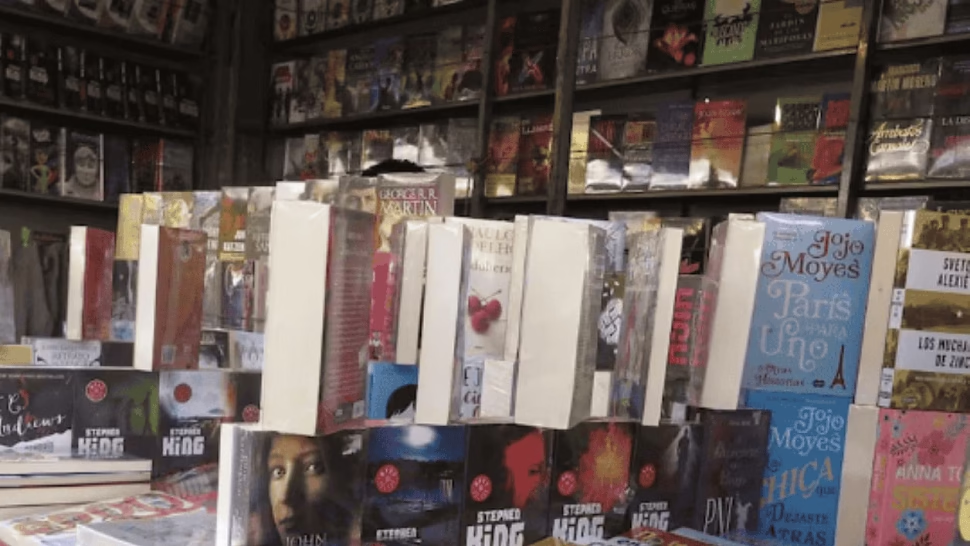
The PAN parliamentary group in the Chamber of Deputies asked the SEP, the IMPI and the FGR for an in-depth investigation into what they call book piracy in Mexico. The request arises after a report by EL UNIVERSAL that revealed profits of up to 19 billion pesos in this illegal market.

Of every 10 copies on sale, five are pirates, according to data from the Mexican Center for the Protection and Promotion of Copyright and the National Chamber of the Mexican Publishing Industry.

The impact of editorial piracy

Federal deputy Daniel Chimal García pointed out that book piracy has become an industry where criminal groups have entered to obtain illicit resources.

“Although we Mexicans do not read due to lack of campaigns that promote this habit, now with pirated books there is a risk of professional training under erroneous publishers,” he explained.

On average, a Mexican reads 2.4 books a year, but the industry is vulnerable due to the cloning of pages, the theft of authors and tax evasion by those who reproduce books without permission. “Book crime steals more than 50 percent of publishers and is a profitable business because they offer books at a lower cost than the original,” he added.

The storage and distribution warehouses are located mainly in the Zócalo of the capital, Iztapalapa, Ciudad Neza and Naucalpan. From there, the clandestine sales points reach states such as Veracruz, Oaxaca, Michoacán and Jalisco, considered influential markets for crime.

In recent years, piracy has grown between 15 and 20 percent, due to the lack of supervision and sanctions in various spheres of the government. In the first batch, at least 300,000 illegal copies were sold, including children’s books, music books, entertainment books, and school books.

Continue reading

Three workers injured by fire at Salina Cruz refinery

Three Pemex employees suffered minor burns after a fire at the Salina Cruz refinery.

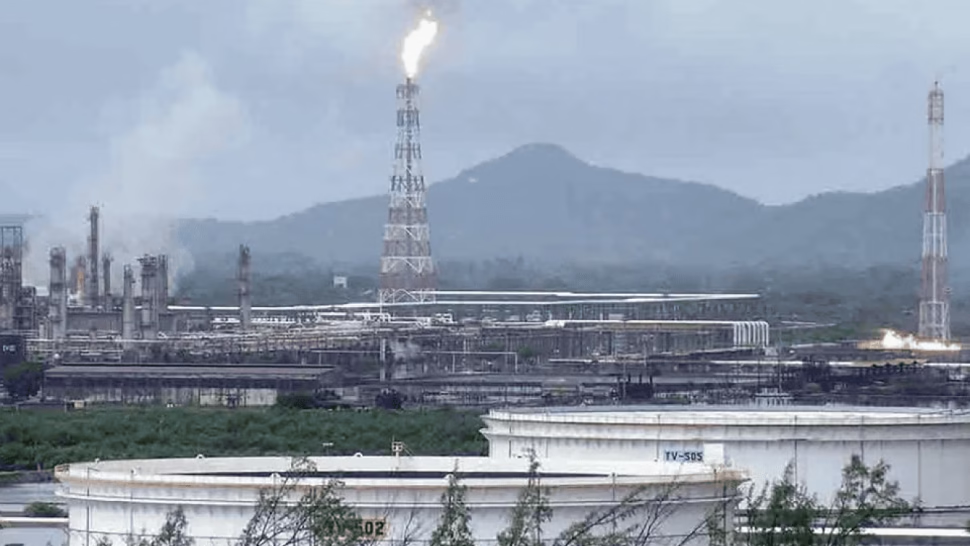
Three Petróleos Mexicanos workers suffered minor burns after an incident at the Salina Cruz refinery, Oaxaca. The parastatal clarified that it was not an explosion, but rather a “flare.”

Incident details

The event occurred during maintenance work at the Alkylation Plant. According to Pemex, the flame occurred in the GA-311 B bottom pump of the DA-304 Fractionation Tower. The company assured that the incident was immediately controlled in accordance with established security protocols.

The three employees suffered minor burns and were taken to the Pemex General Hospital. Their health status is stable and they remain under observation.

No major damage

Pemex stated that the flare did not cause damage to the refinery’s infrastructure. Therefore, operations at the plant continue normally. The company did not provide the names of the injured or additional details about their evolution.

These types of incidents are not recurring at the Salina Cruz refinery, one of the most important in the country with the capacity to process 330 thousand barrels of crude oil per day. Union organizations have pointed out in the past the need to reinforce security protocols at oil facilities.

As of press time, the Ministry of Labor had not issued a statement regarding possible sanctions or additional investigations.

Continue reading