Mexico achieves key extension in T-MEC negotiations with the United States

A strategic respite in the trade tension that redefines the bilateral relationship and the future of the treaty.

Context and scope of the trade agreement

After intense diplomatic negotiations, the governments of Mexico and United States reached a temporary understanding that suspends for 90 days the application of tariffs of 30% on Mexican exports. This development, jointly announced by President Claudia Sheinbaum Pardo and US President Donald Trump, represents a turning point in complex bilateral trade relations, according to analysis by experts in international economics.

Strategic implications for the USMCA

The Secretary of Economy, Marcelo Ebrard, emphasized during the morning conference that this agreement does not constitute a mere extension, but rather a substantial diplomatic advance. “This places Mexico in an unprecedented advantageous position on the global stage,” the official declared, stressing that the country preserved its interests without making additional concessions. Data from the World Bank reveal that Mexico is the second largest trading partner of the US, with bilateral exchange that exceeded $780 billion in 2023.

RelatedCanada matches US tariff exemptions in the T-MEC

Comparative analysis shows that only China had obtained similar conditions in recent negotiations, according to records from the US Department of Commerce. Ebrard highlighted: “The 90-day period aligns the times with the legislative calendar for the ratification of the T-MEC”, referring to the parliamentary review process that would culminate at the end of the year.

Economic impact and future prospects

Studies from the Mexican Institute for Competitiveness (IMCO) project that the imposition of tariffs would have affected 34% of manufacturing exports, particularly in the automotive and agro-industrial sectors. Temporal resolution avoids losses estimated at $15 billion annually, according to econometric models.

Experts consulted agree that this agreement reinforces Mexico’s negotiating credibility, especially in the face of global trade tensions. “The result demonstrates technical capacity and inter-institutional coordination,” said Ana Bertha Gutiérrez, CIDE researcher specialized in foreign trade. However, he warned that the coming months will require constant monitoring of labor and environmental conditions, critical points in the review of the T-MEC.

The Mexican government is now preparing a comprehensive strategy that includes sectoral tables with businessmen and technical meetings with US counterparts. Leaked internal documents reveal plans to modernize 14 customs offices and strengthen dispute resolution mechanisms.

Call to action

This analysis highlights the importance of following key business developments. Share this content on your social networks to keep your professional network informed and explore more articles on international relations in our specialized section.

US alert for security in Mexico vs England at the 2026 World Cup

United States Embassy issues warning to its citizens for Sunday's game.

The United States Embassy in Mexico issued a security alert aimed at its citizens in the country, on the occasion of the match between Mexico and England on Sunday, July 5 at the Mexico City Stadium, within the round of 16 of the 2026 World Cup.

The diplomatic representation, headed by Ambassador Ronald Johnson, warned that during the tournament there have been large gatherings in stadiums, Fan Fests and public spaces, which has caused incidents at recent celebrations in the capital.

Embassy recommendations

In its message, the embassy recommended extreme precautions at mass events. He pointed out that gatherings to watch games and celebrations have caused injuries and even deaths, so he asked to be attentive to the environment and avoid risky situations.

The alert also included warnings about possible mobilizations and demonstrations during the event. He indicated that participating in political activities could lead to immigration arrests or sanctions under Mexican law.

Continue reading

In June, Mexico reaches the lowest number of homicides since 2007

June closed with a daily average of 40 homicides, the lowest record in 19 years.

During June, Mexico recorded an average of 40 intentional homicides per day, the lowest monthly figure since 2007, according to preliminary data from the federal government. Although at the beginning and end of the month there were days with more than 50 cases, the general trend was downward compared to the same period in 2025.

The impact of the World Cup

The decline coincided with the start of the 2026 Soccer World Cup. On the opening day in Mexico, only 30 homicides were recorded. Throughout the month, the numbers fluctuated, but remained below the historical average.

Entities with the highest incidence

Guanajuato topped the list of homicides with 124 victims. In contrast, the World Cup host states reported reductions: Nuevo León added 30, Jalisco 51 and Mexico City 59, all below the June 2025 figures.

Strategy and challenges

Federal authorities attribute the reduction to President Claudia Sheinbaum’s security strategy, which includes coordinated actions against organized crime and a greater police presence. However, civil organizations point out that problems persist in the registration of other crimes, such as disappearances and femicides.

Continue reading

Mexico: 178 journalists murdered in 26 years, most in Veracruz

178 journalists deprived of their lives since 2000. Veracruz tops the list.

Violence against the press in Mexico

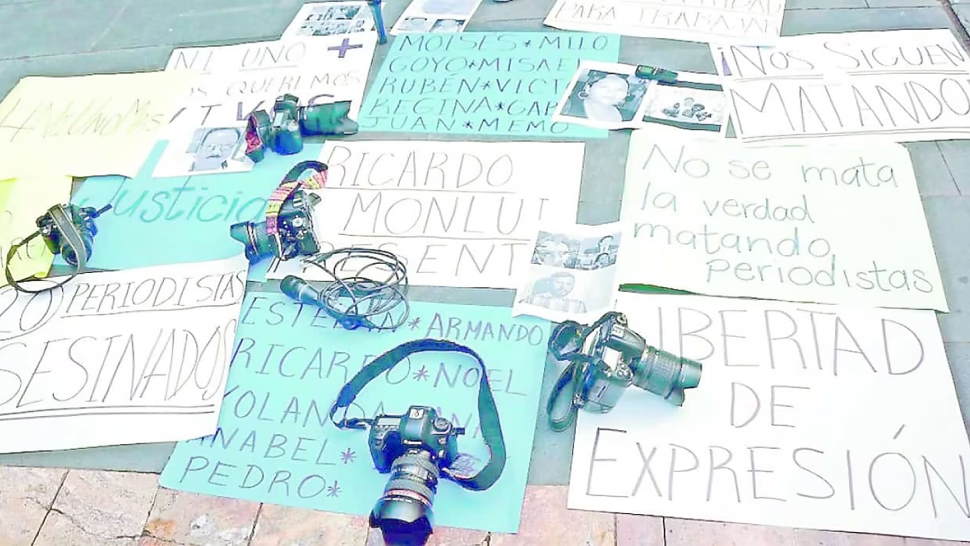
Since 2000, 178 journalists and communicators have been deprived of their lives in Mexico, according to data from the organization Article 19. The most recent case is that of Roxana Berenice Guzmán Ramírez, who was found dead more than a month after her disappearance in Veracruz.

Veracruz is the most violent entity for the press with 34 fatalities, followed by Guerrero with 19. Chihuahua, Oaxaca and Tamaulipas register 15 each. Of the total, 165 were men and 13 women.

The most lethal six-year term was that of Felipe Calderón (2006-2012) with 48 homicides. They are followed by the governments of Enrique Peña Nieto and Andrés Manuel López Obrador, with 47 each. In contrast, seven states did not report fatalities in the same period: Aguascalientes, Campeche, Colima, Hidalgo, Querétaro, Tlaxcala and Yucatán.

Article 19 has called on authorities to guarantee justice and strengthen protection mechanisms. Impunity continues to be a key factor that aggravates violence against the press in Mexico.

Continue reading