Announcement of Bilateral Agreements on Security and Trade
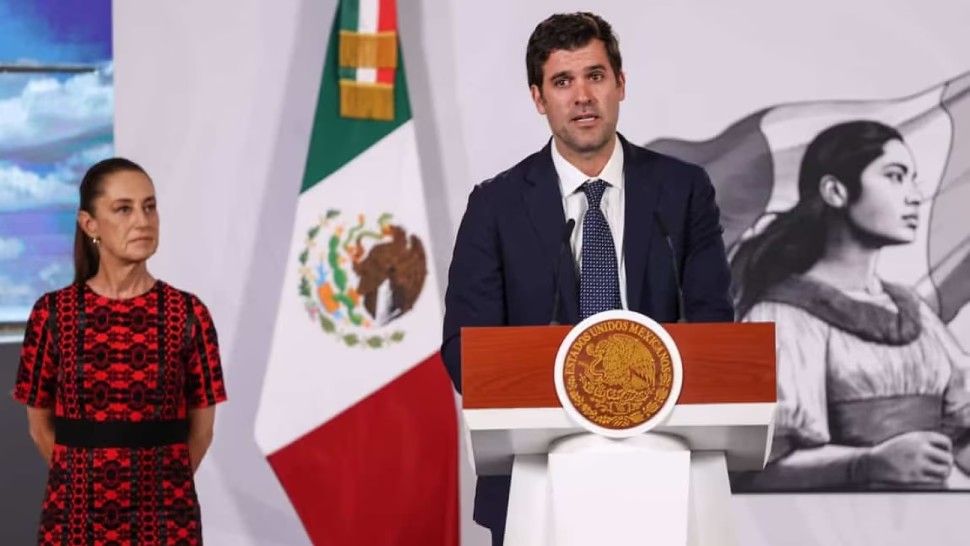
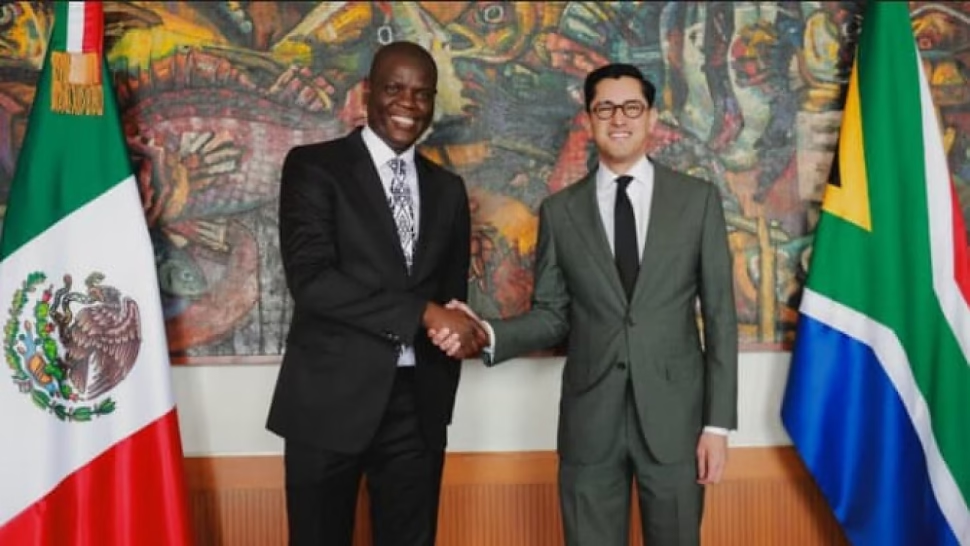
A meticulous investigation of recent events confirms that, during the first week of November, the governments of Mexico and the United States will make public a series of substantive agreements. These pacts, the result of a 90-day negotiation period established by the US administration, will cover critical areas such as binational security, the fentanyl crisis, migratory flows and various aspects of the trade relationship. The Undersecretary of Foreign Trade, Luis Rosendo Gutiérrez Romano, provided this information, indicating that the announcements will be made by President Claudia Sheinbaum. The formalization of these understandings will occur during the meeting between the Secretary of Economy, Marcelo Ebrard Casaubon, and the United States trade representative, Jamieson Greer, within the framework of the Asia-Pacific Economic Cooperation Forum (APEC) summit, scheduled from October 31 to November 1 in Gyeongju, South Korea.
The context of this development is framed in the Global Investors Symposium organized by the Milken Institute in Mexico City. During his speech, the Mexican official explained that, regarding the review of the Treaty between Mexico, the United States and Canada (T-MEC), the prospects are highly positive. “Our analysis leads us to conclude that we are going to reach a very good port, which is the first week of November,” said Gutiérrez Romano. The meeting in Seoul between Ebrard and Greer will serve as the definitive setting to evaluate the progress accumulated during the designated period, consolidating a structured diplomatic process with clear objectives.
In-Depth on the Topics of the Bilateral Agenda
The data collected indicates substantial progress on specific components of the agenda. The undersecretary added that “significant progress has been made in border security and on the issue of fentanyl.” At the same time, significant advances have been registered in the mechanisms for the protection of the trade agreement. This evaluation suggests a comprehensive approach by both nations, addressing both public security challenges and the facilitation of economic exchange. The logical conclusion of this process will be the announcements by President Sheinbaum and Secretary Ebrard, sealing the agreements with their American counterpart.
Regarding the trilateral dynamic, the investigation confirms the existence of a continuous dialogue between Canada and the United States. Gutiérrez Romano highlighted Mexico’s coordinated efforts, noting that “the two partner countries are advancing our relations with the United States within the trilateral agreement.” This point is crucial, as it underlines that, although the immediate announcements are bilateral, the USMCA framework remains the institutional basis of the economic relationship in North America. Available evidence suggests that concrete progress has been made in resolving mutually raised trade concerns.
Trade Harmonization and Future of the T-MEC
A detailed examination of official statements reveals that the progress refers to an exchange of comments and proposals to improve the efficiency of the economic relationship, not necessarily to the elimination of trade barriers in the traditional sense. In such a complex and large-scale relationship, it is common to identify areas for continuous improvement and joint optimization. The approach, as expressed by Secretary Marcelo Ebrard, is to “clear the table” of operational pending issues to concentrate on the substantive negotiations of the treaty, without the distractions of issues that are not inherent to it. This involves technical work such as the homologation of criteria in technology and the review of software issues.
Regarding speculation of a purely bilateral review of the USMCA, the analysis concludes that the three countries will maintain their commitment to the trilateral trade union. The evidence provided by the undersecretary suggests that the primary objective is not the configuration of the parties involved, but rather to ensure that the results are beneficial to the national interests of Mexico. This stance reflects strategic pragmatism and a deep understanding of regional economic interdependence.
Stability of Foreign Investment: The Samsung Case
With regard to the stability of the investment climate, the particular situation of the Korean company Samsung was investigated, which faces an alleged case of double taxation. The Mexican authorities, according to the Undersecretary of Foreign Trade, have maintained “very close” communication with the corporation to address their concerns. The most relevant data obtained from these interactions is the company’s express commitment to remain in the country. “They have told us that they will remain in the country openly. They have told us that they do not want to leave our country,” said Gutiérrez Romano.
The company is exercising its right to defend its position before the Mexican judicial authorities, a common process in any jurisdiction. However, the fundamental conclusion, based on the conversations held, is that Samsung has communicated that, regardless of the final ruling, it will maintain its presence and its investment in Mexico. This fact is a positive indicator of the confidence of large investors in the solidity of the Mexican legal and economic framework, even when specific disputes arise.
The developments planned for November represent a significant milestone in the Mexico-United States relationship, marking a trajectory of strengthened cooperation and constructive dialogue on issues of the greatest importance to both nations.
Did you find this analysis valuable? Share this information on your social networks to keep your network informed and explore more content related to foreign policy and international trade on our site.