A plot twist that not even the most creative screenwriter would dare to write
Well, then hold on because the Venezuelan political soap opera has just launched its most surreal season. In an episode that mixes House of Cards with a Call of Duty mission, Delcy Rodríguez has gone from vice president to president in charge of Venezuela. The trigger? That his boss and ally, Nicolás Maduro, was literally captured by the United States in a nighttime military operation that sounds more like an action movie than international diplomacy. Now, she is offering to “collaborate” with the Donald Trump administration, in what could be the geopolitical plot twist of the year, or simply a desperate attempt to not go down with the ship.
Rodríguez, who since 2018 has been pulling the strings of the Venezuelan oil economy as if it were a video game in difficult mode, was sworn in on Monday before the National Assembly. Meanwhile, Maduro was making his debut in a New York court, facing narcoterrorism charges and pleading not guilty with a face that surely deserves a meme. The scene is worthy of a crossover between a judicial series and a political thriller.
A discourse between pain and strategy
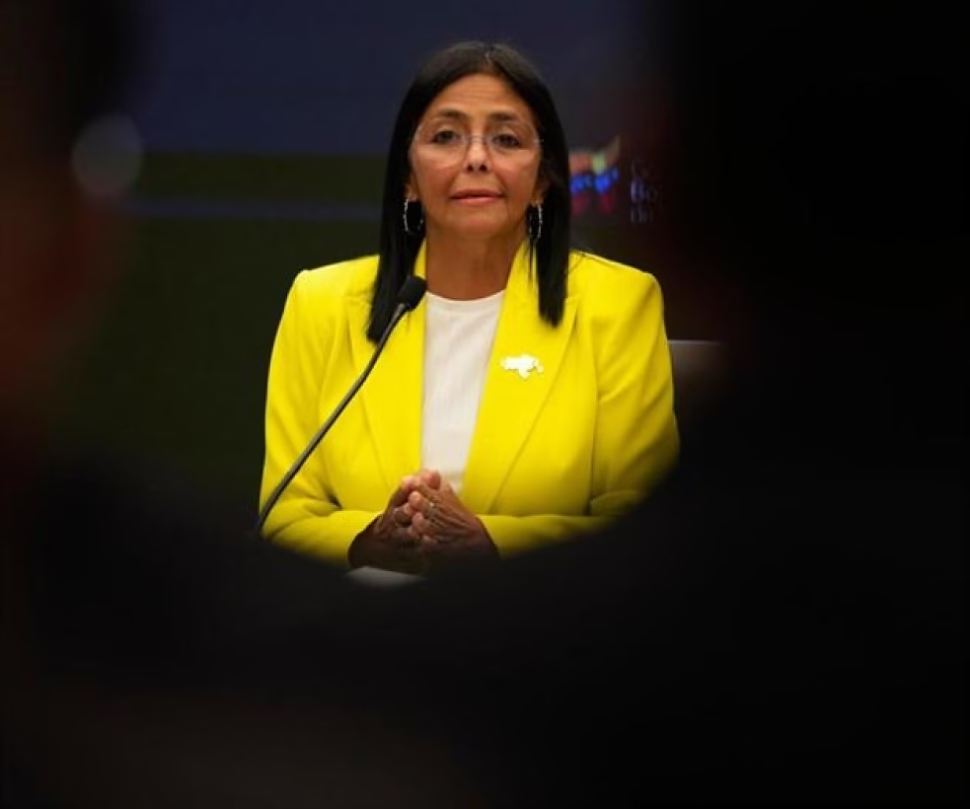
With his hand raised in a luxurious hall of the Legislative Palace, Rodríguez gave a speech that had more layers than an onion. “I come with pain for the suffering that has been caused to the people,” he said, referring to the “illegitimate military aggression.” He also spoke of the “kidnapping” of two “heroes”: Maduro himself and the first lady, Cilia Flores. An emotional script, although many wonder if behind those words there is a political survival manual.
The truth is that Rodríguez and a group of senior officials of Chavismo now seem to be in control, even with Trump threatening from Washington. The Venezuelan Supreme Court of Justice, in a move that no one saw coming on Saturday, ordered her to take over as acting president, and the army, that eternal arbiter of power in the country, gave her its support. A key support in a nation where those in uniform usually have the last word.
And now what? The implications of a scrambled board
Rodríguez, a 56-year-old lawyer with training in the United Kingdom and France, has been the faithful shield of the revolution since the time of Hugo Chávez. The big question at the moment is whether he will approach the Trump administration or follow the line of confrontation of his predecessor. Her promotion was so surprising that even Trump himself announced that his Secretary of State, Marco Rubio, had been speaking with her and described her as “courteous.” Rubio, for his part, dropped the gem that he could work with her, unlike Maduro. Come on, a change of protagonist approved by the villain of the story.
However, in a televised speech, Rodríguez initially showed no desire to cooperate, calling the Trump government “extremist” and defending Maduro’s legitimacy. But, oh surprise, on Sunday he published a message on Instagram (because today even geopolitical crises are managed on networks) with a conciliatory tone, talking about building “respectful relationships” and “shared development“. A turn worthy of an influencer who rectifies after a controversy, but on a state level.
The profile of the new protagonist: between the family legacy and Wall Street
The interim president and her brother, Jorge Rodríguez (head of the National Assembly), have leftist credentials peppered with family drama. His father was a socialist leader who died in police custody after being involved in a kidnapping in the 1970s. Unlike others in Maduro’s circle, the Rodríguezes have (so far) dodged criminal charges in the US, although Delcy did face US sanctions for undermining democracy.
The most ironic thing about his profile is his ties with Republicans in the oil industry and Wall Street. Yes, the same one who chaired an assembly to counter the opposition in 2017, also knows how to move in the circles of capital. A complex character who enjoys a “very particular” relationship with power and the Armed Forces, according to analysts.
Threats, deadlines and the uncertain future
Trump wasted no time in raising the stakes. He warned that if Rodríguez did not fall in line, “he will pay a very high price, probably higher than Maduro,” and demanded “full access” to infrastructure and oil. Meanwhile, analysts such as Geoff Ramsey of the Atlantic Council speculate that his initially firm tone may have been an attempt to “save face” with his base, because it is clear that Maduro’s capture required some internal collaboration.
Venezuela’s Constitution requires elections in 30 days if the president becomes “permanently unavailable.” But the loyal Supreme Court, in its decision on Saturday, declared Maduro’s absence as “temporary”, activating an article that allows the vice president (a non-elected position) to govern for up to 90 days, extendable to six months. And therein lies the trick: the court did not mention that limit, leaving the door open for Rodríguez to try to stay longer, unifying the Chavista factions and avoiding an electoral challenge that, let’s be honest, the ruling party does not even want.
In summary, we are facing a political experiment of extremely high risk. A leader with one foot in the revolution and the other in the pragmatic international reality, trying to navigate a country in crisis under the shadow of an imprisoned former president and a US government with its eyes fixed on oil. The only sure spoiler is that the next chapters promise to be, at the very least, unpredictable.
Were you surprised by this turn in Venezuelan politics? Share this analysis on your social networks and explore more content about the geopolitical movements that are defining our era.