US and Israel launch massive attack against Iran

A coordinated attack by the US and Israel opens a new and dangerous chapter in the Middle East, with immediate retaliation.

A new war front opens in the Gulf

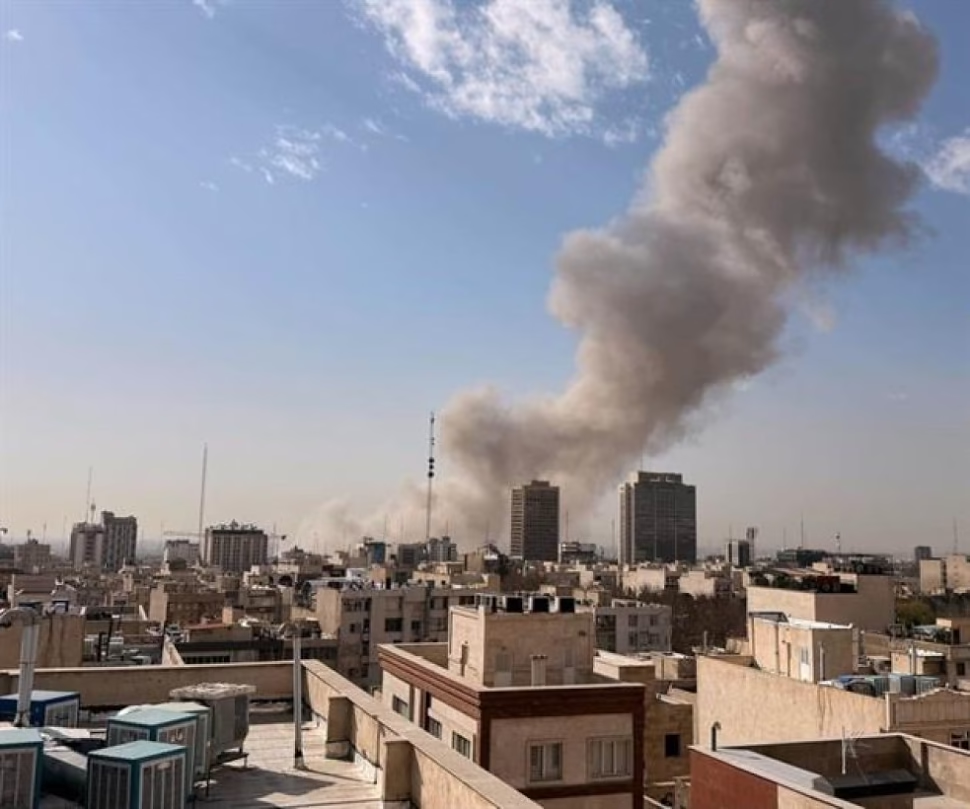
The United States and Israel have opened an astonishing new chapter in war. This Saturday they launched a massive attack against targets throughout Iran, including near the offices of Supreme Leader Ayatollah Ali Khamenei.

From Dubai, where columns of smoke are already visible, the situation is developing at breakneck speed.

“When we’re done, take control of your government. It will be yours. This will probably be your only chance for generations,” Donald Trump said in a video announcing the operations.

Israeli Prime Minister Benjamin Netanyahu echoed the ambitious goal: to create conditions for “the brave Iranian people to take the reins of their destiny.”

RelatedKhamenei’s death in attack opens crisis in the Middle East

The response was immediate

Iran responded as it had threatened for months. First with a wave of missiles and drones against Israel. Then with attacks against US military installations in Bahrain, Kuwait and Qatar.

The state agency IRNA reported the death of 40 students at a girls’ school in the south of the country. At least 45 others were injured in Minab, Hormozgán province.

In a defiant statement, the Iranian Foreign Ministry said it “will not hesitate” in its response. “The time has come to defend the homeland,” they said.

The attack is the second time in eight months that the Trump administration has used military force against the Islamic Republic. It comes weeks after the operation to capture the then president of Venezuela, Nicolás Maduro.

Trump justified the action by alleging that Iran continues to develop its nuclear program and plans missiles capable of reaching US territory.

“They have rejected every opportunity to give up their nuclear ambitions, and we can no longer stand it,” declared the Republican president.

But the reasons seem to go beyond the nuclear program. Trump listed grievances dating back to the 1979 revolution, when Iran went from ally to “fierce enemy.”

The regional board is overheating

Iranian retaliation has set off alarms throughout the region. Bahrain reported a missile attack against the headquarters of the US Fifth Fleet. In Kuwait, explosions were heard near US Army Central Command.

The United Arab Emirates and Iraq closed their airspace immediately. In Jordan, air raid sirens were activated.

Yemen’s Iran-backed Houthi rebels have vowed to resume attacks on shipping in the Red Sea and on Israel.

The economic impact could be enormous if the Strait of Hormuz is endangered. More than 14 million barrels per day of oil pass through this area, around a third of the world’s total transported by sea.

US embassies in Qatar, the United Arab Emirates and Israel told their staff to take cover. They advised all US citizens to “do the same until further notice.”

Meanwhile, Khamenei has not made any public appearances in recent days. During the 12-day war in June, he was believed to have been moved to safety away from Tehran.

Iranian state television reported explosions near its offices, but did not indicate the cause or offer information on casualties.

An official on condition of anonymity confirmed that Israeli targets included the Iranian military, government symbols and intelligence targets.

The international community observes with concern how this coordinated attack redefines the rules of the game in an already turbulent region.

Ceasefire between the US and Iran: step towards peace or temporary truce?

Experts warn that the understanding is just a 60-day memorandum, not a definitive peace.

60-day truce between Washington and Tehran

The conflict between the United States and Iran, which began on February 28, 2026 after a joint military operation with Israel, experienced a new chapter on Sunday, June 14. President Donald Trump announced the beginning of a ceasefire. But the specialists consulted by EL UNIVERSAL agree: it is still premature to talk about definitive peace.

Alide Flores, international analyst, noted that the understanding shows that “even after episodes of direct confrontation, diplomacy remains the most effective mechanism to contain large-scale crises.” The agreement contemplates the reopening of the Strait of Hormuz, negotiations on the Iranian nuclear program and a gradual de-escalation. However, he warned: “The structural disagreements that have characterized the bilateral relationship for decades remain in force.”

“It would be premature to interpret this announcement as the definitive resolution of tensions between Washington and Tehran,” Flores added. The signing is not the end, but “the beginning of a new stage.”

Mauricio Meschoulam, EL UNIVERSAL columnist, was more precise: “What we know for now is that it is an agreement that for now is not a peace agreement as such (…) it is a memorandum of understanding.” He explained that the pact seeks to return to the status quo prior to the conflict, and that the key will be what happens in the next 60 days, when nuclear issues must be negotiated.

“Basically what we are talking about is returning to a kind of status quo that existed before this war,” Meschoulam said.

Solange Márquez considered that the announcement is the closest advance to an understanding since the beginning of hostilities, and highlighted the reopening of the Strait of Hormuz: “The world needs that reopening: a fifth of the world’s crude oil transits through Hormuz.” But he warned: “This agreement is positive because it would lay the foundations for a 60-day truce, with the most difficult part still to be negotiated.”

Experts agree: success will depend on commitments being translated into verifiable agreements in the coming weeks. For now, it is a pause, not a peace.

Continue reading

Trump calls for an end to attacks after Israeli bombing in Beirut

Trump calls for stopping attacks while Israel bombs Beirut and complicates negotiations.

Trump demands to stop violence in the Middle East

Donald Trump called for an end to attacks in the Middle East after Israel bombed Hezbollah positions in Beirut. The action left three dead and 16 injured, according to the Lebanese Ministry of Health.

The US president assured that talks with Iran were close to reaching an agreement that would bring stability to the region, including Lebanon. He warned that the process should not be hindered and hoped that the pact will be signed in the next few hours.

“I hope we can seal the deal and avoid an Iranian military response,” Trump declared.

Israel defended the offensive as a response to previous Hezbollah aggressions against the north of its territory. However, the bombing occurs just when international mediators are seeking to conclude a ceasefire that includes the Lebanese situation.

Iran responded with warnings: any deal must consider fighting on Lebanese soil. Iranian officials said there will be consequences if the attacks continue.

The potential pact would not immediately resolve key disputes — such as the Iranian nuclear program or economic sanctions — but would establish a period of technical negotiations. The international community maintains pressure to avoid a further escalation and achieve a diplomatic solution.

Continue reading

Collective seeks 20 thousand signatures for assisted death in CDMX

Collective seeks popular support for the capital's Congress to discuss medical assistance in terminal cases.

A citizen initiative to open the debate

The Libertad para Morir collective launched a campaign to gather 20,000 signatures and present to the Congress of Mexico City a proposal on medical assistance in dying, aimed at people with terminal illnesses or intolerable suffering.

Asunción Álvarez del Río explained during a conference that the initiative seeks to expand the options available for those facing serious illnesses. He pointed out that currently there is palliative care and the possibility of refusing treatments, but not an assisted death alternative.

The collection of support is carried out through an application of the National Electoral Institute (INE). The objective is to reach the percentage of the capital’s electoral roll that is required by law for the citizen initiative to be discussed by legislators.

Álvarez del Río indicated that they are not seeking the support of political parties or deputies, but rather to comply with the necessary signatures to force the local Congress to review the proposal during the next legislative period, which begins in September.

The campaign has the support of organizations such as the Association for the Right to Die with Dignity, the Dignified Death Now Coalition and Practical Laboratory for Democracy. The promoters stated that they will continue collecting signatures during June and July to reach the goal.

Continue reading