UNESCO calls to regulate technology in ethical schools

UNESCO representative asks that technological implementation in classrooms not violate rights.

Andrés Morales Arciniegas, UNESCO representative in Mexico, stated that “technology must be at the service of people and not the other way around.” He declared it during the morning conference of President Claudia Sheinbaum, at the National Palace.

“Technology can enrich the educational experience as long as its implementation in schools is guided by clear ethical principles and contributes to guaranteeing the right to education.”

Morales pointed out that the unprecedented technological acceleration—the Internet, social networks, generative artificial intelligence—transforms the way we learn, teach and communicate. However, it also poses challenges to the physical, mental and socio-emotional well-being of children and young people, as well as risks to their privacy and personal data.

RelatedPrince Andrew loses his last royal titles after scandal

Global regulation on the rise

The representative explained that in 2023, only 24% of countries had some national regulation on the use of cell phones in schools. By 2026, the figure rose to 58%, which is equivalent to 114 educational systems.

Any regulation, he stressed, must be accompanied by digital literacy strategies. The discussion, he added, must involve authorities, teachers, students, families and technology companies.

The initiative seeks not only to improve education, but also to protect young people in an increasingly complex digital environment.

El Mayo Zambada: life sentence and warning from the DEA

The drug lord's conviction is just the beginning, warns the anti-drug agency.

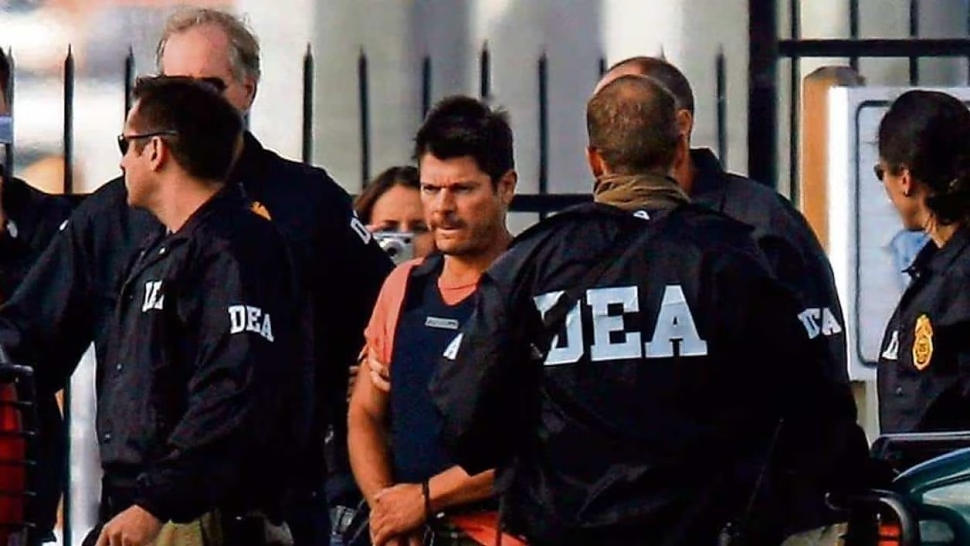
Ismael “El Mayo” Zambada, leader of the Sinaloa Cartel, was sentenced to life in prison in New York. The DEA assures that this ruling is just the beginning.

The DEA warning after the sentence

Terry Cole, head of the DEA, declared after the hearing that corruption was key to Zambada’s criminal empire. “He used bribery, influence and intimidation to protect the cartel from justice, both in Mexico and beyond its borders.”

Cole warned that the Sinaloa Cartel “continues to corrupt institutions and undermine the rule of law for criminal purposes.” And he added: “Whether it takes months, years, decades, we will not stop. We will not lose focus. We will not forgive.”

“The sentencing of ‘El Mayo’ is just the beginning,” Cole said. “It is a warning to all cartel leaders, global criminal enterprises and foreign terrorists. Whether you are traffickers or corrupt government officials, the DEA will come for you.”

Prosecutor Joseph Nocella Jr., of the Eastern District of New York, said the message is clear: “‘El Mayo’ will die in prison. And with the blood he has on his hands, it is exactly what he deserves.”

Nocella called Zambada “the biggest drug trafficker of this century” and claimed that the Sinaloa Cartel “flooded the United States and the world with drugs and made billions of dollars in profits.” He also detailed that, along with Joaquín “El Chapo” Guzmán – who is already serving a life sentence in the ADX Florence prison – “they corrupted numerous officials in Mexico to protect their criminal empire. And when corruption did not work, they resorted to horrible violence, including torture, kidnapping and homicide.”

The prosecutor considered the sentence “an adequate punishment for the damage that ‘El Mayo’ caused to countless victims.”

Continue reading

Sheinbaum: 250 US agents operate in Mexico with authorization

Mexican government confirms 250 accredited US agents, but demands transparency.

President Claudia Sheinbaum revealed that there are about 250 agents from US agencies in Mexico. Everyone must comply with the Constitution and the National Security Law. The president ruled out a confrontation with Washington and opted for diplomacy.

Control and transparency

During his morning conference, Sheinbaum explained that these agents—immigration, intelligence or security—require authorization from a Committee of the Security Cabinet. In addition, they must report their activities monthly.

He recalled the case of Chihuahua, where agents operated without permission. “We asked the embassy to remove them… And indeed, they left the country,” he said.

The problem arises when US officials enter without notifying. Sheinbaum pointed out that they have only identified that case.

Diplomatic means, not confrontation

“We are not seeking a confrontation with the United States government. It is better to use diplomatic means,” he said. He clarified that maintaining cooperation does not imply tolerating violations of sovereignty.

When there are improper actions, Mexico resorts to diplomatic notes or direct contacts between the Ministry of Foreign Affairs, the US Embassy and the Department of State.

This position also applies to trade, security and extraditions, under principles of reciprocity. “We want a good relationship,” he concluded.

Continue reading

CJNG operator arrested in Nayarit

They capture "M4" and nine alleged members of the Jalisco Nueva Generación Cartel.

Capture details

The Secretary of Security, Omar García Harfuch, confirmed the arrest of José Guadalupe Ahumada Villegas, alias “M4”, identified as an operator of the Jalisco New Generation Cartel (CJNG). The capture occurred after the arrest of “El Jardinero” and was part of seven searches carried out in Nayarit.

In total, nine more people were arrested. The detainees were part of a criminal cell that operated in Nayarit, Puebla and Tlaxcala.

Illegal activities attributed

According to official information, the organization is linked to kidnapping, extortion, deprivation of life, drug trafficking, arms trafficking, theft of cargo transportation and theft of hydrocarbons.

During the operations, elements of the Secretariat of Security, National Defense, the Navy and the FGR seized weapons, drugs, vehicles, telephones and documentation.

The arrest of “M4” represents progress in the fight against the CJNG, considered one of the most powerful criminal groups in the country.

Continue reading