Venezuela: death toll from earthquake rises to 2,595

Interim government reports 2,595 deaths and 12,400 injuries after earthquakes on June 24.

Official balance of the earthquake in Venezuela

The interim president of Venezuela, Delcy Rodríguez, updated the figures on Thursday night from the double earthquake that shook the north of the country on June 24. The dead total 2,595 and the injured 12,400, he reported at a press conference in Caracas.

La Guaira was the most affected area, with 189 buildings collapsed. Rodríguez defended the government response and assured that the activation was immediate.

“We didn’t wait a day, two days, three days; it was immediately activated,” he declared.

He explained that three hours after the earthquake, international aid was coordinated and the transfer of rescue teams was ordered. An Emergency General Staff was declared and resources were mobilized before dawn on the first day.

RelatedDouble earthquake shakes Venezuela: more than 900 dead

Criticism and government actions

Foreign journalists questioned government management. On social networks, relatives of victims and those affected have criticized the government and those in uniform. According to Rodríguez, in the first 24 hours, 4,000 civilian and military personnel were deployed, a figure that rose to 11,000 in 48 hours and exceeds 19,000 a week after the earthquake. He highlighted the role of the Bolivarian National Armed Forces in rescues, food distribution and installation of field hospitals.

Rodríguez accused “media laboratories” of generating chaos by promoting the population to concentrate in La Guaira, which would have hindered rescue efforts. He described those who spread these matrices as “miserable.” He also rejected complaints of delays in aid and claimed to have received thanks from those affected.

He announced an initial fund of 200 million dollars with the International Monetary Fund for reconstruction and housing in safe areas, and the opening of an account at the CAF subject to audits. Support was requested from 72 countries. Regarding the identification of bodies, he guaranteed that no one will be sent to mass graves, and this is done through fingerprints and forensic comparisons with the Prosecutor’s Office and the Civil Registry. The victims number 12,800, according to official figures.

Rodríguez was accompanied by her brother Jorge Rodríguez, president of the National Assembly, and the Minister of the Interior, Diosdado Cabello.
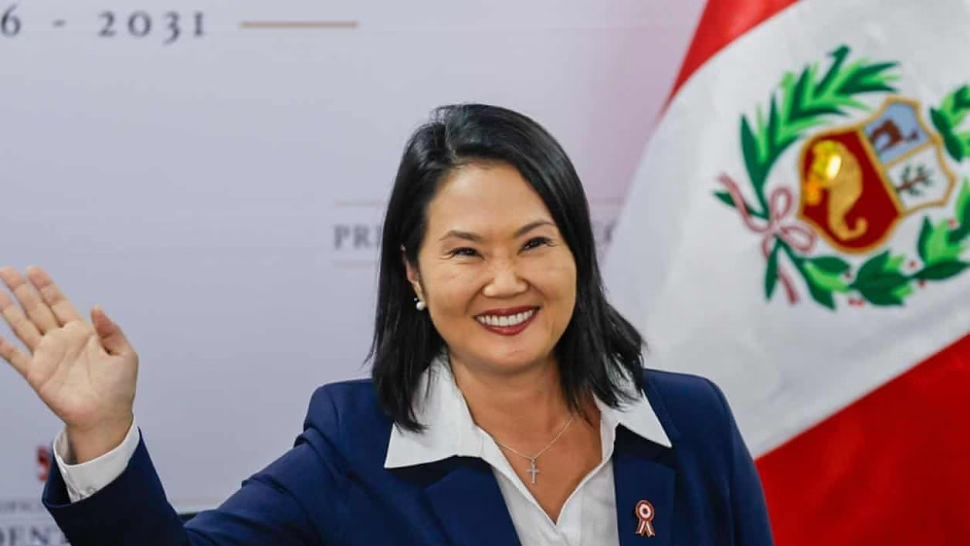
Fujimori announces intention to resume ties with Mexico

The elected president of Peru seeks to reestablish dialogue with Mexico after statements by Sheinbaum.

The elected president of Peru, Keiko Fujimori, stated on Thursday that she has “every intention” of resuming diplomatic relations with Mexico. The statement came a day after the Mexican president, Claudia Sheinbaum, indicated that she had not yet contacted Fujimori to congratulate her on her electoral victory.

“On my side there will be every intention to be able to resume relations between Peru and Mexico,” Fujimori briefly told the press during a public event in Lima.

Background of distancing

Sheinbaum had declared in his morning conference: “We are going to wait, remember that they broke off relations with us.” The break occurred in 2025, when Peru decided to break ties after the diplomatic asylum granted by Mexico to former Prime Minister Betssy Chávez, who took refuge in the Mexican embassy in Lima. Chávez is still waiting for safe passage to travel to Mexico, which Peru has not granted.

The conflict originated in December 2022, when the Peruvian Congress dismissed then-president Pedro Castillo, who was imprisoned after trying to dissolve the Legislature. In this context, Castillo’s wife and two minor children received asylum at the Mexican embassy and then moved to Mexico. Since then, both Andrés Manuel López Obrador and Sheinbaum requested Castillo’s release.

Castillo’s arrest sparked protests that left 50 dead during the repression by security forces under the government of Dina Boluarte. Later, Castillo and Chávez were sentenced to 11 years in prison for conspiracy to rebel. Castillo has appealed the sentence and faces other corruption investigations.

Asked if she considers Castillo’s detention illegal, as Sheinbaum claims, Fujimori responded: “I am very respectful of the institutions of my country.” However, before being proclaimed the winner, she had already pointed out that Peru and Mexico share the Pacific Alliance bloc and that there are “ties of friendship that must be prioritized beyond differences.”

Continue reading

IMF and Venezuela: call for emergency funds after earthquakes

IMF confirms call with Venezuela to release $350 million in humanitarian aid after earthquakes.

Key call between Georgieva and Rodríguez

The International Monetary Fund (IMF) confirmed this Thursday that its managing director, Kristalina Georgieva, spoke by phone with the interim president of Venezuela, Delcy Rodríguez. The central issue was access to the country’s reserve tranche in the organization, an immediate liquidity mechanism valued at approximately $350 million, intended to cover urgent humanitarian needs.

IMF spokesperson Julie Kozack explained that both officials analyzed the economic impact and humanitarian needs caused by the twin earthquakes of June 24. So far, the earthquakes have caused more than 3,800 deaths, nearly 17,000 injuries and have left almost 18,000 people homeless in the north of the country.

“It is an important and easily available source of liquidity that can be mobilized quickly to help meet urgent humanitarian needs arising from the disaster,” Kozack explained.

Available resources and political context

This reserve tranche is independent of the Special Drawing Rights (SDR) retained by the IMF, which amount to about $4.5 billion. In total, Venezuela’s assets in the organization add up to nearly $5 billion. The IMF indicated that it has worked with counterparts to facilitate access to the country’s own resources.

The conversation occurs as emergency response efforts and damage assessment continue in several regions. Days before the earthquakes, Venezuela fully reestablished its membership in the IMF, after years of distancing during the governments of Hugo Chávez and Nicolás Maduro. This approach occurs in the new political context after the capture of Maduro by US forces on January 3.

Continue reading

PAHO alerts: health risks after earthquakes in Venezuela

PAHO warns about outbreaks and lack of water after earthquakes in Venezuela.

Immediate health risks

The Pan American Health Organization (PAHO) warned that the greatest risks after the June 24 earthquakes in Venezuela do not only come from injuries. Limited access to vaccines, disruption of routine medical services and deficiencies in the supply of clean water are the main threats.

“In the coming weeks, the greatest health risks could arise not only from injuries caused by earthquakes, but also from disruptions in health services, conditions of access to medical care, deficiencies in water and sanitation, and access to vaccination and routine medical care,” said Jarbas Barbosa, director of PAHO, in a video conference from Washington.

PAHO collaborates with the Venezuelan Ministry of Health to detect outbreaks in shelters. Barbosa explained that respiratory diseases, like the flu, spread quickly in small spaces. Conditions resulting from the consumption of non-potable water or spoiled food are also of concern.

Damage and needs

Armando Denegri, PAHO representative in Venezuela, reported that three hospitals suffered structural damage and were evacuated. Another 24 had damages that temporarily compromised their operation, although most of them have already been repaired.

“50% of La Guaira’s health professionals were directly affected. Some disappeared, some died, others were greatly affected by the crisis, impacting their families,” Denegri detailed, without specifying more.

PAHO estimates that $24 million is required to cover urgent health needs until the end of the year. According to Barbosa, this amount will allow maintaining services, supporting rehabilitation and restoring facilities.

The magnitude 7.2 and 7.5 earthquakes occurred 39 seconds apart along the northern coastal mountain range of Venezuela, the United States Geological Survey reported. They were the strongest in the country in more than a century.

Venezuelan authorities reported 3,811 deaths and 16,740 injuries in Caracas, La Guaira and Miranda. Most of the deaths were concentrated in La Guaira, 20 kilometers north of Caracas. The government of interim President Delcy Rodríguez estimated that 18,000 people lost their homes and now live in schools, parks and public squares.

Continue reading