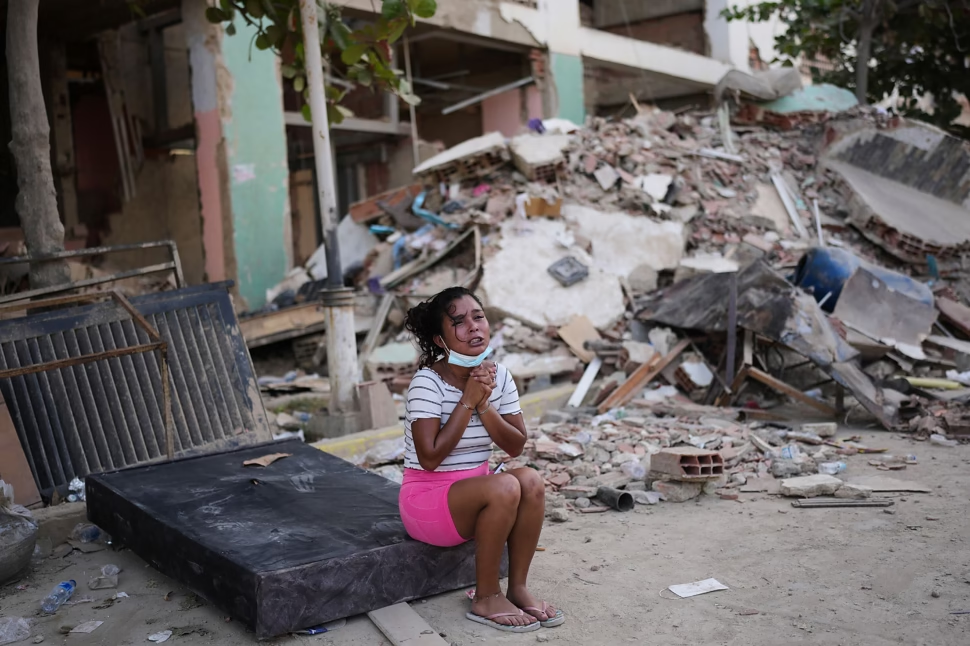
920 dead and criticism for delay in rescues in Venezuela

International rescuers arrive in Venezuela while families dig with their hands.

The toll of the earthquakes of magnitude 7.5 and 7.2 that shook northern Venezuela on Wednesday amounted to 920 deaths and 3,360 injuries this Saturday. Search efforts continue among collapsed buildings, while complaints grow about the slowness in the arrival of rescue teams.

Among the victims is the Italian Francesca Mannina, whose body was identified after she had been missing for two days. His partner was rescued alive the day before.

RelatedDouble earthquake shakes Venezuela: more than 200 victims

Criticism points to the initial response of the authorities. Opposition leaders, led by Juan Pablo Guanipa, denounced the lack of heavy machinery and specialized equipment to free trapped people, especially in La Guaira. “We have people alive under the rubble and we need heavy machinery,” said a resident of Catia La Mar in a video broadcast on the networks. Witnesses pointed out that for hours the inhabitants themselves dug with their hands.

Faced with the emergency, the United States deployed one of the largest international assistance operations. More than 250 rescuers — firefighters, doctors, engineers, urban search specialists and 18 trained dogs — were dispatched. The operation includes two military ships, aircraft and a humanitarian aid package for 150 million dollars. Major General Kevin Jarrard arrived in Caracas to coordinate logistics with the Simón Bolívar airport as the main center.

An Italian civil protection mission also arrived.

The health emergency is worsening in Caracas. Hospitals such as Pérez Carreño and Domingo Luciani are working at their limit after receiving hundreds of injured people from La Guaira. Doctors report shortages of supplies and depend on volunteers to maintain care.

The aftershocks continue. Funvisis reported this Saturday a 4.9 magnitude earthquake north of Maracay, also felt in Caracas, La Guaira, Miranda and Carabobo. Since the main earthquake, at least thirteen minor movements have been recorded.

In the midst of the crisis, teams from El Salvador rescued alive, after more than 50 hours, a 15-year-old teenager with her dog, trapped on the ninth floor of a collapsed building in Playa Grande. Hours earlier, the same rescuers saved another woman who had been under the rubble for two days.

Venezuelan sport suffered a loss: the Venezuelan Football Federation confirmed the death of midfielder Yimvert Berroterán, 18, a member of the U-20 team and the Central University of Venezuela, who had remained missing since the collapse of several buildings in La Guaira.

While the search efforts continue, the government of Interim President Delcy Rodríguez restricted access to the most affected areas. The opposition maintains that this measure hinders the arrival of aid and humanitarian work.
Canada chooses Germany for its largest military purchase: 12 submarines

Canada appoints German firm to build up to 12 submarines, the largest military acquisition in its history.

Canada chooses ThyssenKrupp for its largest military acquisition

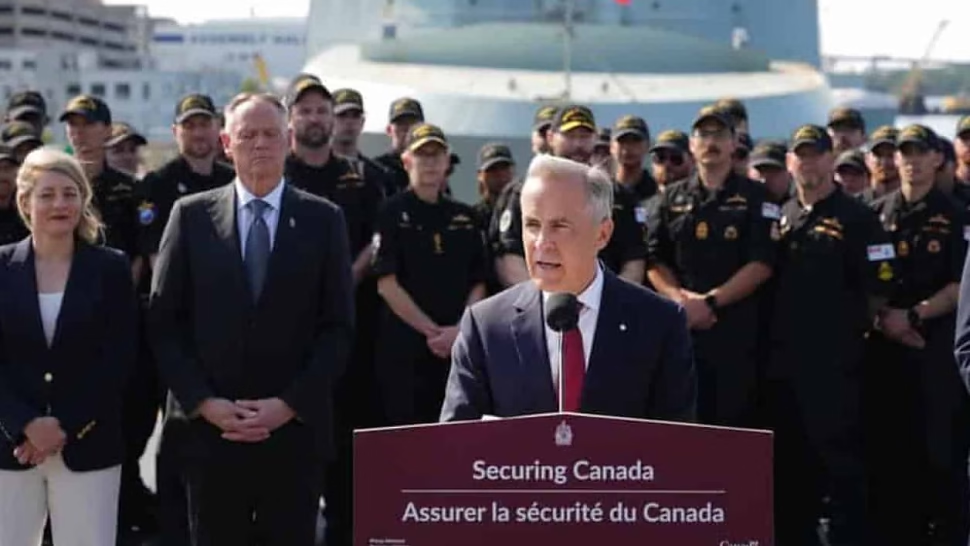
Canada selected the German company ThyssenKrupp Marine Systems (TKMS) as a preferred supplier for the construction of up to 12 submarines. Prime Minister Mark Carney called the operation the largest military acquisition in the country’s history.

The announcement comes days before Carney attends a NATO summit, where allies face pressure to increase their defense spending. The president affirmed that the TKMS platform is optimal for Arctic waters and for the alliance.

“The submarine is proven and capable,” declared Carney.

TKMS supplies submarines to more than a third of NATO members. Carney declined to reveal the exact price, but said it will involve an investment of “tens of billions of dollars.”

German Chancellor Friedrich Merz thanked Carney and stressed:

“This is a strong signal for our transatlantic and European alliance.”

The German company beat the South Korean Hanwha Ocean. ThyssenKrupp said its submarines will strengthen interoperability, as many NATO allies already operate conventionally powered vessels.

Canada has committed to increasing its military spending after years of lagging behind NATO goals. Carney promised to raise defense spending to 5% of GDP by 2035, after reaching 2% of GDP this year, the alliance’s previous goal. The Canadian fiscal plan foresees spending reaching 4% of GDP by 2030.

Germany and Norway, countries that design the submarines together, will open production spaces to speed up deliveries. Canada would receive four submarines by 2034, two years earlier than projected. The new fleet will replace the four Victoria-class submarines, purchased second-hand from the United Kingdom in the late 1990s.

No American company submitted a bid, as the United States only builds nuclear-powered submarines, while Canada was looking for conventional vessels.

“The sovereignty of our country, bounded by three oceans and the longest coastline in the world, depends on our maritime capabilities,” concluded Carney.

Continue reading

China launches ballistic missile from nuclear submarine in the Pacific

Test with dummy warhead draws criticism from Australia, Japan and New Zealand.

Ballistic missile test from nuclear submarine

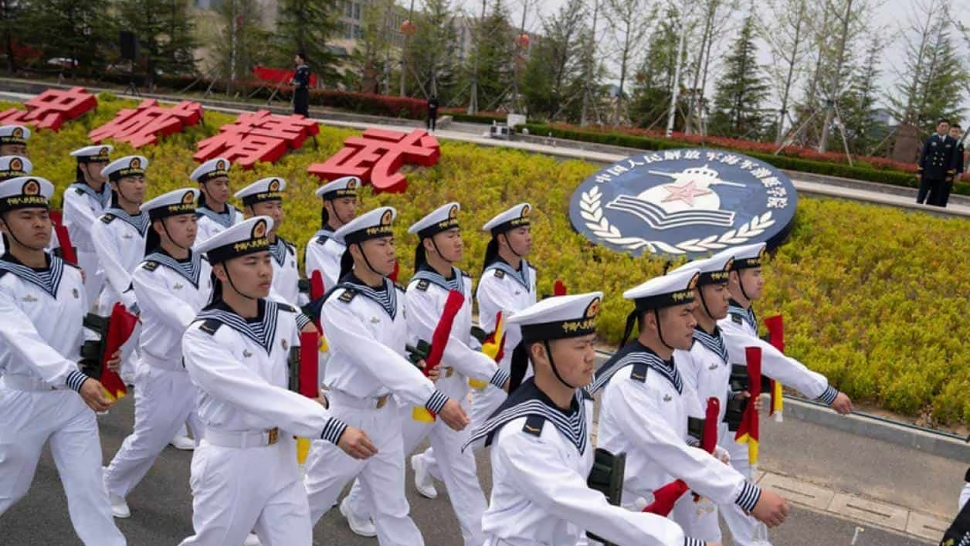
China’s military on Monday test-launched a long-range ballistic missile from a nuclear-powered submarine in the South Pacific Ocean. The warhead was fictitious, according to the official Xinhua agency. The launch, at 12:01 local time, was part of routine annual training and was not directed against any country, said a brief Xinhua statement republished by the Ministry of Defense.

Australia, Japan and New Zealand protested. New Zealand Foreign Minister Winston Peters declared:

“It appears that, despite our long-standing concerns about this type of activity, China carried out the test within hours of informing us.”

The test occurred on the same day that Australia and Fiji signed a mutual defense treaty, in a gesture to counter Chinese influence. Australian Foreign Minister Penny Wong said:

“Australia has been clear with China that we consider this to be destabilizing for the region.”

Japan expressed concern. Chief Cabinet Secretary Minoru Kihara said:

“China’s military activities, combined with its lack of transparency, have become a serious concern for Japan and international society.”

Beijing dismissed the criticism. A Foreign Ministry spokesperson stated: “We hope relevant countries will avoid overinterpretation.”

The United States also reacted. State Department spokesman Thomas Pigott said:

“Beijing’s rapid and opaque buildup of nuclear weapons is of grave concern to the region and the world.”

Experts pointed out the lack of transparency. Drew Thompson, a researcher at Nanyang Technological University, commented: “China’s modernization and military buildup have occurred without parallel increases in openness and transparency.”

Lyle Morris of the Asia Society Policy Institute noted that it is the first publicly acknowledged test of a dummy warhead from a nuclear submarine traveling so far in the Pacific. Morris stressed that Japan, New Zealand and Australia received notifications, but not the United States.

China maintains a “no first use” policy on nuclear weapons, but modernizes its arsenal. According to the Pentagon, China had about 600 warheads in 2024 and projects more than 1,000 by 2030.

Continue reading

Italy opts for silence in the face of Trump’s new criticism of Meloni

Rome remains silent after Trump's new attack on Meloni in the middle of the NATO summit.

Official silence in the face of Trump’s disqualification

The Italian government decided not to respond to the latest message from Donald Trump, who launched a direct criticism against Prime Minister Giorgia Meloni. The position seeks to prevent the episode from overshadowing the NATO summit in Ankara, Türkiye, where both leaders will meet.

Sources from the Chigi Palace indicated that Meloni dedicated the previous hours to preparing the work agenda, without referring to the American president. The atmosphere, however, became tense after Trump spread a meme about an alleged harassment restraining order, weeks after accusing Meloni of having “begged” him for a photo during the G7 summit.

These accusations have eroded mutual trust and buried the “special relationship” that both leaders exhibited a year ago at the NATO meeting in The Hague.

Internal reactions and bipartisan support

The tension escalated to the point that, according to internal versions of the Italian Executive, the participation of officials in the official reception of the American embassy was reconsidered. Washington’s version of Meloni’s alleged unfulfilled commitments causes confusion in Rome; Some leaders close to the prime minister have questioned Trump’s state of health to explain what they describe as “disconcerting statements.”

However, government sources assure that both the State Department and the Pentagon reiterated their willingness to maintain bilateral cooperation.

Deputy Prime Minister and Foreign Minister Antonio Tajani—who will meet with Secretary of State Marco Rubio—said that Trump’s statements speak for themselves and that the transatlantic relationship goes beyond a single person. The Defense Ministers, Guido Crosetto, and Deputy Prime Minister Matteo Salvini avoided delving into the controversy to preserve the strategic alliance.

Internally, Meloni received the support of the president of the Senate, Ignazio La Russa, and the leader of the Chamber of Deputies, Lorenzo Fontana, who condemned the disqualification and demanded a dialogue based on mutual respect.

Continue reading