Trump authorizes direct flights to Lebanon after decades

The US president will allow commercial flights to Lebanon and meets with the Lebanese president to promote peace.

Direct flights and diplomatic dialogue

President Donald Trump announced that his administration will allow the resumption of direct flights between the United States and Lebanon, suspended since 1985 after the hijacking of TWA Flight 847. The measure became known after his meeting at the White House with the Lebanese president, Joseph Aoun.

“I am ordering my Administration to allow all US airlines to fly directly to Lebanon so that Americans can easily visit this beautiful land,” Trump wrote on social media.

During the meeting, Trump promised to “help a lot” to Lebanon. Aoun is the first Lebanese leader to visit Washington since 2009. The visit occurs in a context of regional tension, after months of conflict between Israel and the armed group Hezbollah, backed by Iran.

RelatedLebanon and Israel approach positions in pilot areas under US mediation

Progress towards a framework agreement

Lebanon and Israel signed a framework agreement on June 26 that provides for the withdrawal of Israeli forces from the south of the country and the disarmament of Hezbollah. The implementation began in pilot areas such as Zawtar al-Gharbieh, where the Lebanese army has already begun to deploy. However, disagreements remain: Israeli forces fired warning shots during the operation, although both sides differ over the location of the incident.

Secretary of State Marco Rubio backed the deal: “How do you replace Hezbollah? You defeat them and replace them with a government strong enough to be the only armed force in the country.” He warned that Lebanon will not be at peace until the issue of the armed group is resolved.

Trump mentioned that he would speak to Hezbollah personally if Aoun asked him to, and even raised the possibility of Syria intervening against the organization. Both options are unpopular in Lebanon.

Caution on the ground

Abed Ezzeldine, mayor of Zawtar al-Gharbieh, sounded cautious: displaced residents will be able to check their homes, but not stay because of the destroyed infrastructure. “The houses have been demolished. They (the Israelis) have destroyed the streets,” he declared.

Israel plans to maintain a prolonged military presence in a “security zone” in the south. Meanwhile, the Lebanese government, emerged from a reformist campaign in 2025, insists that Israeli withdrawal and international financial support are essential for a sustainable solution. The recent conflict left more than 4,000 dead and 1.2 million displaced in Lebanon.
Zelenskyy dismisses Syrskyi amid protests in Ukraine

The change in high command responds to citizen pressure and internal criticism.

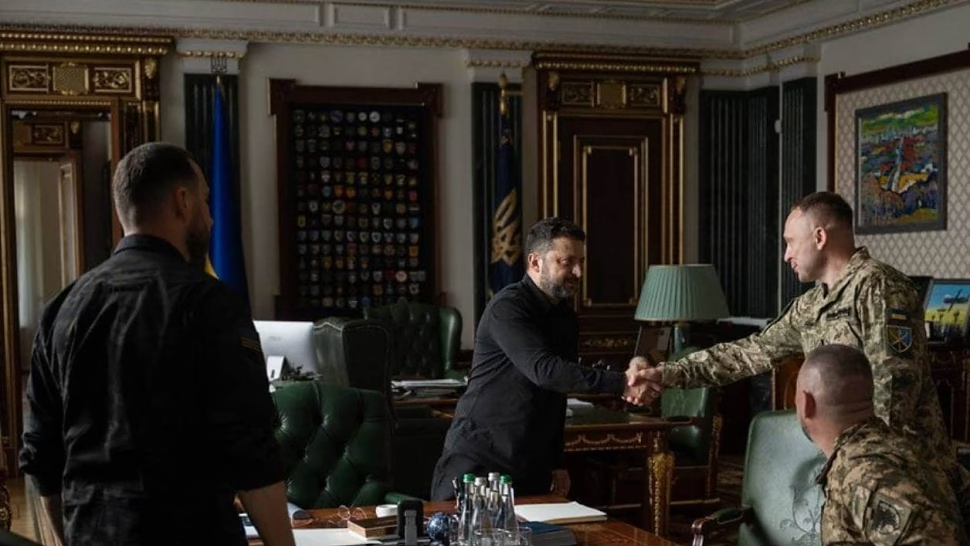
Ukrainian President Volodymyr Zelenskyy dismissed General Oleksandr Syrskyi as commander-in-chief of the armed forces, following several days of protests in kyiv and other cities demanding his ouster. In his place, he appointed Mijailo Drapatyi, according to an official statement.

“Our shared desire is one: victory over the enemy,” Zelenskyy declared.

Citizen pressure and internal changes

It was Zelenskyy’s second major turn under pressure from public opinion. The protests also demanded the reinstatement of former Defense Minister Mikhailo Fedorov, seen as a driver of military modernization. Syrskyi was criticized for representing a Soviet-style command culture.

Zelenskyy thanked Syrskyi for the defense of kyiv and the operations in Kharkiv and Kursk. He then introduced Drapatyi as the new boss.

Drapatyi wrote on Facebook:

“Serving Ukraine has always been an honor for me… I will work with responsibility, with focus and with respect for the people who defend our State today.”

Fedorov congratulated Drapatyi and called the appointment “a new hope in the struggle of free peoples for freedom and justice.” Zelenskyy offered Fedorov a position to unify the technology sector, but it was not confirmed whether he accepted.

Fedorov had publicly criticized Syrskyi, saying that he was blocking his reforms and that he should be replaced. After the impeachment, he called Syrskyi to thank him for his contributions, but noted that the country must move faster and correct mistakes.

Continue reading

New US attacks on Iran raise tensions in the Middle East

Ninth night of US strikes against military targets in Iran.

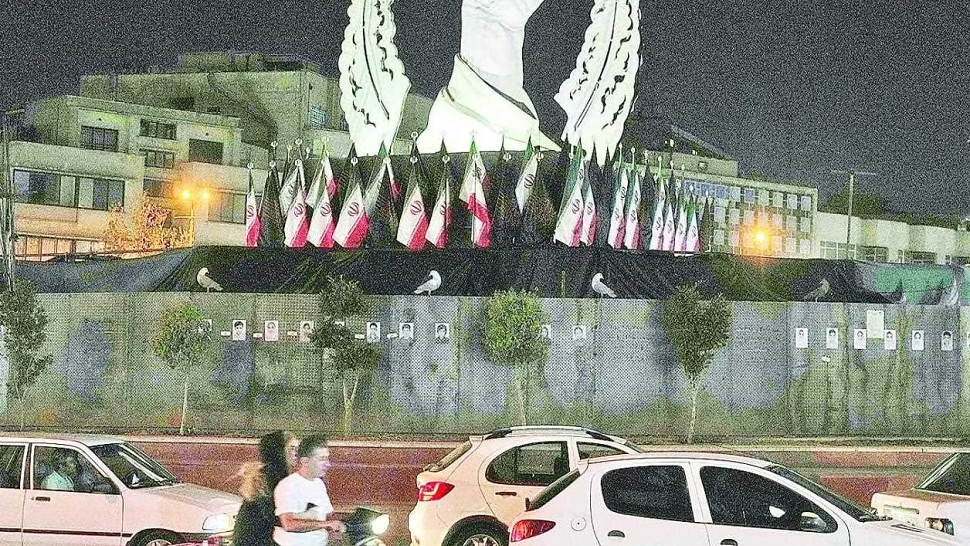
The United States launched a new air offensive against Iran early this Monday, the ninth consecutive night of bombing. Washington confirmed the death of another American soldier in Iraq, while Tehran responded by attacking Bahrain and Kuwait, key US allies in the region.

Objectives and implications

The US Central Command reported that the attacks targeted command centers, air defense, coastal surveillance, missile and drone bases, as well as Iranian communication networks. Official Iranian media reported at least one death near Tabriz, an area where there are allegedly underground bases of the Revolutionary Guard. Attacks were also recorded in other strategic provinces.

The escalation reached the Strait of Hormuz: a merchant ship caught fire after being hit by a projectile near the coast of Oman, forcing the crew to evacuate it. The Revolutionary Guard claimed to have attacked oil tankers in the area. Bahrain activated anti-missile sirens and Kuwait confirmed that its air defenses intercepted Iranian projectiles.

Oil impact and diplomacy

The price of Brent oil exceeded $90 per barrel due to the interruption of maritime traffic in the Strait of Hormuz, through which about a fifth of the world’s crude oil transited before the conflict. Washington maintains a naval blockade on Iranian ports to stop its exports.

Secretary of State Marco Rubio reiterated that the US remains open to negotiating, although he acknowledged that there are still no conditions for an agreement. Iranian authorities confirmed proposals through mediators, while former Foreign Minister Mohammad Javad Zarif insisted that only diplomacy will prevent further escalation. Since the start of the war on February 28, 17 US service members have died; According to Tehran, the recent bombings left at least 50 dead and 517 injured in Iranian territory.

Continue reading

Congo faces deadliest Ebola outbreak: 930 dead

The Bundibugyo strain has no vaccine or treatment. Insecurity aggravates the crisis.

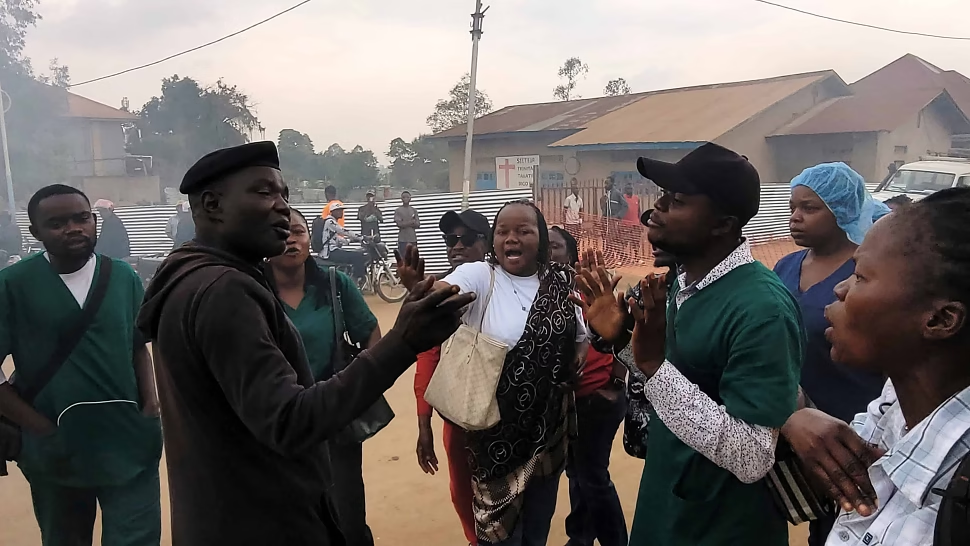
The Ebola outbreak in the Democratic Republic of the Congo now has 930 deaths, according to the Ministry of Health. Between Friday and Saturday alone, 37 new losses were recorded, one of the highest daily figures since May 15, when the emergency began.

The challenge of a strain without a vaccine

The authorities report 2,344 confirmed cases as of Saturday. The current outbreak is caused by the Bundibugyo variant of the virus, considered the fastest growing known. Unlike other strains, there is no vaccine or approved treatment yet.

Insecurity in the province of Ituri, the most affected, complicates the response. Attacks on medical facilities—fueled by rumors and mistrust—along with lack of payment to healthcare workers are hampering the containment of the virus.

The World Health Organization (WHO) warned that 80% of new infections come from unknown transmission chains. The disease is spreading faster than teams can track. In addition, 36 health workers have died after becoming infected while providing care.

Despite the panorama, the Ministry of Health assures that it is strengthening the response. Currently 724 patients remain hospitalized or in isolation. In the last 24 hours, 22 new recoveries were reported, although authorities recognize that controlling the outbreak continues to be one of the country’s biggest health challenges.

Continue reading