Zelenskyy dismisses Syrskyi amid protests in Ukraine

The change in high command responds to citizen pressure and internal criticism.

Ukrainian President Volodymyr Zelenskyy dismissed General Oleksandr Syrskyi as commander-in-chief of the armed forces, following several days of protests in kyiv and other cities demanding his ouster. In his place, he appointed Mijailo Drapatyi, according to an official statement.

“Our shared desire is one: victory over the enemy,” Zelenskyy declared.

RelatedUkraine evaluates US peace plan under international pressure

Citizen pressure and internal changes

It was Zelenskyy’s second major turn under pressure from public opinion. The protests also demanded the reinstatement of former Defense Minister Mikhailo Fedorov, seen as a driver of military modernization. Syrskyi was criticized for representing a Soviet-style command culture.

Zelenskyy thanked Syrskyi for the defense of kyiv and the operations in Kharkiv and Kursk. He then introduced Drapatyi as the new boss.

Drapatyi wrote on Facebook:

“Serving Ukraine has always been an honor for me… I will work with responsibility, with focus and with respect for the people who defend our State today.”

Fedorov congratulated Drapatyi and called the appointment “a new hope in the struggle of free peoples for freedom and justice.” Zelenskyy offered Fedorov a position to unify the technology sector, but it was not confirmed whether he accepted.

Fedorov had publicly criticized Syrskyi, saying that he was blocking his reforms and that he should be replaced. After the impeachment, he called Syrskyi to thank him for his contributions, but noted that the country must move faster and correct mistakes.

ASEAN foreign ministers discuss crisis in Middle East and South China Sea

ASEAN foreign ministers meet in Manila over tensions in the Middle East and South China Sea.

Foreign ministers’ meeting in Manila addresses security challenges

The foreign ministers of the Association of Southeast Asian Nations (ASEAN) began a three-day meeting in Manila on Tuesday. The agenda focuses on the main security challenges in the region, marked by the escalation of tensions between the United States and Iran and the growing differences in the South China Sea.

In a joint statement after their first session, the foreign ministers expressed their concern about the escalation in the Middle East. They called for an immediate halt to hostilities and the safe reopening of the Strait of Hormuz, a strategic route for global oil and gas trade. They also reiterated the commitment to resolve differences between States through dialogue and respect for sovereignty and territorial integrity.

The meeting in Manila becomes a key space for member countries to discuss strategies that promote regional stability. The ministers emphasized the importance of maintaining open communication channels to avoid misunderstandings and major conflicts.

ASEAN has historically been a forum for cooperation and dialogue in Southeast Asia. This meeting seeks not only to address current conflicts, but also to strengthen regional integration and collaboration on security and economic development issues.

Continue reading

Tenth day of conflict between Iran and the United States without respite

Pakistan intensifies mediation as attacks continue in the Persian Gulf.

Escalation in the Middle East

The conflict between Iran and the United States reached its tenth day this Tuesday with no signs of de-escalation. While clashes continue in Iranian territory and in the Persian Gulf, diplomats are intensifying efforts to save the provisional agreement that sought to reduce tensions.

The Iranian Minister of the Interior, Eskandar Momeni, began a visit to Pakistan, a country that acts as a mediator. In Islamabad he met with the head of the Pakistani Army, Asim Munir, and Prime Minister Shehbaz Sharif. The latter expressed concern about the military escalation and urged all parties to act with restraint, seeking to resume negotiations.

The United States reported attacking command centers, air defense, and missile and drone launch sites in Iran. In response, Tehran intensified operations in the Strait of Hormuz, where a tanker was attacked and its crew had to evacuate the ship.

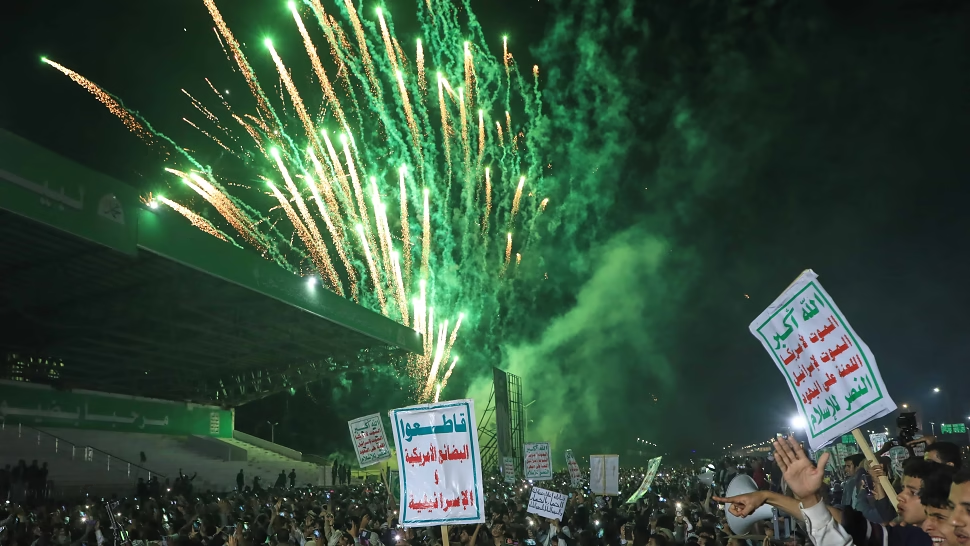
The tension spread to the Red Sea. Yemen’s Iran-backed Houthi rebels announced a naval blockade against Saudi Arabia and warned shipping companies about transiting Bab el-Mandeb. The interruption of these routes raised international concern about oil supply, driving the price of crude oil above $90 per barrel.

Despite diplomatic efforts, a climate of mistrust persists. US Secretary of State Marco Rubio stated that his government keeps the possibility of negotiating open, but warned that any agreement must offer real guarantees. The continuity of bombings and attacks on energy infrastructure keep the international community on alert regarding the risk of an expansion of the conflict in the Middle East.

Continue reading

Putin thanks North Korea for its military support

The Kremlin receives the North Korean chancellor in a context of global tensions.

Meeting in the Kremlin

Russian President Vladimir Putin held a meeting in the Kremlin with North Korean Foreign Minister Choe Son Hui. The meeting reaffirmed the growing alliance between both nations.

Putin expressed his gratitude to the North Korean government for its support of Russian military operations in Ukraine. The visit was carried out at the invitation of the Russian Foreign Minister, Sergei Lavrov.

Although not confirmed, speculation is circulating about a possible visit by North Korean leader Kim Jong Un to Russia. The meeting reflects the strategic closeness between Moscow and Pyongyang in a complex international context.

The alliance between both countries has strengthened amid global tensions. This approach could have repercussions on regional geopolitics.

Continue reading