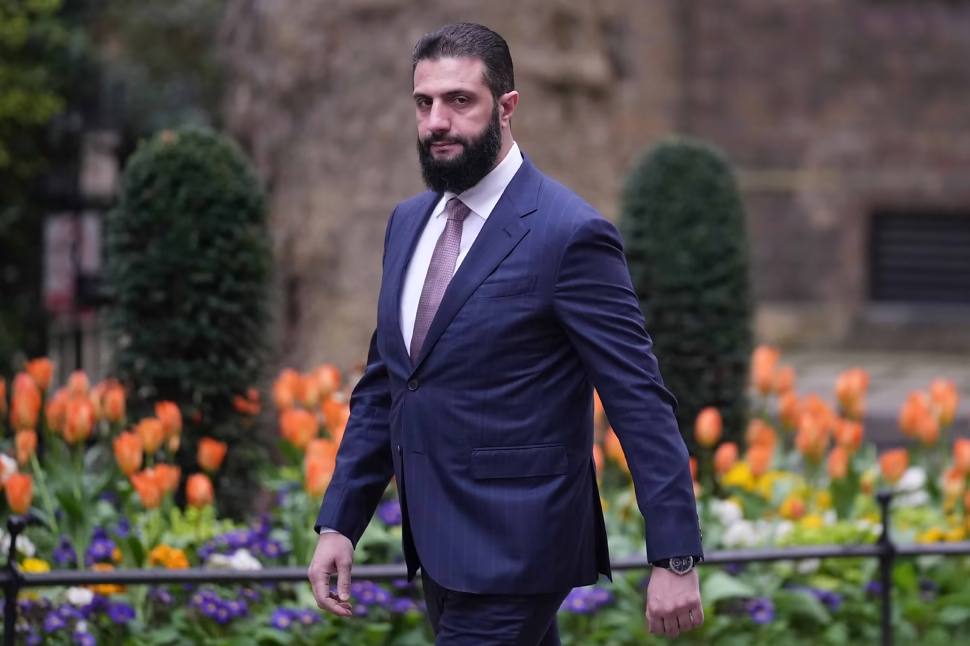
Syria intercepts advanced weapons destined for Hezbollah

Syrian authorities seize a truck with rockets and advanced weapons from Iraq.

Syrian authorities reported that they foiled an alleged arms smuggling attempt to the Lebanese group Hezbollah. The shipment was intercepted in a truck carrying advanced weapons and rockets from Iraq.

According to the state agency SANA, initial investigations indicate that the weapons were destined for the Shiite organization backed by Iran. The seizure occurred as part of the new government’s actions to strengthen border security and combat the illicit trafficking of weapons and drugs.

RelatedLebanon and Israel approach positions in pilot areas under US mediation

An official from the Syrian Ministry of the Interior, who asked not to be identified, said that this operation reflects the authorities’ commitment to control the flow of weapons in the region. Concern grows over Hezbollah’s link with Tehran and its influence in the Syrian conflict.

The discovery includes rockets and high-capacity war material. No arrests have been reported so far, but investigations continue to identify those responsible for the smuggling network.

This incident underlines the challenges that Syria faces in controlling its borders, especially in a regional context marked by tensions between armed factions and external interests.
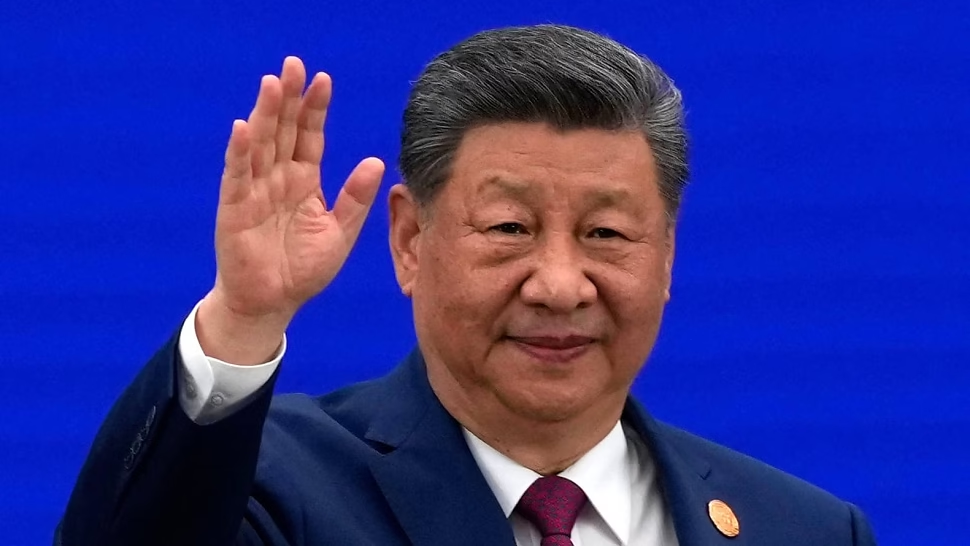
Xi Jinping calls for global AI governance without unilateral dominance

China proposes international cooperation in artificial intelligence and offers training to developing countries.

China bets on global governance of AI

Chinese President Xi Jinping urged the promotion of global governance of artificial intelligence (AI) and stated that its development should not belong to a single country. During the opening of the World Conference on Artificial Intelligence in Shanghai, he questioned what he called an “overreach” of the concept of national security in this area, in clear reference to the technological restrictions imposed by the United States.

“Artificial intelligence must become a symphony of global cooperation, not an isolated competition between nations,” Xi said.

As part of its strategy, China will strengthen AI collaboration with organizations such as ASEAN, the Arab League, the African Union, CELAC and the BRICS countries. In addition, it will offer five thousand training opportunities for developing countries in the next five years.

Multilateral agreement in Shanghai

Before the event, 29 countries—including Russia, Pakistan and Kazakhstan—signed an agreement with Beijing to create a World Artificial Intelligence Cooperation Organization, based in Shanghai. Analysts interpret this initiative as China’s response to the US Pax Silica framework, which seeks to strengthen AI supply chains with its allies.

Continue reading

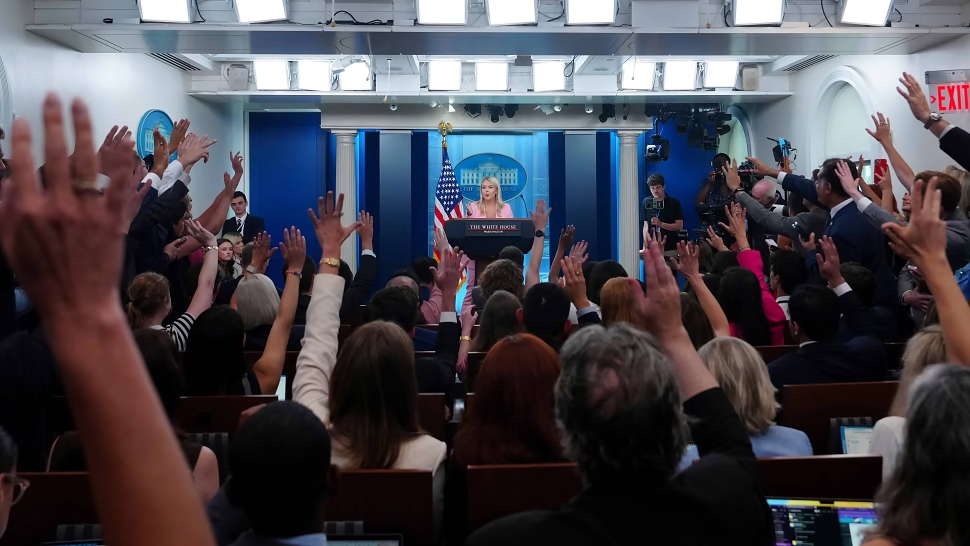
The US reduces visas for foreign journalists to 240 days

Trump administration shortens visa validity for foreign correspondents to 240 days.

Donald Trump’s administration implemented a drastic change to the visa system for international correspondents. From now on, visas for foreign journalists will have a maximum validity of 240 days, compared to the several years allowed by the previous scheme. In the case of Chinese journalists, the stay permit is reduced to only 90 days.

Reactions and justifications

The Department of Homeland Security explained that the “duration of status” system, which allowed correspondents to remain in US territory as long as they met their visa requirements, is eliminated. Instead, renewable fixed periods are established, with the aim of facilitating the supervision and review of each case.

Organizations such as Reporters Without Borders and the Committee to Protect Journalists pointed out that the measure restricts press freedom and hinders information coverage by international media in the United States. From Beijing, the Chinese government described the decision as discriminatory and warned that it will take response measures.

The new regulations also impact students and other visitors under similar schemes. At a time when Washington and Beijing seek to stabilize their bilateral relations, this immigration hardening could fuel tensions between both powers.

Continue reading

Germany and France strengthen cooperation in nuclear defense

Germany joins a French-led nuclear exercise before the end of the year.

German-French military agreement

Germany and France agreed to strengthen their defense cooperation. The German military will participate in a nuclear exercise led by French forces before the end of the year.

The announcement was made by Chancellor Friedrich Merz and President Emmanuel Macron. Both stressed that the measure seeks to reinforce European security in a context of growing global uncertainty.

Conventional participation, without breaking with NATO

Merz explained that German participation will, for now, only be through conventional means. He clarified that this collaboration complements the NATO deterrence scheme, of which Germany continues to be a part through the deployment of US nuclear weapons on its territory.

The chancellor pointed out that the current geopolitical scenario requires new responses in terms of security. The joint exercise is part of a broader European strategy to diversify defensive capabilities.

France, as a nuclear power, has been leading this type of maneuvers for decades. The incorporation of Germany represents an unprecedented step in the military integration of the continent.

Continue reading