Sheinbaum defines the ethics of public service in the Fourth Transformation

The president establishes a code of ethical conduct for her government officials, far from the excesses of the past.

A guiding principle for the public service

The president of Mexico, Claudia Sheinbaum Pardo, has established a fundamental ethical framework for the members of her administration and the political movement in power. During the commemoration of the seventh anniversary of the so-called Fourth Transformation, held in the Zócalo of the capital before a crowd, the president was categorical in pointing out that there is no justification – neither moral, ethical nor political – for the officials and leaders of this project to live surrounded by luxuries and privileges. This declaration is not a mere exhortation, but the reaffirmation of a doctrinal pillar of the current government.

The speech, addressed to more than half a million attendees, focused on redefining the relationship between public servants and citizens. Sheinbaum emphasized that those who hold positions of representation or leadership are never above the people, but rather their role is strictly one of service. Governing, according to his approach, is not a vehicle for obtaining personal benefits, but rather entails a deeply human responsibility. This positioning seeks to mark a deliberate break with historical practices associated with corruption and abuse of power.

RelatedSheinbaum reaffirms the direction of the transformation in the Zócalo

Republican Austerity and the Juarista legacy

By delving into the concept of Republican Austerity, the head of the Federal Executive linked it directly to the redistribution of resources. He argued that its essence lies in the systematic reduction of institutional privileges to channel public funds towards collective benefit. In a country where a significant part of the population subsists on a minimum wage that barely covers basic needs, the existence of ostentatious political elites becomes, from this perspective, indefensible.

The president turned to historical heritage to support her argument, invoking the figure of Benito Juárez and his principle of just mediocrity. He explained that this precept is not synonymous with poverty, but with decorum and moderation. According to his interpretation, Juárez taught by his example that the duty of the public servant is not the accumulation of wealth, but the exercise of power with humility, without excesses. This principle stands, therefore, as the ethical lighthouse that must guide the conduct of all members of the current public administration.

The significance of this ethical transformation was another crucial point. Sheinbaum warned that true Transformation must be comprehensive: it is not limited to the economic and social spheres, but must include a moral revolution. For this change to be lasting, it must emanate from the character, honesty and deep convictions of those who lead the institutions. It is, in essence, about building a new political culture from power, where legitimacy is derived from impeccable service and authentic connection with popular needs.

This analysis reveals that the speech goes beyond a protocol reminder. It constitutes a programmatic definition of governmental identity and an internal accountability mechanism. By raising it in a massive forum, Sheinbaum subjects his team’s commitment to public surveillance, establishing a renewed social contract where probity is the fundamental currency for citizen trust.

Do you share this vision of an austere, people-centered public service? Spread this analysis on the principles of the Fourth Transformation on your social networks and explore more content on our site to delve deeper into governance and national policy issues.

Pedestrian bridge collapses on Manzanillo beach; two injured

Pedestrian bridge fall on La Boquita beach leaves two minor injuries.

Collapse in La Boquita

Two people suffered minor injuries after the collapse of the pedestrian bridge on La Boquita beach, in Manzanillo, Colima. The incident occurred on the afternoon of Saturday, July 25 and mobilized Civil Protection elements, who came to provide support.

According to the authorities, those affected did not require hospital transfer. The area was cordoned off to avoid risks to other tourists and to allow security checks.

Background and investigation

The same bridge had already collapsed in 2017 and was rebuilt. However, authorities noted that the new structure appeared to have deficiencies. An investigation will begin to determine responsibilities for its construction and maintenance.

Specialized personnel will carry out inspections to evaluate conditions and rule out other risk points. Visitors were asked to avoid the affected area. Municipal and state authorities will maintain surveillance until safe access is guaranteed.

The case revived the debate about tourism infrastructure and the need for periodic reviews in public spaces.

Continue reading

PAN accuses political persecution against Ernesto Ruffo Appel

The PAN leader denounces political use of justice against the former governor of Baja California.

Accusations of political persecution

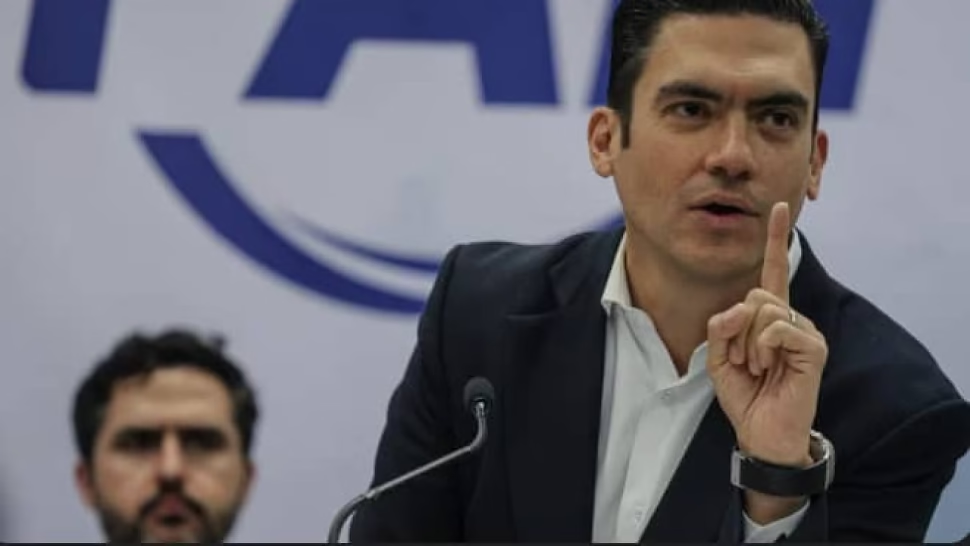
The national president of the PAN, Jorge Romero Herrera, assured that Ernesto Ruffo Appel is a victim of political persecution by the federal government. In a statement, the PAN leader pointed out that the admission of the former governor of Baja California to a maximum security prison responds to a political use of justice institutions.

Romero Herrera stated that there is not enough evidence to support the accusations against Ruffo Appel for an alleged tax evasion network. The PAN member maintained that the government has chosen to persecute opponents while ignoring accusations against Morena figures.

Comparison with Morena cases

The PAN leader mentioned Morenoist politicians such as Rubén Rocha Moya, Enrique Inzunza, Américo Villarreal and Marina del Pilar Ávila. He said that they have faced questions about possible links to organized crime without the authorities acting as quickly.

Romero Herrera insisted that the law must be applied without distinctions. He stressed that anyone who commits a crime must respond to justice, but demanded that the criminal system not be used as a tool of political persecution.

Continue reading

Afore withdrawals and unpaid loans put millions at risk

Moreira and experts warn about the impact of early withdrawals and unpaid loans.

Risk for workers’ assets

Rubén Moreira, coordinator of the PRI in the Chamber of Deputies, warned that the increase in the overdue portfolio of mortgage and consumer loans, along with the increase in withdrawals from Afores due to unemployment, puts the assets and future pensions of millions of Mexicans at risk.

During the program “With Pears, Apples and Oranges”, Moreira pointed out:

The lack of employment has forced many families to stop paying their bank loans and resort to their retirement savings to cover basic needs such as food and medicine.

The legislator criticized the fact that there is not enough information about the consequences of withdrawing resources from the Afores, since this reduces accumulated savings for retirement.

He also warned about the growth of loans granted by fintech and digital banks, some of which can handle high financial costs and represent risks for users.

Mario Di Costanzo, specialist, reported that between January and June of this year more than one million workers made partial withdrawals of their Afores due to unemployment. He added that Infonavit’s overdue portfolio reached 410 billion pesos during the first quarter of 2026, while mortgage and consumer loans in arrears exceeded 110 billion pesos.

Miguel Ángel Sulub, for his part, explained that early withdrawals from Afores not only affect the amount available for retirement, but also the weeks of contributions necessary to obtain a pension.

Continue reading