A message of integrity in a critical institutional setting
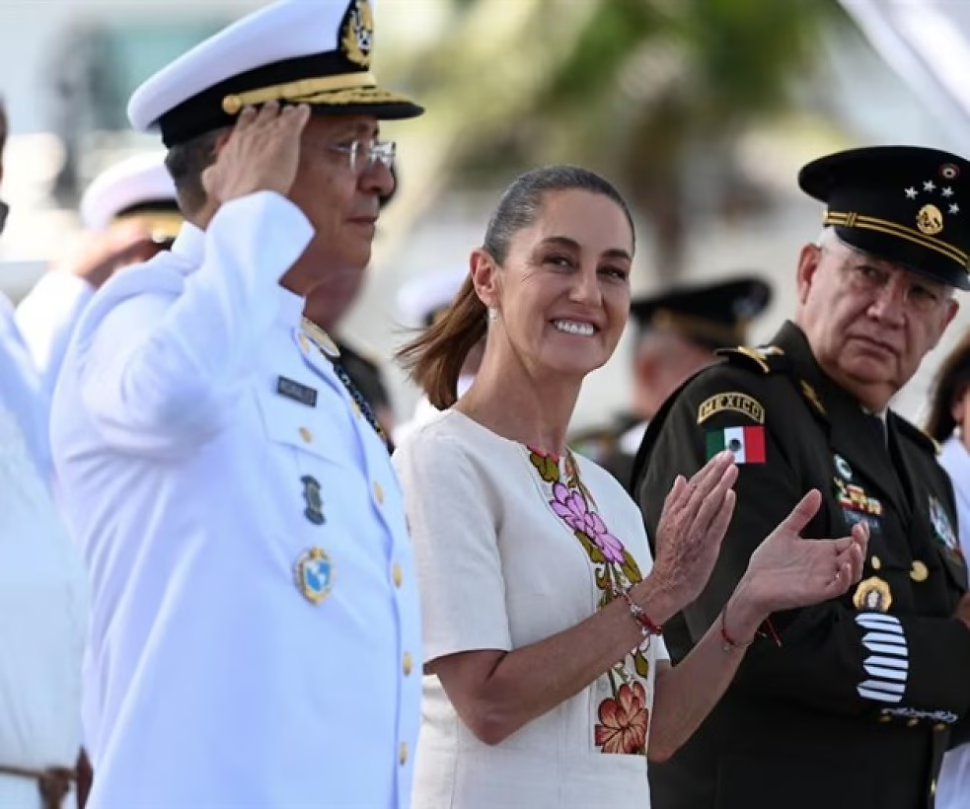
In the framework of the commemoration of the 204th Anniversary of the Mexican Navy, President Claudia Sheinbaum Pardo gave a speech of profound political and ethical significance to the senior naval commanders. The ceremony, held in the port of Veracruz, served as a platform for the president to directly address the issue of institutional corruption, an issue of special sensitivity after the recent government revelation about the participation of naval officials in a fuel smuggling plot that involved millions of liters.
The meticulous researcher who analyzes this event cannot ignore the strategic context of the presidential intervention. Sheinbaum chose a forum of great military solemnity, with the presence of Admiral Raymundo Morales Sánchez, Secretary of the Navy, and General Ricardo Trevilla, Secretary of Defense, to establish a clear line of conduct. Their statements, therefore, transcend mere protocol formalism to become a declaration of government principles specifically addressed to an institution in crisis of credibility.
The ethical conceptualization of corruption as disloyalty
The core of the presidential message lies in the conceptual definition that Sheinbaum developed about corruption. The president characterized it as “betrayal of all values” and as “disloyalty”, thus establishing a direct link between ethical conduct and military institutional identity. This formulation is particularly significant in the military field, where the concepts of loyalty and honor constitute fundamental pillars of the code of conduct.
From an analytical perspective, it is possible to identify in this approach a discursive strategy that seeks to redefine the problem of corruption, moving it from the legal-administrative field to the field of fundamental values. By stating that “the opposite of honesty is corruption,” Sheinbaum establishes a moral dichotomy that does not allow intermediate nuances, thus reinforcing intolerance towards these practices. The statement that this scourge “not only destroys institutions but also corrodes the national soul” represents a deepening of the seriousness attributed to the phenomenon, placing it as a threat to the moral integrity of the nation as a whole.
The rhetorical question “What good is ill-gotten money if with it you lose your reputation and legacy?” completes this conceptual framework by appealing to the long-term rationality of public servants, contrasting immediate economic gain with permanent damage to moral and historical heritage.
Continuity and rupture in the anti-corruption policy
The analysis of the Veracruz speech must be framed in the broader political context of the first year of Sheinbaum’s government and its relationship with the previous administration. The fight against corruption was one of the central narrative axes of the government of Andrés Manuel López Obrador, which makes the recent scandals in the Navy a particularly delicate challenge for the current administration.
Detailed investigation reveals that this episode illustrates the complex dynamic that Sheinbaum has called “continuity with change”. On the one hand, he maintains the rhetorical and programmatic commitment to republican austerity and integrity in public service that characterized his predecessor. On the other hand, it establishes a clear critical distance with respect to the illegal practices that emerged during the implementation of the Fourth Transformation, particularly those that involve figures close to the former president, such as Admiral José Rafael Ojeda, whose nephew appears linked to the smuggling plot.
This positioning becomes more relevant when considering the presence at the event of opposition figures such as Kenia López Rabadán, president of the Chamber of Deputies, and Hugo Aguilar Ortiz, president of the Judiciary, which suggests an intention to project the message beyond the confines of the ruling party.
The construction of presidential leadership: between technique and territory
The analysis of the leadership profile that Sheinbaum is consolidating reveals a singular synthesis between her academic training as a researcher and her evolution as a political figure. In the recently released government documentary, the president makes this duality explicit when referring to her “twenty years dedicated to making mathematical models” and her “obsession with numbers”, while emphasizing her commitment to “territory government” and proximity to citizens.
This identity construction responds to early criticism about his alleged technocratic style and lack of political charisma. The national tour that culminates with a massive event in the Zócalo of Mexico City represents, from this analytical perspective, the operationalization of its government philosophy, which combines technical rigor with territorial presence, following López Obrador’s advice to maintain direct contact with the population.
The explicit reference to machista criticism that questioned her ability to govern due to her gender adds another dimension to the analysis, revealing how the president is simultaneously navigating the challenges of institutional corruption and gender stereotypes in the exercise of power.
Institutional implications and political projection
The repercussions of the message delivered to the Navy transcend the military sphere to project itself onto the entire state apparatus. By establishing a line of absolute intolerance towards corruption in a traditionally closed and hierarchical institution like the Navy, Sheinbaum sends an unequivocal signal to the rest of the government agencies.
The Navy scandal, added to the fall of Hernán Bermúdez, former Tabasco police chief linked to organized crime and associated with Morena politicians, represents a critical test for the credibility of the Fourth Transformation project. Sheinbaum’s response seems aimed at demonstrating that his administration will not tolerate practices that compromise the integrity of the State, even when they involve figures close to former President López Obrador, as is the case of Senator Adán Augusto López.
From a comparative politics perspective, this episode illustrates the universal challenge faced by political movements that come to power promising to eradicate corruption when they must confront these phenomena within their own ranks. Sheinbaum’s ability to implement concrete consequences behind his forceful rhetoric will largely determine public perception of the authenticity of his anti-corruption commitment.
The culmination of the national tour in the capital’s Zócalo, a symbolic space par excellence of Morenoism, represents the consolidation of a distinctive style of government that seeks to balance the political heritage of López Obrador with the personal imprint of the first woman to occupy the presidency of Mexico. The fight against corruption, now elevated to the category of defense of the “national soul”, is thus configured as one of the defining axes of this political project in its second phase.
Was this analysis of the government’s anti-corruption strategy revealing to you? Share this content on your social networks to contribute to the informed debate and explore more research on Mexico’s political transformation.