The unexpected feat of the most voted president
It seems that in Mexico politics has become an extreme sport where Claudia Sheinbaum not only broke the glass ceiling, but pulverized it with the elegance of an elephant in a china shop. A year after reaching the presidential chair, our protagonist maintains an approval level of 80%, a figure so enviable that even TikTok influencers would blush. But does anyone dare to question this spectacle of popularity? Of course not, because we are facing a “stable” trend in a country where political stability usually lasts less than an ice cream in the Sonoran desert.
The comparison with its predecessor is inevitable, like comparing a bull with a whale. Andrés Manuel López Obrador, that titan of charisma who governed with the force of a Sunday sermon, averaged a modest 75% in his first year. Meanwhile, our lead scientist combines self-leadership and government approval as if she were mixing reagents in a lab. Could it be that we Mexicans have developed an addiction to strong figures, or do we simply love changing messiahs every six years?
When the unthinkable becomes ordinary
Six years ago, the idea that anyone would surpass AMLO’s popularity was as far-fetched as thinking that opposition parties could win a federal election. But here is that Sheinbaum not only achieved the highest vote in history, but also registered five points more approval than his mentor. And if that were not enough, it has reduced polarization, because apparently in Mexico we love to polarize until someone arrives to unite us in general disenchantment.
Morena, that party that was born as a movement and became a machine, went from 25% to 45% in party affinity. Currently, 62% of Mexicans view the organization favorably, which makes us wonder: could it be that we have forgotten how to be the opposition, or have we simply surrendered to the inevitable passing of power?
The million dollar question is: why does Sheinbaum retain such broad support? Have we discovered that we like technical management more than passionate speeches? Or could it be that the average Mexican prefers someone who talks less and (apparently) does more? The reasons that explain this phenomenon are as varied as the excuses for not paying taxes.
The miracle of transversality or how to please everyone
Our president achieved what seemed impossible: being approved even by the opposition. According to the surveys, the PAN members approve it at 73%, the PRI members at 72% and even the Emecistas (that party that we all forget exists) give it 70% approval. This is as surprising as finding a politician who keeps his campaign promises. Could it be that the opposition is so desperate to find something to praise that even a Morenoist government seems acceptable to them?
His candidacy not only consolidated the Obradorista base, but also attracted voters who locally support other parties. It’s as if suddenly América fans started supporting Cruz Azul, but in a political version and with less violence (well, maybe with the same). This transversality is the envy of any marketer: how to sell the same product to such diverse audiences? Simple: with a mix of continuity and change, like those restaurants that keep the name but change the entire menu.
The magic of continuing without copying
Sheinbaum chose to maintain what worked about the Obrero project: the social programs, the morning sessions and republican austerity (that phrase that sounds good but no one knows exactly what it means). But at the same time it has marked differences in security, medications and the gender agenda. While López Obrador concentrated everything on her figure (as if she were the sun around which the political system revolved), our current president is building a shared leadership that mixes heritage and renewal, like those antique furniture that we restore to make them look modern.
The woman factor deserves special mention. In a country where machismo is as common as basket tacos, Sheinbaum manages to balance the gender balance in evaluations. While AMLO was always better evaluated by men, our president gets equal approval. Could it be that we are finally evolving, or are we simply afraid to contradict a woman with a PhD?
Governing a country where nine femicides are recorded daily is as heartbreaking as it is absurd. Domestic violence shows the limits of public policies in the face of problems rooted in private life. Still, eight out of ten citizens recognize progress in women’s rights under their government, which is either a testament to its effectiveness or to our desperation to see progress anywhere.
The government dream team
Sheinbaum’s strong cabinet looks like something out of a reality show about talented politicians. Omar García Harfuch, with his 74% knowledge and 77% positive opinion, is as popular as a reggaeton singer, but with a better survival record. Marcelo Ebrard, with 78% knowledge and 67% favorable opinion, shows that in politics you can lose an internal position and still be relevant, like those soccer players who retire but continue appearing in commercials.
This level of visibility is unprecedented: in Enrique Peña Nieto’s first year, key figures in his cabinet such as Luis Videgaray and Miguel Ángel Osorio Chong did not have more than 15% recognition. Which makes us wonder: could it be that we have a better memory now, or simply more media exposure?
All-encompassing approval
Another central difference with López Obrador is that while he enjoyed more personal popularity than government popularity, Sheinbaum maintains high levels in both dimensions. His management receives consistent evaluations that would make any outstanding student cry with envy: 78% in democratic strengthening, 77% in poverty reduction, 76% in economic growth, 68% in combating corruption, 64% in security and 63% in combating drug trafficking.
Even in foreign policy, traditionally the ugly duckling of Mexican diplomacy, it has gained respect. Even Donald Trump — that character who normally treats foreign leaders as if he were negotiating a reality show contract — has shown deference to her. Could it be that our president discovered the antidote to Trumpian arrogance, or does the former US president simply recognize someone equally stubborn when he sees one?
The challenges that lurk behind the smoke screen
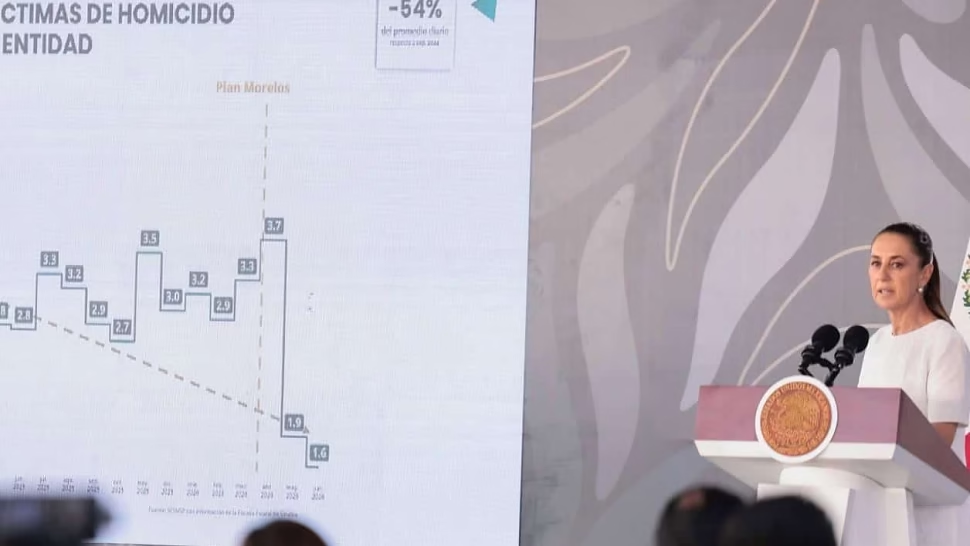
The million-dollar question is whether this popularity will resist the wear and tear of governing a country with two structural cancers: insecurity and corruption. 49% of citizens consider that the security situation is worsening and 41% think the same about corruption. These indicators reflect the limits of any government project in the face of a reality where organized crime has more influence than some state governors.
The challenge for the rest of his mandate will be to demonstrate that historical legitimacy and citizen support can be translated into tangible results in the most complex areas. Because, let’s be honest, the true measure of his government will not be defined in the polls, but in his ability to reduce violence and dismantle the networks of corruption that have weakened the Mexican State for decades. Only then will we know if her popularity becomes a legacy or remains as that curious anecdote that we will tell to future generations: “did you know that we once had a president with 80% approval?”.
Meanwhile, we will continue to marvel at this spectacle of popularity in a country where we normally distrust anything that smacks of government. Have we finally found our perfect politician, or are we simply enjoying the calm before the next political storm? Time, that implacable judge that usually mocks our hopes, will have the last word.
Do you agree with these record numbers or do you think it is just a momentary mirage? Share this analysis on your social networks and join the conversation about the political future of Mexico. Explore more content related to current national politics on our portal.