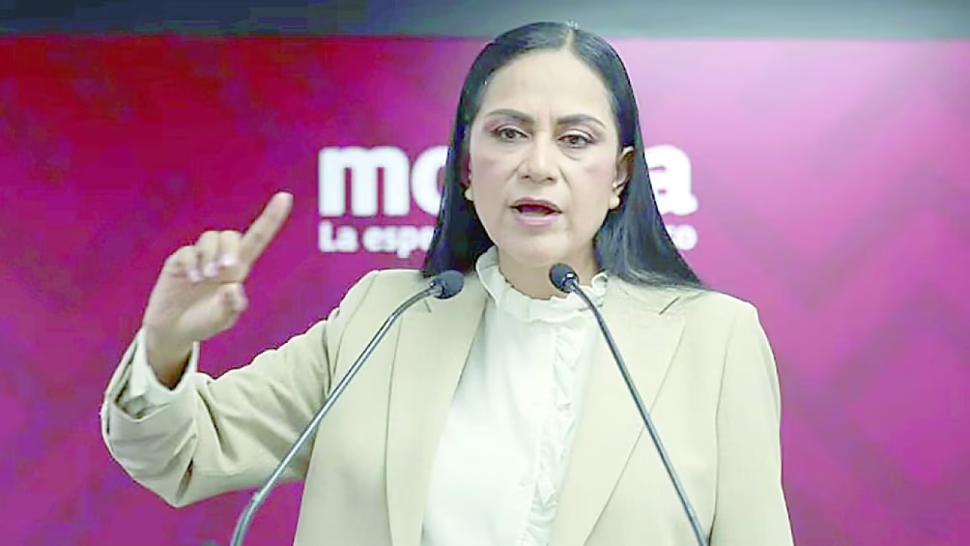
Mexico establishes mandatory gender parity in the foreign service

The Chamber of Deputies establishes a mandatory criterion to balance the representation of women in the country's diplomatic missions.

Mexico Approves Gender Parity in the Foreign Service

The plenary session of the Chamber of Deputies has taken a historic step by approving, with a resounding support of 471 votes in favor, a crucial reform to the Mexican Foreign Service Law. This legislative modification formally incorporates the principle of gender parity as a fundamental and mandatory criterion for the appointment of ambassadors and consuls, as well as for internal promotions within the diplomatic career.

This parliamentary decision seeks to radically transform the composition of the Mexican Foreign Service (SEM), an area where female representation has traditionally been low. Currently, only 34% of positions are occupied by women, a figure that shows a significant gender gap in Mexico’s levels of international representation.

RelatedMexico advances in gender parity but the world remains in debt

A Structural Change towards Substantive Equality

During the plenary session, representative Lorena Piñón of the Institutional Revolutionary Party (PRI), the main promoter of the initiative, argued that this female underrepresentation is not an isolated phenomenon, but rather the manifestation of a deeply rooted structural inequality. “This underrepresentation is the expression of a structural inequality that cannot be tolerated in a country that has made equality a constitutional principle,” he declared from the legislative gallery.

The reform has a quantifiable and ambitious objective: to move from the current 34% of women in the foreign service to a balanced composition of 50% of ambassadors and consuls who represent the interests of Mexico on the global stage. This is a gender equity measure designed to correct a historical imbalance and take full advantage of the talent and capacity of Mexican diplomats.

The legislator emphasized the profound meaning of this transformation: “Our diplomacy will be a mirror of equality, inclusion and gender justice. The Mexican foreign service will become an area where merit and parity walk together”. This statement emphasizes that the purpose is not to replace professional excellence, but to complement it with an unwavering commitment to equal opportunity.

The Impact of Civil Society and Next Steps

A highlight of the process was the explicit recognition of the work of the 50+1 Collective, a civil society group specialized in promoting female leadership. This group, led by the Mexican consul in Houston, María Elena Orantes, demonstrated how sorority between women from various professional fields can catalyze concrete and far-reaching legislative transformations.

Deputy Piñón stressed the binding nature of the new provision: “Incorporating gender parity in the Foreign Service is not a gesture, it is a mandate of justice. It is recognizing that the intelligence, discipline and vision of Mexican diplomats must have space at all levels of representation”. This statement makes it clear that the reform transcends the symbolic to establish itself as a legal obligation and an ethical imperative for the Mexican Foreign Ministry.

From a public policy perspective, this reform is aligned with the international commitments assumed by Mexico regarding women’s rights and female empowerment, such as the United Nations 2030 Agenda for Sustainable Development. Effective implementation will require the modification of internal regulations, the creation of selection and promotion protocols with a gender perspective, and possibly the implementation of training and mentoring programs to accelerate the preparation of candidates for positions of greater responsibility.

The path to full parity will not be without challenges. The federal public administration must design a transition strategy that allows achieving gender balance without compromising the efficiency of the service or the experience necessary for senior management positions. However, the legal framework now exists, providing a solid foundation for the Secretariat of Foreign Affairs to build a more modern, representative diplomatic corps in line with the values of equality that Mexican society demands.

This legislative advance not only strengthens the democratic governance of Mexico, but also projects an international image consistent with its discourse in favor of human rights and social justice. An equal foreign service is not only a matter of internal equity; It is a powerful tool of public diplomacy that reinforces Mexico’s credibility and leadership in multilateral forums.

Do you think this progress towards equality in international representation is relevant? Share this news on your social networks to make this historic achievement visible and explore more content related to women’s rights and legislative reforms on our site.

Jóvenes Construyendo el Futuro: 3.5 millones de beneficiarios en ocho años

Sheinbaum detalla los alcances del programa social en Xalapa, Veracruz.

La presidenta Claudia Sheinbaum informó que el programa Jóvenes Construyendo el Futuro ha beneficiado a más de 3.5 millones de personas entre 2019 y 2026. El anuncio lo hizo durante una asamblea en el Museo Kaná de Xalapa, Veracruz.

Cifras del programa

El programa ofrece un año de experiencia laboral pagada por el gobierno. Los participantes son considerados aprendices y reciben un apoyo mensual equivalente al salario mínimo, además de seguridad social.

“Ese año de experiencia a los jóvenes les ha permitido encontrar de mejor manera un empleo”, afirmó Sheinbaum.

La subsecretaria de Empleo, Quiahuitl Chávez Domínguez, precisó que la inversión total supera los 170 mil millones de pesos en los últimos siete años.

RelatedYoung People Building the Future opens 45 thousand training places

Inversión educativa

Sheinbaum también destacó que su administración trabaja en la creación de 200 mil nuevos espacios para Educación Media Superior y 330 mil para Educación Superior, a través de instituciones públicas.

A la reunión asistió la gobernadora de Veracruz, Rocío Nahle García, quien reconoció el impacto de la estrategia en la entidad. El beneficiario Diego Armando Gallardo Castillo agradeció la continuidad del apoyo económico para el sector de las artes escénicas.

Continue reading

70% de alumnas en medicina, pero solo 30% en puestos directivos

Persisten brechas de género en el sector salud pese a la feminización de la matrícula.

La matrícula de la Facultad de Medicina de la UNAM está compuesta en un 70% por mujeres. Sin embargo, en los puestos directivos del sector salud apenas alcanzan el 30%. Así lo informó la directora de esa entidad, Ana Carolina Sepúlveda Vildósola.

Al encabezar la graduación de la primera generación del Programa de Formación de Liderazgos de Mujeres Médicas, señaló que persisten barreras estructurales que limitan el acceso femenino a la toma de decisiones.

“La medicina se está feminizando”, subrayó.

El programa, impulsado junto con Aúna y Roche, capacitó a 48 médicas y profesoras de pregrado y posgrado para fortalecer su liderazgo. Sepúlveda Vildósola las invitó a proyectarse como futuras directoras de hospitales, jefas de servicio y diseñadoras de políticas públicas.

RelatedUNAM protects its Faculty of Medicine from attempted takeover

La directora general de Roche México, Mónica Palomanes Seoane, destacó la relevancia de incorporar más liderazgos femeninos en un sector donde la participación de las mujeres es cada vez mayor. Su directora médica, Maryet Pérez Barahona, señaló que el programa busca mejorar la atención a pacientes y fortalecer equipos de trabajo.

Mónica Tapia Álvarez, coordinadora estratégica de Aúna A.C., consideró que México vive un momento favorable para ampliar la presencia femenina en liderazgo, gracias a generaciones con mayor escolaridad y participación en espacios públicos.

Continue reading

Profeco advierte: no descuides tus finanzas en el Mundial 2026

Profeco emite guía para evitar deudas durante la Copa Mundial 2026.

A meses del Mundial 2026, la Procuraduría Federal del Consumidor (Profeco) lanzó una serie de recomendaciones para evitar que la emoción del torneo afecte tu bolsillo.

Compras responsables

La dependencia sugiere fijar un presupuesto antes de adquirir artículos, boletos o servicios relacionados con el evento. Comparar precios es clave. Para ello, está disponible la plataforma Quién es Quién en los Precios, donde se revisan costos de distintos productos.

RelatedProfeco demands that Sony show PlayStation prices in pesos

Evita compras impulsivas. Define cuánto puedes gastar y qué realmente necesitas.

Cuidado con el crédito

Profeco recuerda que las tarjetas de crédito generan intereses. Si usas promociones a meses sin intereses, el total no cambia. Evalúa tu capacidad de pago antes de comprometerte.

“Los pagos mensuales pueden parecer reducidos, pero el monto total de la compra permanece sin cambios”, advierte el comunicado.

Cumple puntualmente con las fechas de pago para evitar recargos.

Canales de atención

La institución mantiene su correo y líneas de atención habituales para recibir reportes, consultas o denuncias relacionadas con el Mundial.

Proteger tu economía también es parte del juego.

Continue reading