SRE establishes mandatory training for non-diplomatic ambassadors

The Foreign Ministry implements a mandatory training program to guarantee the effectiveness of new representatives abroad.

The Ministry of Foreign Affairs implements mandatory training for representatives not belonging to the Mexican Foreign Service

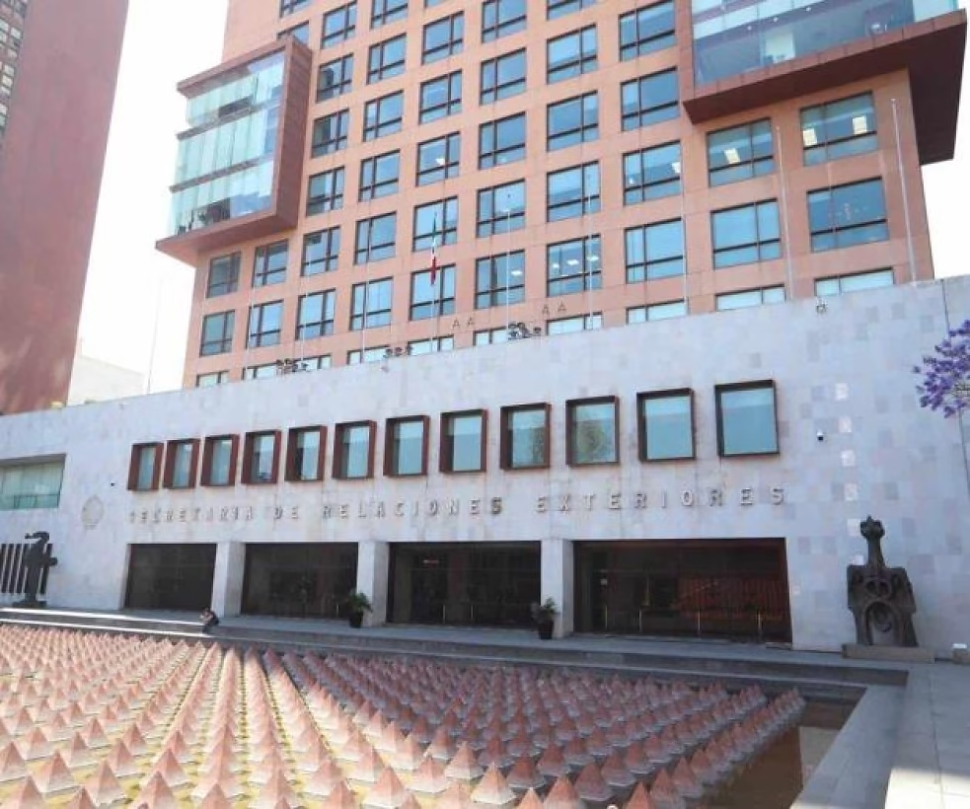
The Secretary of Foreign Affairs (SRE) has established a formal provision that requires all personnel outside of the Mexican Foreign Service (SEM) to complete a comprehensive training program before assuming responsibilities abroad as holders of embassies or consulates. This strategic decision arises in response to the recent appointments of political and professional figures outside the traditional diplomatic corps to direct Mexico’s representations at a global level.

The Matías Romero Institute, the training arm of the Foreign Ministry, will be in charge of teaching these specialized courses. The curriculum is designed to cover fundamental areas such as foreign policy principles, diplomatic practice, consular protection services and administrative management. The primary objective is to ensure that all representatives, regardless of their professional origin, possess the essential knowledge to effectively defend the interests of Mexico and provide optimal care to the Mexican community abroad.

RelatedMexico maintains cordial relations with China despite new tariffs

Legal framework and training content

Last Friday, the agency led by Ambassador Juan Ramón de la Fuente published in the Official Gazette of the Federation (DOF) the specific guidelines that regulate this training. The agreement stipulates that training is a prerequisite and indispensable for any person who joins the areas of foreign policy and international relations without being accredited as a member of the SEM.

The programmatic content includes detailed modules on the normative principles of Mexican foreign policy, the historical and conceptual foundations of diplomacy, the legal framework that governs the SEM, and the essential procedures regarding consular services. This ranges from the protection and documentation of fellow nationals to linkage strategies with Mexican communities abroad and the administrative management of a diplomatic mission.

The official document is precise regarding the timing of the training: “(The training) must be completed by the designated persons before their appearance before the Senate of the Republic for their ratification process or after having received their appointment and before their transfer”. This regulation specifically applies to those who have received their appointment directly from the head of the federal Executive Branch.

Concrete examples of this new profile of representatives include the academic and communicator Genaro Lozano, appointed as Ambassador of Mexico in Italy, and the former commander of the National Guard, Luis Rodríguez Bucio, appointed Consul General in Dallas. The training seeks to provide diverse profiles with a diplomatic and consular common ground.

Preparations for the visit of the Prime Minister of Canada

In an area related to the dynamic foreign agenda, the SRE is immersed in preparations for the next official visit to Mexico of Mark Carney, Prime Minister of Canada. As part of these preparations, Roberto Velasco, head of the North American Unit of the Foreign Ministry, made a working visit to Toronto.

The objective of this meeting, in which Altagracia Gómez, coordinator of the Regional Economic Development Advisory Council, and Carlos Manuel Joaquín, Ambassador of Mexico in Canada, also participated, was to dialogue with executives from the private sector, Canadian banks and pension funds to promote bilateral trade. This preparatory visit sets the stage for the high-level meeting between President Claudia Sheinbaum and Prime Minister Carney, whose tentative date is scheduled for September 18.

This diplomatic meeting acquires special relevance in the current geopolitical context, since it will take place on the eve of the renegotiation process of the Mexico-United States-Canada Treaty (T-MEC) and while the United States carries out its public consultations prior to international negotiations, marking a crucial moment for the economic integration of North America.

Was this analysis of the evolution of Mexican diplomacy useful to you? Share this article on your social networks to inform your community and explore more content related to foreign policy and international relations on our portal.

Darán capacitación a no diplomáticos

Sheinbaum announces 42 CT scanners and telemedicine to strengthen health

The president detailed investments in medical equipment, telemedicine and improvement of clinics.

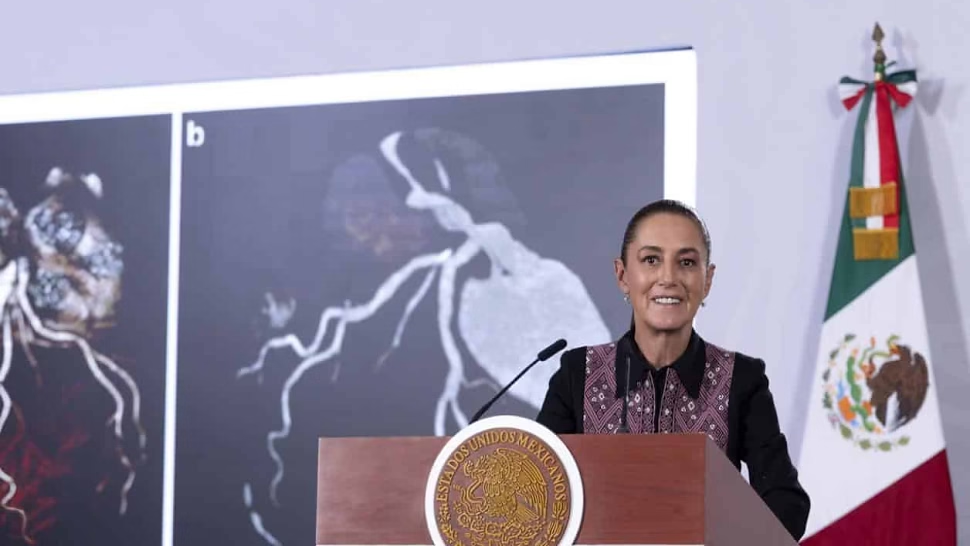
President Claudia Sheinbaum reported on advances in the public health system, with investments in equipment, telemedicine and improvement of clinics. He affirmed that the State must guarantee access to health from prevention to care for complex diseases.

“We are compensating for the profound damage that neoliberalism caused in the health system,” he said at the morning conference.

Equipment and telemedicine

The IMSS installed 42 state-of-the-art CT scanners in 40 hospitals in 19 states. Of these, 41 are from 256 cuts. They allow early detection of tumors and bleeding, perform up to 50 studies per day and reduce waiting times. They were acquired for 29 million pesos each, below the 40 million in the past.

The ISSSTE expanded telemedicine from 239 to 859 units. It offers consultations in 15 specialties, such as cardiology and dermatology, from 118 second and third level units to 741 first level.

The Clinic is Ours

The La Clínica es Nuestra program delivered 4,608 million pesos in 2025 to 8,483 medical units, with the participation of 67,864 people. 42 thousand improvement actions were carried out in infrastructure and equipment. The 2026 call will begin in July, including for the first time 153 units from Yucatán with 80 million pesos.

Sheinbaum added that progress is being made in the House to House Health program, with more than 20 million consultations with older adults and people with disabilities. Starting in August-September, you will be able to collect medications at Farmacias del Bienestar, health centers and a network of pharmacies. Next year the Universal Health Service will begin with a single credential.

Continue reading

Massive security reinforcement and alcohol ban at the Azteca

56,000 police officers and alcohol restriction for the game at the Azteca.

Measures for the Mexico-Czech Republic match

The government of Mexico City announced an unprecedented security operation for this Wednesday’s game at the Azteca stadium. 56,000 personnel will be deployed, five times more than the 11,219 employed last week.

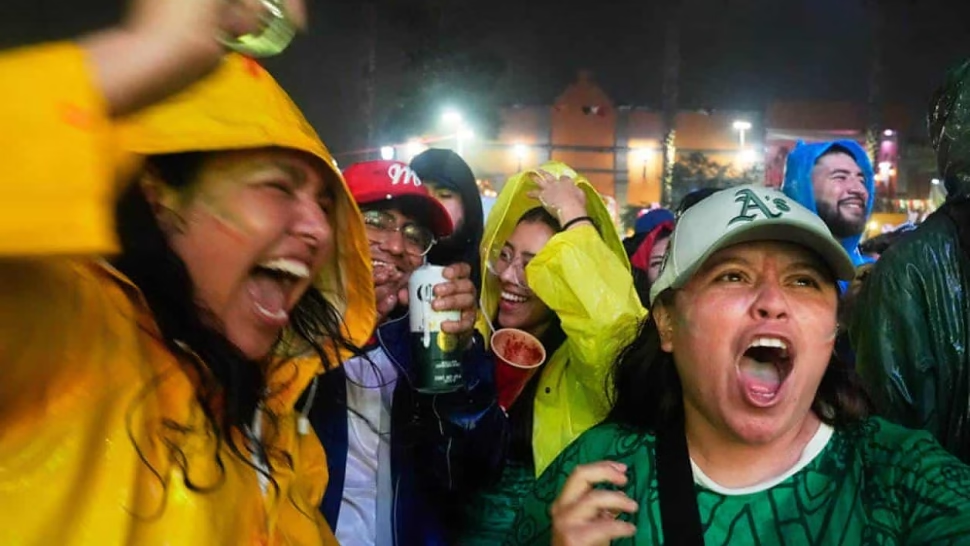
The decision responds to the celebrations of the previous Thursday, when some 700,000 people gathered in the capital after Mexico’s victory over South Korea. Although there were no injuries, nearly 40 tons of garbage were collected in the Ángel de la Independencia and the Zócalo.

The Secretary of Security, Pablo Vázquez, detailed that 7,500 police officers will guard the Azteca stadium. Another 3,275 will be in the Zócalo and 4,200 on Reforma Avenue. The objective is to protect players, referees, authorities and fans.

In addition, the Secretary of Government, César Cravioto, reported that starting at 3 p.m. on June 24, a ban on the sale of alcohol will take effect for sixteen hours. Applies to the Historic Center and five neighborhoods of Cuauhtémoc.

Sales will only be allowed in restaurants, hotels and private clubs, accompanied by food. Convenience stores and supermarkets are excluded. The fines for non-compliance amount to up to 293,275 pesos (about $17,251).

The Mexican Alliance of Transporters Organization (AMOTAC) called for mobilizations on highways in the 32 states and blockades in the capital to protest against the violence. The operation also considers these protests.

Continue reading

UNAM, new WHO collaborating center in oral health

The WHO recognizes UNAM as a reference in oral health and aging.

International recognition for UNAM

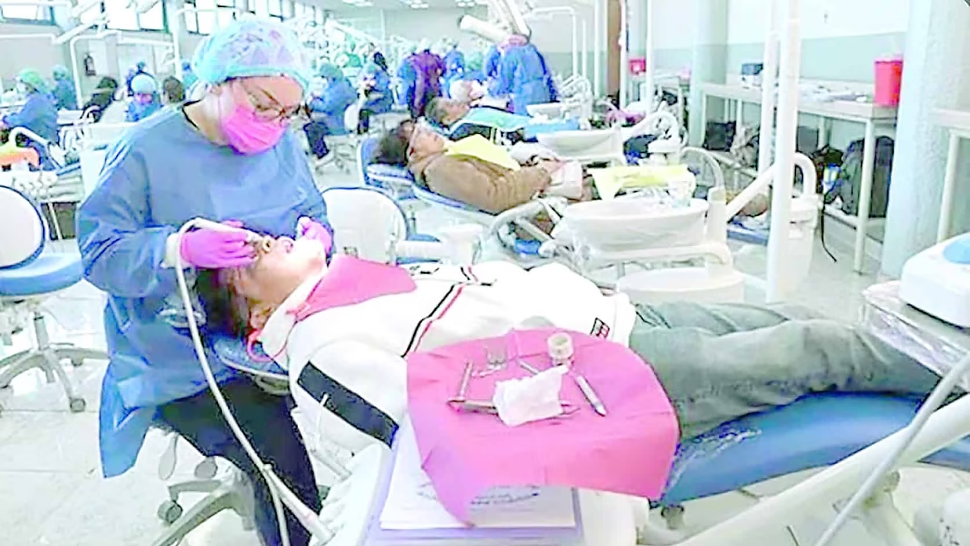
The World Health Organization (WHO) designated the Department of Oral Public Health of the UNAM Faculty of Dentistry as a Collaborating Center in Oral Health and Aging. The distinction is valid for four years.

With this appointment, the highest educational institution consolidates itself as a regional reference in the comprehensive care of older adults.

Implications of the appointment

The recognition will allow university specialists to participate in the development of public policies focused on improving the quality of life of the elderly.

In addition, they will promote strategies to promote among older adults and caregivers the importance of maintaining adequate oral health as an essential part of general well-being.

The designation places UNAM on a level of technical cooperation with the WHO, which opens opportunities to influence global guidelines on aging and oral health.

Continue reading