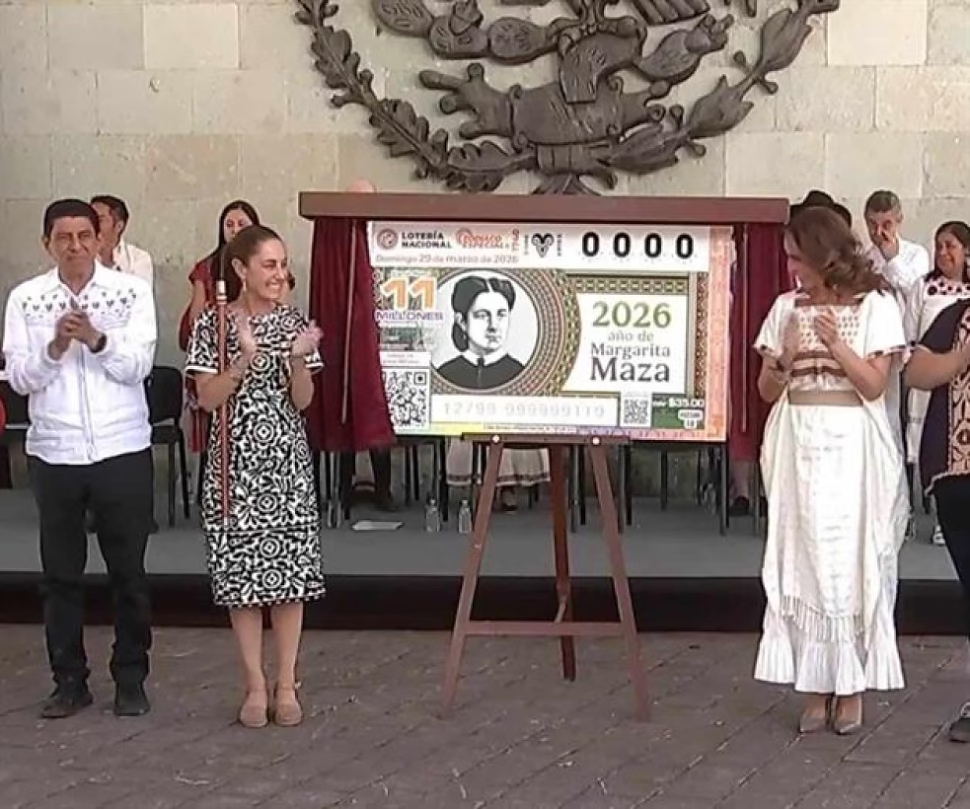
An act in Guelatao with echoes of sovereignty and legacy
The esplanade of Guelatao, Oaxaca, was the setting. There, President Claudia Sheinbaum not only commemorated the 220th anniversary of Benito Juárez’s birth. He signed a decree that changes official history.
Margarita Maza Parada, wife of Benemérito, was recognized as the first historical ambassador of the Mexican Republic. A gesture to rewrite the role of women in the construction of the State.
The speech: Juárez as a current political flag
Sheinbaum connected the past with his government project directly. “Juárez lives in the fourth transformation,” he declared to the community. He said that his spirit is in the fight against privileges and those who believe themselves above the law.
“Juárez lives in every public school, he lives in every act of justice, he lives in every community that defends its dignity,” said the president.
The reference to the relationship with the United States was key. He recalled the Juarista principle: “sovereignty is not negotiated”. A clear message in a complex geopolitical context.
Sheinbaum also took the opportunity to launch a veiled criticism. He said Juárez’s teachings “continue to annoy conservatives.” A line that draws the current political battlefield.
More than words: symbols and concrete gestures
The event did not stop at speeches. A statue of Margarita Maza was unveiled in Guelatao. A lottery ticket and postage stamp were also presented in his honor.
The president cited Maza as “a woman of principles” and “our most extraordinary ambassador”. He revived the exile she faced for the Juarista cause, presenting her as a political figure in her own right.
Governor Salomón Jara Cruz reinforced the message. He said that the people support “the transformation” and reject “the meanness of those who cling to the past”. The script was clear: this is modern Mexico versus the old regime.
The master move: Sheinbaum linked the indigenous legacy. He recalled that Juárez was president of the Supreme Court and highlighted that today an indigenous person, Hugo Aguilar, occupies that position. He connected history with current representation.
In the end, the event in Guelatao was much more than a commemoration. It was a political manifesto. They used Juárez and Maza to justify a national project and mark red lines abroad. In politics, even the dead vote.