Kachi, the UNAM app to preserve Nahuatl

UNAM revolutionizes the learning of native languages ​​with a digital tool that merges tradition and modernity.

Kachi: A digital bridge between Nahuatl tradition and the modern era

In a global context where technology redefines learning methods, the National Autonomous University of Mexico (UNAM) presents Kachi, a mobile application designed to revitalize Nahuatl, one of the most vital indigenous languages in Mexico. According to data from the National Institute of Indigenous Languages (INALI), this language, belonging to the Yuto-Nahua family, has 1.7 million speakers distributed in 233 municipalities, although it faces preservation challenges in the face of globalization.

Technology at the service of linguistic diversity

Developed by students from the Faculty of Higher Studies Acatlán (FES), Kachi uses advanced frameworks such as SwiftUI and Core ML to offer an interactive experience. Its name, derived from Mixtec (“say” or “speak”), reflects its mission: democratizing access to native languages ​​through digital resources. This project not only addresses a gap in educational platforms—only 2% of language apps include indigenous languages—but also aligns with UN Goal 16 to promote inclusive societies.

RelatedKachi, the UNAM app to revitalize Nahuatl

The application integrates three fundamental pillars:

  • Cultural repository: A digital archive with vocabulary, ancestral recipes and interactive codices.
  • Tonalpohualli Calendar: Pedagogical tool based on the Mesoamerican calendrical system.
  • Gamification: Advances through achievements linked to the Nahua worldview.

Impact and projection

Kachi arises in response to an alarming diagnosis: 60% of the native languages in Mexico are at risk of disappearing, according to UNESCO. By incorporating playful and anthropological elements, the app transcends the linguistic field to become an instrument of cultural rescue. Currently in the financing phase for its Android version, its model could be replicated for other languages such as Mayan or Zapotec.

Experts in ethnolinguistics highlight that projects like this reduce the digital divide in indigenous communities and promote national identity. A study by UNAM (2024) revealed that 78% of young Mexicans do not know basic words in Nahuatl, despite their historical relevance.

Why is it relevant? Beyond its educational function, Kachi symbolizes an institutional effort to combat linguistic discrimination and revalue intangible heritage. Its technical development—with machine learning algorithms to adapt to the user—positions it as a benchmark for innovation with social impact.

Next steps

The team behind Kachi works in partnerships with native speakers to ensure dialect accuracy. It is expected to launch on iOS in the first quarter of 2025, with a library of 500 terms and 20 interactive lessons. Its success could inspire public policies to integrate technologies in cultural preservation.

Explore more about how technology is transforming education on our social networks. Share this article to make visible initiatives that protect the linguistic diversity of Mexico.

Are you interested in contributing to the project? Follow UNAM’s official updates to learn about collaboration opportunities.
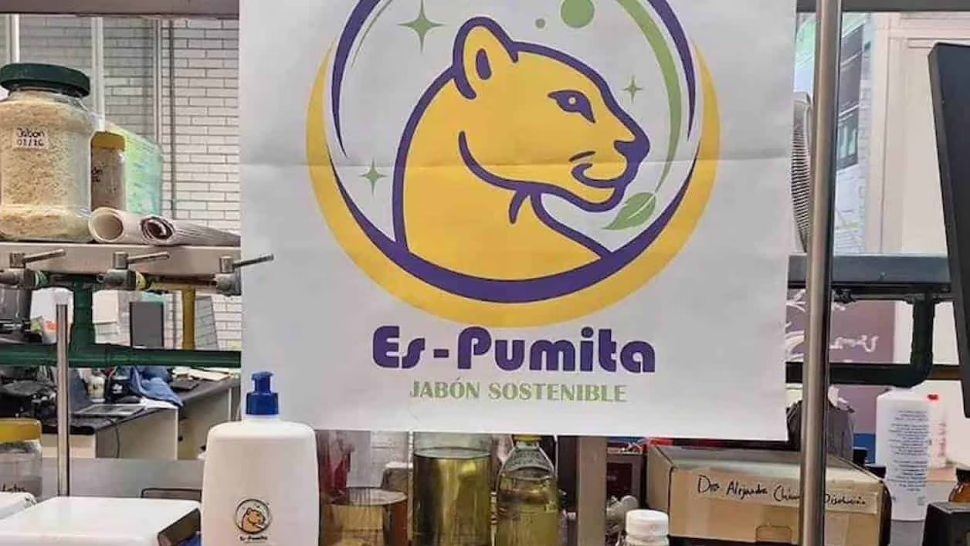

UNAM students create biodegradable soap with used oil

One liter of used oil contaminates 40 thousand liters of water; students turn it into ecological soap.

Students and researchers from UNAM’s Faculty of Higher Studies (FES) Zaragoza developed Es-Pumita, a biodegradable liquid soap made with used cooking oil. The raw materials come from the cafeterias on Campus II, as part of a circular economy and sustainability project.

From waste to resource

Alejandra Chávez Riveros, a researcher at the entity, leads the initiative. Every week they collect about 20 liters of oil to transform them into between six and 10 liters of liquid soap. The process includes filtering, cleaning and purification to remove impurities, solids, moisture and odors. Then they apply saponification: the fat reacts with a strong base to obtain soap.

The environmental impact is the main benefit. A single liter of oil disposed of improperly can contaminate up to 40 thousand liters of water. Furthermore, when it reaches the drainage, it contributes to clogging pipes and worsens flooding, especially in the eastern area of ​​Mexico City.

“Unlike commercial products, our soap has fatty acid salts obtained by saponification as an active ingredient, which gives it high biodegradability. It also highlights its approach to circular economy and environmental education,” explained Chávez Riveros.

The academic pointed out that the project seeks to formulate a product with few additives, favoring simple ingredients to reduce the environmental impact and promote education among the university community.

Es-Pumita already has a brand registration and is the first product of the research line “Green chemical engineering and sustainability”. Initially they tried to make a solid soap in the shape of puma claws, but later they achieved a liquid version. It is currently used as a pilot in the bathrooms on Campus II, with the goal of extending it to Campus I.

The team is looking for a larger space to increase production and become a collection center. Society’s interest in participating drives this expansion.

Continue reading

Liga MX returns to EA Sports FC27; multi-year contract

Multi-year agreement includes all 18 Mexican soccer teams.

Return after five years

Liga MX and EA Sports announced the return of the Mexican league to the EA Sports FC27 video game. The agreement is multi-year, so the five-year wait is coming to an end. The news confirms the participation of all 18 teams from the top circuit, with Atlante being the most recent club to join.

“Liga MX is home to some of the most passionate fans, iconic clubs and a rich tradition that has inspired generations of players,” said Jeff Sharma, vice president of EA Sports FC.

The video game will be available starting September 25 for consoles and devices. This edition will include new game modes that seek to attract consumers. With this return, the Mexican league regains presence on a global entertainment platform.

Continue reading

Volvo EX30: free recall in Mexico

Free corrective measure for battery of EX30 units 2024-2025.

Volvo Car Mexico reported that the corrective measure is now available for the EX30 model years 2024 and 2025 units included in a service campaign.

What does the solution include?

The review of the battery system and, if necessary, the replacement of modules at no cost to customers. Owners can schedule an appointment exclusively through the Volvo Solutions Center (centrodesoluciones.mx), where they select an authorized dealer and the available date.

Preventive measure: While the inspection is not carried out, it is requested to maintain the maximum load at 70%. Once the intervention is completed, the vehicle can be used with a full load. The telephone number 968 6586 is available for guidance.

Background of the call

Since February, Volvo issued safety notice R10363 for certain EX30 units in single motor extended range and twin motor performance versions. The reason: in some cases there was an increase in temperature with high load. No incidents have been recorded in Mexico.

Continue reading