Indigenous rap fights to preserve the native languages of Mexico

A rhythmic battle against oblivion, where modern beats become the war cry to save ancient languages.

The Ancestral Cry in Every Beat

The story of Juan Santiago Téllez is an epic tale of resistance and redemption. As a child, his own parents, in a heartbreaking act of love and fear, forbade him to speak Totonaco. It was a shield forged with the tears of generations, a protection against the cruel discrimination that has persecuted the native peoples of Mexico for centuries. But in the heart of that young man, now known as Juan Sant, a flame of defiance burned. “I wanted to break with that,” he declares, his voice charged with a passion that resonates like a war drum. From the town of El Terrero, in Pantepec, Puebla, this modern bard transforms pain into art, marginalization into powerful verses. “I transform discrimination into art so that our people continue speaking Totonac,” he proclaims, turning each stanza into an act of stubborn rebellion against extinction.

A Battle Against Imposed Silence

Today, Juan Sant stands with unwavering pride. Totonaco, a language that vibrates in the states of Puebla and Veracruz with its approximately 250,000 speakers, is now its weapon and its banner. Although it is recognized as a national language, the artist accuses a glaring absence of genuine official policies to preserve it. Their music, therefore, is not simple entertainment; It is an act of bravery in the face of state apathy. He began his journey in rap in 2004, but the crucial turn, the moment of enlightenment, came years later when he decided to intertwine the words of his ancestors with the urgent beats of the present. “I decided to rap because I love my culture,” he confesses, feeling the weight of a sacred mission. “The same people who listen to me, the people of my community, put on my shoulders the commitment to revitalize these native languages that are increasingly spoken less.”

RelatedOralibrura promotes literature in indigenous languages of Mexico

Mexico, a territory of overwhelming linguistic wealth, is home to 68 indigenous languages considered national, placing it among the ten nations with the greatest linguistic diversity in the world. Seven million people speak a vernacular language, and more than 25 million recognize themselves as indigenous. The giants are Nahuatl, with 1.6 million speakers, and Mayan, with 860,000. However, this vastness is under constant threat. Nicolás Hernández, music producer and anthropologist with the soul of a cultural warrior, says that the initiatives to safeguard them are squalid, insufficient. “In some government institutions, projects are being carried out that try to rescue and revitalize native languages. However, these strategies are not very well adapted or do not reach the beneficiaries,” he criticizes with the lucidity of someone fighting an uphill battle.

Black Mind’s Musical Trench

More than a decade ago, Hernández founded Mente Negra, a music production company that has become a beacon of hope for indigenous artists. This visionary has collaborated with 20 native rappers and has produced six albums in Totonaco, Mazatec, Mixe, Mazahua, Nahuatl and Mayan. His work is titanic: he provides musical accompaniment, records songs and videos, and faces a market that looks with disdain on what it classifies as a minority. “We face large distributors, which makes it difficult to spread original rap. As an independent project, sometimes we have to do 10 or 15 times more activities,” he explains, revealing a struggle where self-management is the only way. Each artist, each member, contributes their own in an act of collective faith to generate content that challenges oblivion.

But music, with its overwhelming power, makes its way. Hernández witnesses a profound cultural transformation within the communities. “The incorporation of non-traditional music in the towns has been very widely accepted,” he observes. Adults and young people embrace these new formats that, far from eroding, revitalize. This monumental effort was also immortalized in the book Musical Creation in Native Languages, a chronicle of this crusade to preserve the sound identity of Mexico.

The Protest Rap That Makes the City Tremble

On a cloudy August morning, the heart of Mexico City witnessed an epic duel. Juan Sant and his colleague Gilberto Navor, a titan of rap in mazahua, met at the Monument to the Revolution. Inspired by the movement that was born in the Bronx and Harlem, these modern champions adapted the genre to become their war song. Navor, whose language is spoken by some 136,000 people, channels his rage into incendiary protest rap. “I touch on issues of racism, classism, discrimination, lack of opportunities,” he declares, his voice an echo of the frustration of millions. “About how indigenous musicians are not taken into account very much, because we do not have the opportunities to appear on the radio, television… That is the protest I make in my rap.”

While they were rapping, the curious approached, their faces expressing eloquent amazement, unable to decipher the words but hypnotized by the force of the message. Many, including foreigners, were unaware that they were facing living, vibrant languages, which millions of Mexicans speak even within that same megalopolis. For Navor, the road has been full of obstacles. “As Mazahuas, we do not have musical materials, because our culture is not very musical,” he explains, highlighting the innovation of his proposal. He has encountered the wall of rejection due to his lyrics full of necessary rebellion, but he does not give in. Each verse is one more step in the fight to be heard, to exist, to not allow their voices to fade into silence.

Were you moved by this rhythmic battle for identity?Share this story so the world can hear the heartbeat of native languages and explore more content on how art challenges oblivion.

Nuevo León renueva transporte público en zona sur de Monterrey

Gobierno de Nuevo León entrega 30 nuevas unidades para rutas 5 y 405 en La Estanzuela.

Entrega de 30 unidades para mejorar la movilidad

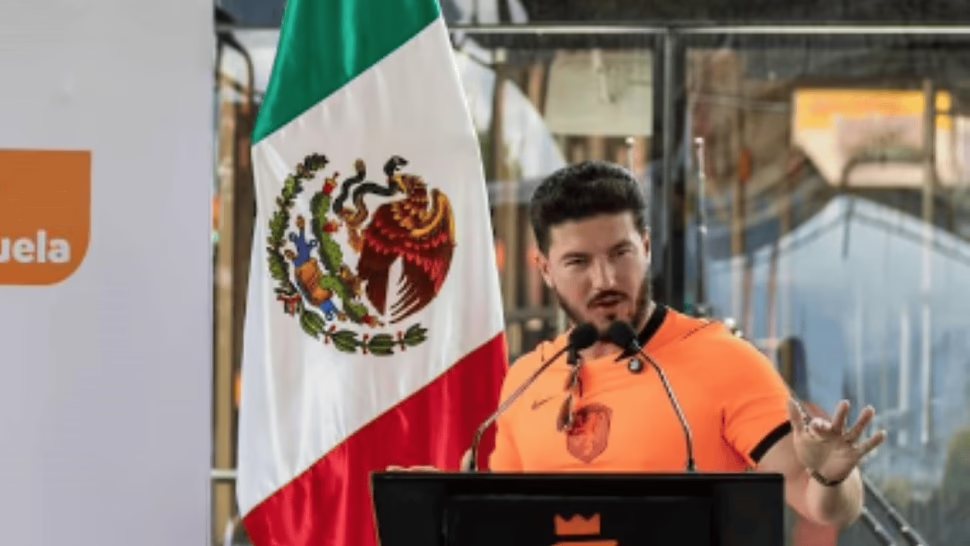
El gobernador de Nuevo León, Samuel García, junto con Mariana Rodríguez, titular de AMAR a NL, entregaron 30 nuevas unidades de transporte público para las rutas 5 y 405 en La Estanzuela, al sur de Monterrey.

García detalló que estas unidades —con aire acondicionado, cámaras conectadas al C5 e internet— buscan ofrecer un servicio “más digno, seguro y eficiente”. La administración estatal tiene la meta de incorporar 4 mil camiones nuevos en todo el estado.

RelatedSamuel García announces 4,000 new transport units for November

“Me da mucho gusto venir a la Estanzuela. Que sepan que estamos trabajando y arreglando la seguridad, el agua, la movilidad y los camiones”, expresó el mandatario.

Beneficios para más de 157 mil habitantes

Abraham Vargas Molina, director general de Metrorrey, explicó que la modernización reemplazará vehículos con más de dos décadas de antigüedad. Esto beneficiará a más de 157 mil personas en la Cuenca Sur de Monterrey, que abarca sectores de San Pedro. Las acciones continuarán en los municipios de García y Santa Catarina.

Vargas Molina destacó que la mejora del sistema no es solo la sustitución de unidades, sino también la profesionalización de conductores, mejores condiciones laborales y un monitoreo permanente.

Continue reading

Registro de celulares: medidas de seguridad y riesgos

El nuevo registro de líneas telefónicas vinculadas a la CURP busca combatir extorsión, pero expertos alertan sobre filtraciones.

Registro obligatorio de líneas telefónicas

La medida que obliga a vincular cada línea telefónica —prepago o pospago— con la Clave Única de Registro de Población (CURP) ya está en vigor. El objetivo declarado: enfrentar delitos como la extorsión y el fraude. Quien no cumpla, se arriesga a la suspensión del servicio.

Las principales operadoras han implementado protocolos. América Móvil (Telcel) asegura que aplica medidas administrativas, técnicas y físicas para evitar accesos no autorizados. Para el registro remoto, exige una prueba de vida mediante selfie.

RelatedRegistro celular: dudas sobre seguridad y privacidad

Telefónica Movistar México detalla que cualquier validación ante el Registro Nacional de Población (RENAPO) requiere consentimiento expreso del titular. Aclara que no almacena datos biométricos, fotos ni copias de identificación tras completar la verificación.

AT&T México, por su parte, utiliza herramientas de resguardo electrónico y contractuales con terceros, además de validación automatizada con fuentes oficiales para emitir los folios de registro.

Preocupaciones sobre la seguridad de datos

A pesar de estas garantías, defensores de derechos digitales advierten sobre fallas estructurales. La custodia recae en las operadoras, no en una base gubernamental única, según lineamientos de la Comisión Reguladora de Telecomunicaciones (CRT) y el Instituto Nacional de Transparencia (INAI).

El temor principal: filtraciones hacia el mercado negro. Experiencias previas, como el padrón RENAUT, muestran que cuando la información queda expuesta, el número telefónico se convierte en una llave maestra vinculada a cuentas bancarias, correos y redes sociales.

Además, han surgido líneas fantasma: usuarios descubren que su CURP está ligada a números que no contrataron. La CRT habilitó plataformas de consulta para verificar el estatus. Se recomienda revisar periódicamente y, si se detectan anomalías, solicitar la desvinculación para evitar suplantación de identidad.

Continue reading

Estados Unidos emite alertas de viaje para México por el Mundial 2026

Seis estados en nivel máximo de riesgo; sedes del Mundial tienen distintas advertencias.

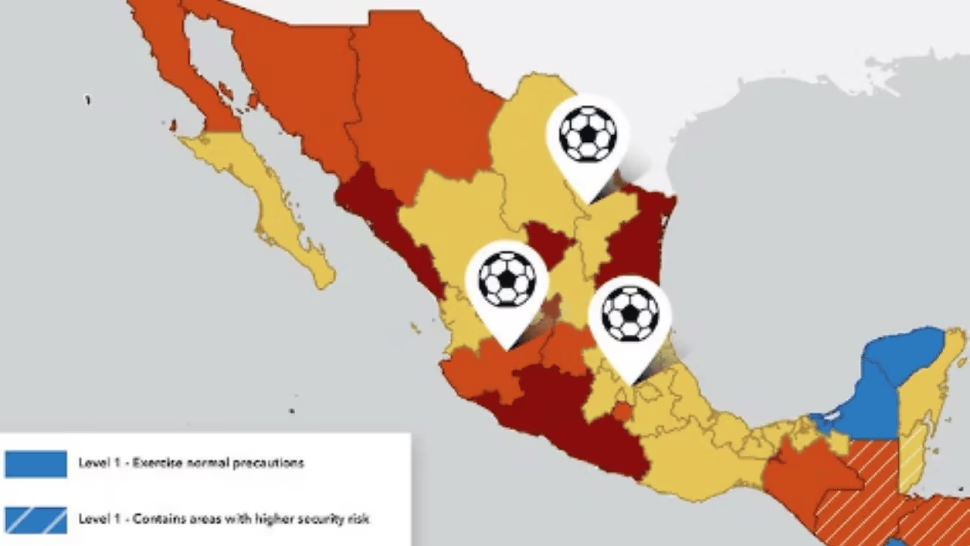
A dos días del inicio de la Copa Mundial de Fútbol de la FIFA 2026, el Departamento de Estado de Estados Unidos, por medio de su Embajada en México, actualizó las alertas de viaje para todo el país. El aviso es para ciudadanos estadounidenses que planeen asistir al torneo.

La dependencia, encabezada por el embajador Ronald Johnson, publicó un mapa con los cuatro niveles de advertencia para cada entidad federativa. El mensaje fue difundido en redes sociales.

“México es un destino vacacional popular, pero los riesgos de seguridad varían mucho según la región, por lo que asignamos nivel de advertencia de viaje para cada estado mexicano”, señala la descripción.

Niveles de alerta por estado

Nivel 1 (Precauciones normales): Campeche y Yucatán.

RelatedCyclone Lorena intensifies towards northwest Mexico

Nivel 2 (Más precaución): Aguascalientes, Baja California Sur, Ciudad de México, Coahuila, Durango, Estado de México, Hidalgo, Nayarit, Nuevo León, Oaxaca, Puebla, Querétaro, Quintana Roo, San Luis Potosí, Tabasco y Veracruz.

Nivel 3 (Reconsiderar viaje): Baja California, Chiapas, Chihuahua, Guanajuato, Jalisco, Morelos y Sonora.

Nivel 4 (No viajar): Colima, Guerrero, Michoacán, Tamaulipas, Sinaloa y Zacatecas.

La Embajada recomendó a quienes tienen boletos para partidos en México verificar la alerta más reciente. También advirtió sobre delitos como asaltos, robos de vehículos, agresiones sexuales, secuestros, homicidios y terrorismo.

El gobierno de Donald Trump señaló que su capacidad para brindar asistencia en México es limitada, “un país extenso donde las condiciones varían considerablemente de un estado a otro e incluso dentro de un mismo estado”.

“Si te encuentras con un control de carretera, debes obedecer. Huir o ignorar las instrucciones puede provocar que resultes herido o incluso fallecido”, agrega el aviso.

Para empleados del gobierno estadounidense, se restringió viajar entre ciudades después del anochecer y se exige usar taxis regulados o aplicaciones como Uber o Cabify. No pueden pedir taxis en la calle ni conducir entre ciudades fronterizas y el interior del país, salvo excepciones.

Las sedes del Mundial: Ciudad de México y Nuevo León están en nivel 2; Jalisco, en nivel 3 (reconsiderar viaje).

Continue reading