Kachi, the UNAM app to revitalize Nahuatl

UNAM revolutionizes the learning of native languages ​​with a digital tool that merges culture, technology and tradition.

Kachi The Digital Revolution to Preserve Our Roots

Imagine having the power to connect with the ancestral wisdom of Mexico directly from your mobile device. That’s the magic of the digital age we live in! Activities that once seemed complex, such as mastering a new language, are now accessible, fun and completely free. And we are not talking about just any language, but about the languages ​​that shaped the history of our nation. Are you excited by the idea of ​​an app designed specifically to immerse you in the richness of a native Mexican language? Get ready, because Kachi, an innovative creation of the National Autonomous University of Mexico (UNAM), is about to change the rules of the game and we are going to tell you everything about this wonderful initiative.

The Deep Meaning of Kachi and its Cultural Mission

Nahuatl, a word that evokes “harmonious sound” or “things that sound good”, is much more than just a language. It represents the living voice of a people, a vibrant culture and a history that deserves to be celebrated and perpetuated. It is one of the 68 indigenous languages that are currently spoken in Mexico and, according to the National Institute of Indigenous Languages, it remains one of the most vigorous, with a presence in 233 municipalities. Learning it is not just acquiring a new vocabulary; It is a deep immersion into a unique worldview, an act of preservation that prevents this invaluable cultural legacy from fading. It is honoring our ancestors and strengthening our collective identity.

RelatedKachi, the UNAM app to preserve Nahuatl

And this is where Kachi comes in! Developed by the brilliant students of the Acatlán Faculty of Higher Studies (FES) of the UNAM, this project was born in August 2024 with a clear and powerful vision. Using cutting-edge technologies like SwiftUI, Core ML, and WidgetKit, these young innovators are building a bridge to the future. The name of the application, “Kachi”, comes from Mixtec and means “to say”, “to relate” or “to speak”. A name that perfectly encapsulates its fundamental objective: to give voice to native cultures through modern technology, promoting learning, the exploration of cultural expressions and the teaching of symbols, rituals and words through playful and fun experiences.

But its impact goes even further. Kachi aligns with the Agenda 2030 of the United Nations (UN), specifically with Goal 16 of Sustainable Development, which seeks to promote peaceful, inclusive and just societies for all. By bringing indigenous languages ​​to digital environments, this application not only promotes accessibility, but also combats lack of representation and fosters a deep respect for the Mesoamerican worldview. It is a tool to break down social and cultural barriers, uniting the past with the present to build a more inclusive future.

An Immersive and Fun Learning Experience

How will this extraordinary tool work? Although the project is still in development and seeking funding to expand to Android, its creators have shared a preview of the features that will make Kachi a unique and unforgettable experience.

First of all, it will have an incredibly complete cultural repository. Imagine having at your disposal a vast digital archive where you can consult authentic recipes, expand your vocabulary, listen to traditional songs and explore fascinating codices. It’s like having a museum and a library in the palm of your hand!

One of its most innovative features is the integration of the Tonalpohualli Calendar. Through it, users will be able to delve into the worldview of the Nahua people through deeply enriching educational, visual and symbolic content. The application will offer interactive experiences with Nahua characters, guiding you on a journey of discovery that will connect you with every aspect of this ancient culture.

To make learning even more motivating, Kachi will incorporate a cultural advancement system based on wisdom and exploration. Each lesson completed, each word learned, will bring you closer to understanding the depth of this cultural heritage. It is an invitation to embark on an adventure where each step is a celebration and each achievement, no matter how small, will fill you with pride and knowledge.

The final vision of its creators is clear and noble: to build a solid and lasting bridge between indigenous peoples and the digital society. It is a powerful reminder that technology, when used with purpose and heart, can be an incredible force for good, unity, and the preservation of our cultural diversity.

Do you feel the emotion? Curiosity to explore this perfect fusion between tradition and innovation? Stay tuned to the official UNAM channels so as not to miss the Kachi release date. This is your opportunity to be part of a transformative movement, to connect with your roots and to contribute to making Mexico’s cultural wealth shine brighter than ever. The future of learning is vibrant, inclusive and about to arrive! Share this fantastic news on your social networks and encourage your community to explore more content like this. Together, we can celebrate and preserve the heritage that defines us.
The oldest plague: remains from 5,500 years ago in Siberia

Traces of plague from 5,500 years ago found in teeth of Siberian hunter-gatherers.

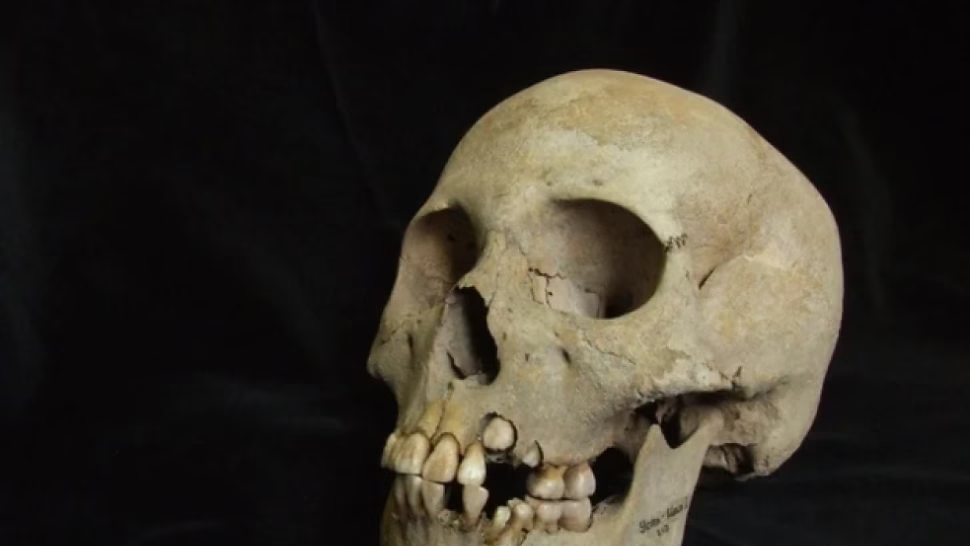
Scientists have identified the earliest evidence of plague known so far: traces of bacterial DNA in the teeth of hunter-gatherers buried near Lake Baikal in Siberia. Carbon dating indicates that the disease caused outbreaks about 5,500 years ago, about 200 years earlier than previously thought.

Finding in Siberia

A team led by geneticist Eske Willerslev of the University of Copenhagen analyzed remains from four cemeteries. They found traces of Yersinia pestis in the teeth of 18 individuals. The dating revealed two episodes of infection.

“To understand our own history, understanding the history of the plague is extremely important,” Willerslev said.

The prehistoric plague spread in stages. According to the authors, it was probably transmitted from marmots—native rodents—when people consumed their raw organs or handled infected skins. It also spread from person to person through coughing or sneezing.

Many of the deceased were children between 8 and 11 years old. Three girls were buried together; two were cousins. An aunt and her nephew were found in another mass grave. “There were people who buried the dead and who knew who they were. It’s a very human element,” said co-author Ruairidh Macleod, an expert in ancient DNA at the University of Oxford.

Implications of the study

The researchers note that children may be at greater risk due to still developing immune systems. The presence of multiple victims suggests that the prehistoric plague caused both isolated cases and outbreaks, said geneticist Aida Andrades Valtueña, from the Max Planck Institute for Evolutionary Anthropology, who was not involved in the study.

This ancient strain evolved long before the bubonic plague responsible for the medieval Black Death. However, there is evidence that earlier plagues were just as serious. The disease not only affected populous cities, but also small nomadic groups.

“Understanding the steps the bacteria took to become the deadly pathogen we know today can provide clues about how pathogens could emerge in the future,” wrote Andrades Valtueña.

The study was published Wednesday in the journal Nature.

Continue reading

Brain chips restore mobility and voice to patients

Two studies in Nature Medicine show advances in brain chips for ALS and Parkinson's.

Advances in brain-computer interfaces

Two investigations published in Nature Medicine confirm that neurotechnology is no longer science fiction. A man with severe amyotrophic lateral sclerosis (ALS) managed to communicate from home thanks to an implantable chip, used for two years. The study, led by Sergey Stavisky and David Brandman (University of California, Davis), is the first to demonstrate that these devices can be operated outside the laboratory.

“It is an important step forward, although it remains to be seen whether it can be generalized,” said Luca Berdondini, a researcher at the Italian Institute of Technology (IIT) in Genoa.

In the second study, coordinated by the Federal Polytechnic School of Lausanne (EPFL) and the University Hospital of Lausanne (CHUV), 40 Parkinson’s patients improved their gait. A chip combined with artificial intelligence interprets brain activity in real time and adjusts electrical stimulation autonomously. The technique, used for 30 years, is now becoming much more adaptable.

The challenge of bringing technology to the clinic

Both cases reflect a global career. Berdondini warns that “Europe risks falling behind the United States and China” due to regulatory barriers. Although European research has advanced, the transition from trials to clinical application needs to be accelerated, respecting ethics.

The arrival of Elon Musk’s Neuralink accelerated the pace. “These results are a stimulus for companies, because they show that the path is viable,” concluded the researcher. The challenge now is to bring these findings to more people and ensure that technological competition does not leave Europe behind.

Continue reading

World Cup 2026: the technology that will transform how you watch football

Data, AI and 3D avatars will change the fan experience at the trinational tournament.

Almost 50 teams, three countries and more than one hundred matches. The 2026 World Cup will not only be the largest in history, but it will also transform the way we watch football from home. Artificial intelligence and advanced statistics will be the protagonists.

Tools like Football AI Pro, created with Lenovo, will help coaches prepare for matches and detect weak points. For the viewer, the data will be converted into graphs and summaries that explain what is happening on the court.

How the experience changes

In Qatar 2022, 12 cameras were already used to track the ball and 29 body points of each player 50 times per second. By 2026, that level of detail will be the norm. Stats will no longer be cold numbers: defensive lines, heat maps and movement patterns will be displayed.

In addition, the organization announced 3D avatars to recreate plays and referee decisions. Thus, tactical concepts such as high pressure or compact block will be visual and easy to understand.

The 2026 World Cup will maintain the excitement of goals and surprises, but with tools that allow us to better understand the game. Technology does not take away passion, but rather adds context.

Continue reading