Brain chips restore mobility and voice to patients

Two studies in Nature Medicine show advances in brain chips for ALS and Parkinson's.

Advances in brain-computer interfaces

Two investigations published in Nature Medicine confirm that neurotechnology is no longer science fiction. A man with severe amyotrophic lateral sclerosis (ALS) managed to communicate from home thanks to an implantable chip, used for two years. The study, led by Sergey Stavisky and David Brandman (University of California, Davis), is the first to demonstrate that these devices can be operated outside the laboratory.

“It is an important step forward, although it remains to be seen whether it can be generalized,” said Luca Berdondini, a researcher at the Italian Institute of Technology (IIT) in Genoa.

RelatedSheinbaum announces control over the sale of cell phone chips

In the second study, coordinated by the Federal Polytechnic School of Lausanne (EPFL) and the University Hospital of Lausanne (CHUV), 40 Parkinson’s patients improved their gait. A chip combined with artificial intelligence interprets brain activity in real time and adjusts electrical stimulation autonomously. The technique, used for 30 years, is now becoming much more adaptable.

The challenge of bringing technology to the clinic

Both cases reflect a global career. Berdondini warns that “Europe risks falling behind the United States and China” due to regulatory barriers. Although European research has advanced, the transition from trials to clinical application needs to be accelerated, respecting ethics.

The arrival of Elon Musk’s Neuralink accelerated the pace. “These results are a stimulus for companies, because they show that the path is viable,” concluded the researcher. The challenge now is to bring these findings to more people and ensure that technological competition does not leave Europe behind.
NASA takes the 2026 World Cup ball into space and plays it on the ISS

NASA sent an official 2026 World Cup ball into space and opened an exhibition in Houston.

World Cup ball arrives at the International Space Station

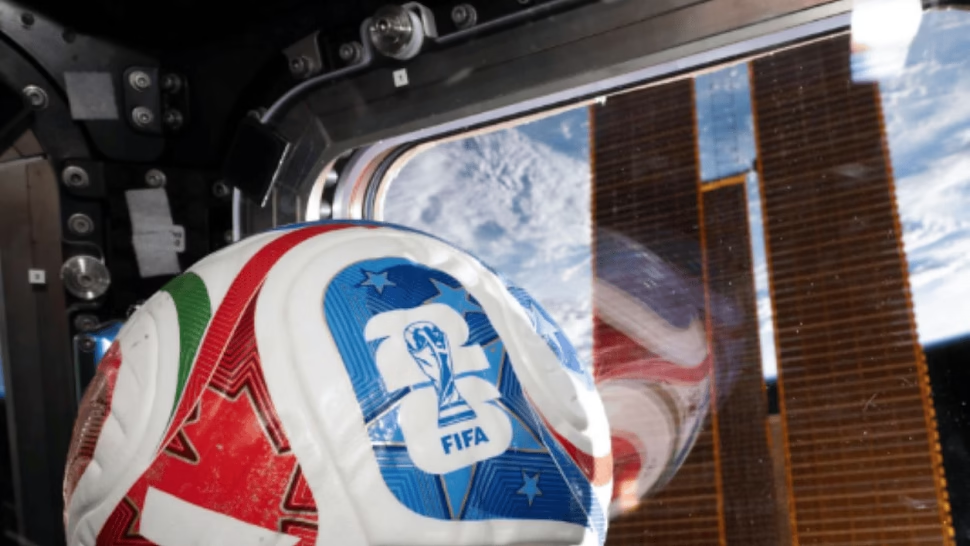
The fever of the 2026 World Cup permeated the atmosphere. NASA sent an official World Cup ball to the International Space Station (ISS). In a video shared on social networks, four astronauts are seen playing with the ball in microgravity. The message: “We work to inspire the next generation by showing how space exploration drives innovation in sports science.”

The agency seeks to disseminate how research on the ISS generates advances in science, technology and human health. Benefits that even reach the soccer field.

Exhibition at the FIFA Fan Fest in Houston

NASA set up an exhibit at the FIFA Fan Fest in Houston, Texas. It opened on June 11 at the start of the World Cup and will be available until July 19. Visitors can discover how space research improves life on Earth and learn about the Artemis program missions.

The exhibition explains how more than 25 years of studies on the ISS have helped understand the aerodynamics of the ball. According to a statement from the Johnson Space Center, previous research analyzed how internal mass, sensors and seam texture affect stability and rotation under real-play conditions.

Science applied to sports

As part of the project, NASA and Adidas present the “STEMonstration” demo. They compare how balls spin with different balance in microgravity. The objective: to show that space discoveries benefit athletes and fans of the most popular sport in the world.

Continue reading

Users report massive drop in X this Monday

Users report problems accessing social network X this Monday, June 22.

Cuts in X during Monday

Users of the social network X, formerly Twitter, reported this Monday, June 22, difficulties accessing and browsing the platform. According to data from DownDetector, a site that monitors digital failures, 1,131 people have reported problems with the application, loading the main feed and connecting to servers.

The most common issues include the inability to refresh the home page, errors when displaying posts, and crashes when using basic functions. When trying to log in, some see messages like “Something went wrong. Try loading again,” without the platform recovering.

So far, X has not issued an official statement on the origin of the failures or the estimated time to restore service.

Continue reading

How artificial intelligence transforms global security

Motorola Solutions is committed to hybrid models and agentic AI in the transformation of the sector.

Security industry: cloud migration and artificial intelligence

Security is undergoing a profound transformation. The cloud, generative artificial intelligence and video surveillance systems as decision tools are redefining the sector. This was stated by Pedro Simoes, global vice president of video security and analytics at Motorola Solutions.

“The cloud is a very strong trend, but it is not a solution for all sectors,” he explained. Prison facilities, airports and nuclear plants require hybrid models that combine local infrastructure with cloud services. Motorola Solutions is committed to unified platforms.

One of the key advances is agentic artificial intelligence. The company introduced Operator, a platform that integrates video, access controls and sensors in a single interface. The objective: reduce the time between detection and response. “It’s not just identifying. It’s being collaborative in decisions,” said Simoes.

The role of sensors in smart cities

Cameras no longer just record: they are sensors. “Today a camera produces data that can be used to optimize logistics, mobility or business decisions,” he added. Security information extends to multiple applications.

However, the growth of AI poses privacy challenges. Motorola Solutions developed “AI nutrition labels,” documents that detail capabilities and limitations of its models. “We are the first company in the sector to create and use this type of labels,” said Simoes.

Mexico and the 2026 World Cup

Mexico is experiencing a key moment for the 2026 FIFA World Cup. The arrival of millions of visitors is driving investments in technological infrastructure and security in airports, hotels and stadiums. Simoes confirmed collaboration with governments, without revealing details. “Safety is a priority; our responsibility is to develop technology that protects people and infrastructure.”

He recommended organizations think long term: “The decision should not be based only on current problems, but on the challenges of three or five years.” The combination of cloud, generative AI and unified platforms will define the next stage of the sector.

Continue reading